
ETL vs ELT Explained for Aspiring Data Engineers
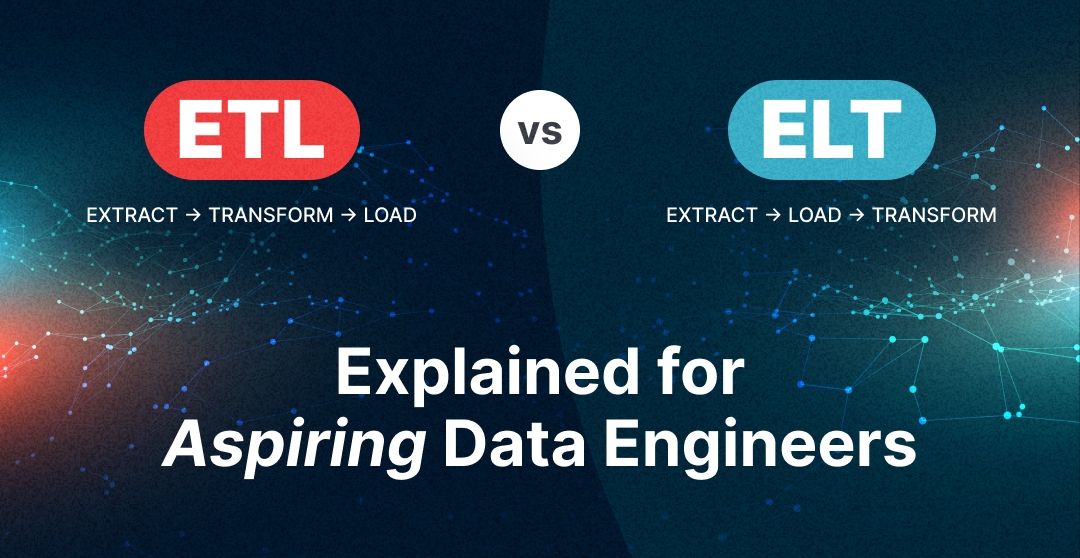
ETL transforms data before loading it into a target system. ELT loads raw data first, then transforms it inside the warehouse or lakehouse. That small shift changes how fast you can ship pipelines, what tools you need, how much storage you keep, and how teams work with data.
If you’re new to data engineering, this matters early. You’ll hear ETL and ELT in interviews, project docs, and tool demos. More importantly, you’ll need to know which model fits a job, a stack, or a business need. Let’s make it simple, practical, and easy to picture.
Read first:
Quick summary: ETL and ELT solve the same problem, moving data from source systems to analytics systems. The big difference is where transformation happens, and that choice affects speed, cost, control, and workflow.
Key takeaway: ETL is better when data must be cleaned before storage. ELT is better when teams want raw data fast and flexible analysis later.
Quick promise: By the end, you’ll know how both workflows operate, when each one fits, and what skills to learn first if you want data engineering work.
ETL vs ELT in simple terms, how the two workflows actually work
ETL transforms data before loading it. ELT loads data first and transforms it inside the destination platform.
Think of ETL like prepping ingredients before they go into the fridge. ELT is more like bringing groceries home first, then sorting and cooking them when needed. Both methods get the job done, but the order changes everything.
How ETL moves and changes data before it reaches storage
In ETL, the process follows a fixed path. First, you extract data from sources like app databases, CRM records, APIs, or CSV files. Next, a separate system cleans and reshapes that data. Then it loads the finished result into the warehouse or reporting database.
That middle step matters. A team might remove duplicates, standardize dates, mask personal data, join sales tables, or rename messy columns before loading anything downstream.
Because of that, the target system receives cleaner, more controlled data from the start. This worked well in older on-prem setups, especially when storage was expensive and reporting models were tightly managed.
How ELT stores raw data first, then transforms it later
In ELT, extraction still comes first, but transformation moves to the end. Data lands in a cloud warehouse or lakehouse in raw or lightly processed form. After that, SQL or another transformation layer shapes it for reporting, dashboards, or machine learning.
This is common in platforms like Snowflake, BigQuery, Redshift, and Databricks, because they can store and process large amounts of data inside the same environment. As a result, teams can load fast, keep history, and decide later how they want to model the data.
For example, you might load raw app events every hour, then build separate models for product analytics, finance, and marketing. Each group can reuse the same base data without re-ingesting it.
The biggest differences between ETL and ELT that affect real projects
ETL and ELT mainly differ in where transformation happens, how quickly teams can ingest data, and how much they depend on modern cloud platforms. Those differences show up in architecture, debugging, speed, and cost.
A side-by-side view makes the tradeoffs easier to spot.
| Area | TL | ELT |
| Transformation location | Before loading, in a separate layer | After loading, inside warehouse or lakehouse |
| Initial ingestion speed | Often slower | Often faster |
| Raw data retention | Less common | More common |
| Best fit | Strict control, legacy systems | Cloud analytics, flexible modeling |
| Debugging focus | Pipeline engine and staging steps | Warehouse models and SQL logic |
The short version is simple. ETL favors control up front. ELT favors speed and flexibility after the load.
Where the transformation happens, and why that changes architecture
With ETL, you usually need a processing layer before the target system. That means more moving parts. You may have connectors, staging space, a transformation engine, and then the final warehouse.
With ELT, the destination does more of the heavy lifting. The pipeline often looks simpler at first, because raw data goes straight into the warehouse. Then models run there, often with SQL.
That affects ownership too. In ETL-heavy teams, engineers may control most transformation logic. In ELT-heavy teams, analysts and analytics engineers often take a bigger role because transformation lives close to the warehouse.
Debugging changes as well. ETL problems often live in jobs, scripts, or staging tables. ELT issues often show up in warehouse queries, model dependencies, or bad source assumptions.
Speed, flexibility, and storage costs, what teams usually trade off
ETL can give you cleaner data from day one. That’s useful when bad data can’t enter the target system at all. Still, it can slow ingestion because data must be processed before landing.
ELT flips that tradeoff. Teams can load first and ask questions later. That makes experimentation easier, especially when business needs shift fast.
The catch is storage and compute. Keeping raw history can cost more, and transformation inside the warehouse uses warehouse resources. On the other hand, ETL can also be expensive if a separate processing layer adds operational overhead.
So which one costs less? It depends on platform, data size, workload, and team habits. There isn’t one universal winner.
When ETL makes more sense, and when ELT is the better choice
Neither method is always better. The right choice depends on data volume, compliance rules, warehouse power, team skills, and how quickly the business needs new data.
In practice, many companies even mix both. They might use ETL for sensitive pipelines and ELT for product analytics.
Use ETL when data must be cleaned or masked before loading
ETL makes sense when raw data should not land in the target system at all. That’s common with strict governance, regulated data, or legacy reporting systems that expect a clean schema from the start.
Picture a healthcare or finance workflow. If personal data must be masked before anyone can query it, ETL creates a safer path. The same applies when a downstream database has limited compute and can’t handle large transformation jobs well.
ETL also helps when reports must follow a fixed structure. Some older enterprise systems were built around curated tables, not flexible raw zones. In those cases, control matters more than speed.
Use ELT when you need fast loading and flexible analytics
ELT works well when teams want data in the warehouse fast and want to reuse it in different ways. That’s a strong fit for cloud analytics, self-service BI, experimentation, and fast product work.
Imagine an e-commerce company. Product analysts want clickstream data, finance wants order-level facts, and marketing wants campaign attribution. If raw events land first, each team can build models that fit its own use case.
That’s why ELT fits many modern data stacks. Warehouses and lakehouses are strong enough to store and transform at scale, and analysts can often work closer to the data.
Start Free Tutorials at DataEngineerAcademy
What aspiring data engineers should learn first about ETL and ELT
Learn the concepts first, then learn the SQL, pipeline logic, and warehouse basics that make both approaches work. Buzzwords fade, but these core skills keep showing up in real jobs.
If you can explain data flow clearly and build a simple pipeline, you’re already ahead of many beginners.
Core skills that transfer across both ETL and ELT jobs
A few skills matter in almost every stack:
- SQL, because you’ll filter, join, aggregate, and transform data constantly.
- Basic Python, because many pipelines still use scripts for extraction, validation, or automation.
- Data modeling, because raw tables rarely make good analytics tables on their own.
- Testing, because bad data spreads fast once a pipeline breaks.
- Orchestration concepts, because jobs need schedules, retries, and dependencies.
- Debugging habits, because logs, row counts, and schema checks save hours.
- Source-system awareness, because pipelines fail when you don’t understand where the data came from.
Notice what’s not on that list. Memorizing tool names won’t carry you far unless you understand the logic behind them.
A simple learning path for beginners who want hands-on practice
Start with SQL and basic data cleaning. Load a small CSV into a local database or cloud warehouse. Then write queries to clean dates, remove duplicates, and join tables.
Next, build a tiny pipeline. Pull data from one source, move it to a target, and transform it into a reporting table. After that, learn how a cloud warehouse works, including schemas, permissions, and compute basics.
Then move into orchestration and transformation tools. At that point, terms like ETL and ELT stop feeling abstract, because you’ve already built both patterns in a small way.
If you want a faster route, a structured bootcamp or guided project set can help you avoid random learning and focus on job-ready practice.
Strong data engineers don’t pick ETL or ELT because one sounds newer. They pick the method that fits the data, the platform, and the business need.
That’s the real lesson here. ETL and ELT solve the same core problem in different ways, and your job is to know when each one makes sense. Start small, build one pipeline each way, and the difference will click fast.