
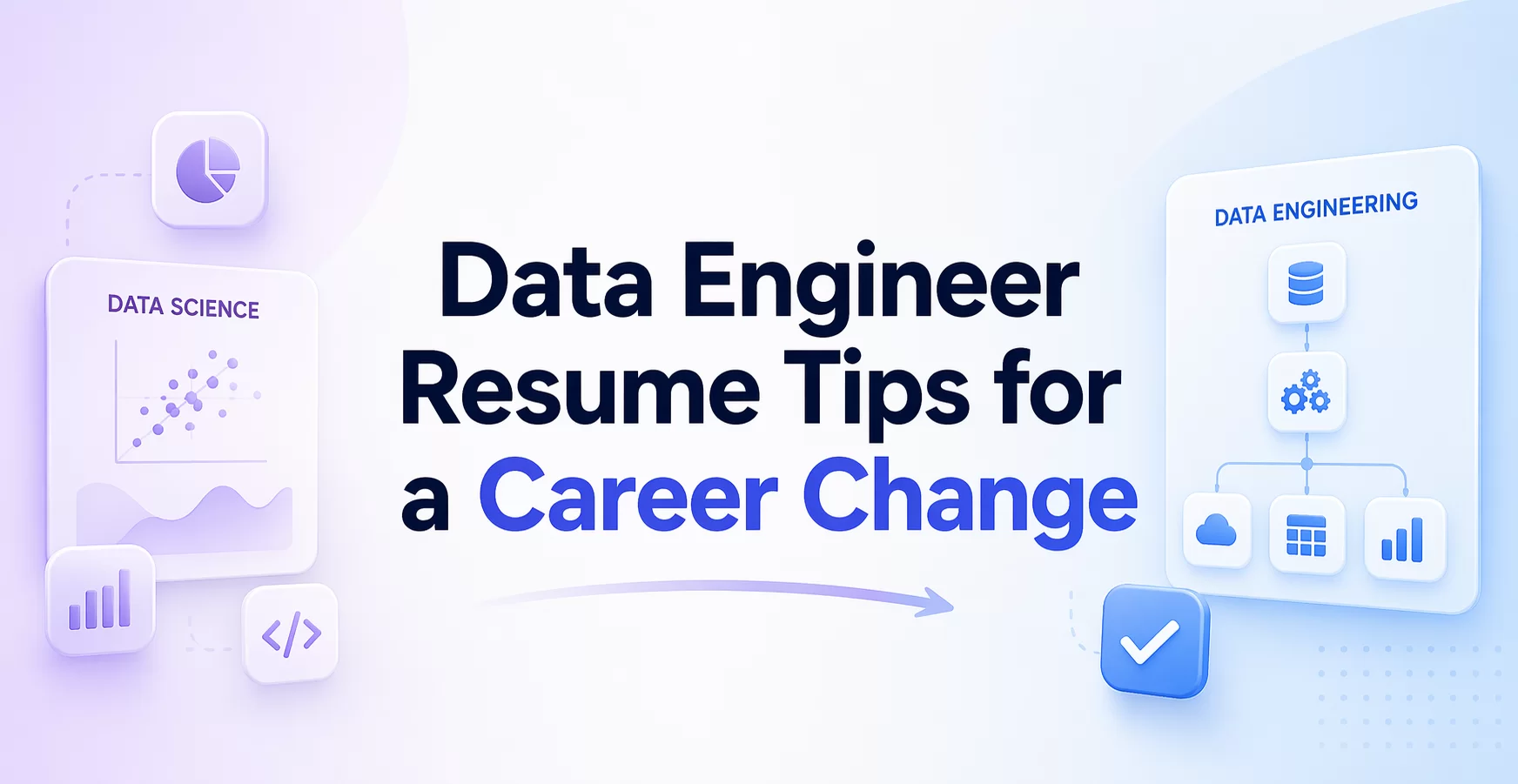
Data Engineer Resume Tips for a Career Change
You don’t need a perfect background to land data engineering interviews. You need a resume that makes sense fast, shows real technical proof, and gives hiring teams a reason to trust your pivot.
That matters because career switchers often look weaker on paper than they are in practice. Maybe your title says analyst, developer, accountant, or operations manager, but your work already touched data pipelines, SQL, automation, or cloud tools.
A strong resume doesn’t hide your past. It connects your past work to the role you want next, and that starts with the story your resume tells.
Start by Framing Your Career Change as a Strength, Not a Risk
A career switch can look messy if your resume reads like a list of unrelated jobs. It looks strong when it shows progression. Your job is to make that progression obvious.
Maybe you came from analytics and built recurring ETL jobs. Maybe you worked in finance and owned messy reporting data. Maybe you were in IT and managed databases, scripts, and system logs. Those experiences count because data engineering teams care about problem solving, data ownership, automation, reliability, and working with stakeholders.
What matters most is the story line. Show where you started, what technical skills you built, and why data engineering is the next step. If a recruiter can grasp that in 20 seconds, you’re ahead of many applicants.
Hiring teams care less about your old title than the proof on the page.
Pick a resume summary that explains your shift in a few clear lines
A summary helps when your background needs context. For career switchers, that is often the case. Keep it short, usually 2 to 4 lines.
State the role you’re targeting, name a few core tools, and link your prior experience to data work. For example, someone moving from BI could mention SQL, Python, dbt, and cloud warehousing, then note years spent building reporting pipelines and improving data quality for business teams.
Skip generic phrases like “results-driven professional” or “passionate self-starter.” They waste space and say nothing. A resume summary should answer one question: why does this person belong in the data engineer pile?
Use a headline that matches the job you want
Your headline gives recruiters an instant label. Make it clear and honest.
If you’re early in the switch, “Aspiring Data Engineer” can work. If you’ve built strong projects and have relevant technical tasks in prior roles, “Junior Data Engineer” may fit. If your past work matters, a blended headline can help, such as “Data Engineer with Analytics Background.”
This isn’t about sounding bigger than your experience. It’s about making the target role obvious. A vague headline, or none at all, forces recruiters to guess. Guessing usually hurts the candidate.
Show Proof of Data Engineering Skills, Even If Your Job Title Was Different
This is the heart of your resume. Titles help, but evidence wins. If you don’t yet have “Data Engineer” on your job history, pull proof from every relevant place: past roles, freelance work, coursework, bootcamps, labs, open source, and personal projects.
Each bullet should connect a tool to a task and an outcome. Saying you know Python is weak. Saying you used Python and SQL to automate daily ingestion from APIs into a warehouse is stronger. Adding that it cut manual reporting time by 6 hours a week is stronger still.
Recruiters scan for signs that you can build, move, clean, test, monitor, and model data. Give them those signs.
Translate old job tasks into data engineering language
Many career switchers already did related work, but they described it in business language. Rewrite those bullets so the technical value is easier to see.
If you automated Excel or reporting tasks with SQL and Python, say that. If you prepared dashboard source data, call out transformation logic, joins, validation, and scheduling. If you maintained database tables, mention query optimization, schema updates, and data quality checks.
Be careful, though. Reframe the work without stretching the truth. “Built data pipelines” is fair if you extracted, transformed, and loaded data on a recurring basis. It is not fair if you only downloaded CSV files once a month.
A simple test helps: focus on what you built, moved, cleaned, modeled, tested, or monitored. Those verbs sound closer to the role because they are closer to the work.
Make projects work like real experience
Projects matter because they show initiative and current skill. They matter even more for career switchers because they fill the gap between your old title and your new target role.
Still, not all projects help. A toy notebook with a tiny dataset won’t carry much weight. An end-to-end project tied to a business question has far more value. For example, building a pipeline that ingests sales data from an API, loads it into Snowflake, transforms it with dbt, schedules jobs with Airflow, and supports a reporting use case sounds job-ready.
Write project bullets the same way you write job bullets. Include the scope, stack, data source, storage layer, orchestration, and result. Mention scale if it adds context, such as row counts, refresh cadence, or validation tests.
One or two strong projects beat six weak ones. Depth builds trust. A recruiter would rather see one credible pipeline with sound design choices than a pile of half-finished tutorials.
List the tools that matter most for entry-level data engineering roles
A skills section still matters because recruiters and ATS tools scan for terms. The trick is to list what the role needs, not every tool you’ve touched once.
For many entry-level data engineering jobs, the most common scan terms include SQL, Python, ETL or ELT, Airflow, dbt, Spark, Kafka, Snowflake, AWS, Azure, GCP, Git, Docker, Linux, and data modeling.
This quick reference helps when you’re deciding what belongs near the top:
| Skill area | Common tools | Best use on the resume |
| Querying and transformation | SQL, dbt | Pair with data cleaning, modeling, and testing work |
| Programming and pipelines | Python, Airflow | Show automation, ingestion, scheduling, or orchestration |
| Cloud and storage | AWS, Azure, GCP, Snowflake | Tie to warehouses, object storage, or deployed pipelines |
| Engineering workflow | Git, Docker, Linux | Use when you built, ran, or versioned real projects |
The takeaway is simple: only list tools you can discuss in an interview. If you can’t explain when and why you used Kafka, leave it off.
Build a Resume That Is Easy to Scan for Recruiters and ATS
Great content can still fail if the page is hard to scan. Fancy layouts, dense paragraphs, and buried skills make recruiters work too hard. Most won’t.
A clean resume helps both ATS systems and human readers. For early-career candidates, one page is often enough. Two pages can work if you have substantial relevant experience, but every line needs a reason to stay.
Tailoring matters more than design. Read the job post, mirror the core language where it fits truthfully, and move the most relevant proof to the top.
Put the most relevant sections near the top
Order shapes first impressions. If your recent job history is unrelated, don’t force recruiters to dig through it before they see your technical work.
A strong order for many career switchers looks like this: headline and summary, technical skills, projects, experience, education, then certifications. That layout gets the right signals on the page early.
If your projects show better fit than your latest job, place projects above professional experience. That’s not a trick. It’s smart structure. You want the recruiter to see why you’re a match before they notice why your path is unusual.
Use bullet points that show impact, not just responsibilities
Weak bullets describe duties. Strong bullets show results.
A simple formula works well: action + tool + outcome. “Built Python scripts to validate and load daily CSV files into PostgreSQL, cutting manual cleanup time by 80%” is stronger than “Responsible for data uploads.”
Metrics help because they make the work feel real. Use them where you can, such as faster refresh times, fewer errors, larger data volumes, or reduced manual effort. Even project work can show impact through scale, test coverage, reliability, or design tradeoffs.
Keep bullets tight. Start with a strong verb. Then add the tool. Then add the result.
Avoid the Resume Mistakes That Make Career Switchers Easy to Skip
Most weak resumes fail for the same reason. They create doubt. Either the candidate looks unfocused, the claims sound inflated, or the technical work gets lost.
The fix isn’t more content. The fix is sharper content.
Do not bury technical work under unrelated experience
You should keep your older roles, especially if they show steady work and domain knowledge. But don’t spend most of the page on duties that have nothing to do with data engineering.
Lead with the parts that support your target role. If you worked in operations, highlight automation, SQL reporting, data cleanup, or process improvement before broader team tasks. If you came from finance, push data extraction, reconciliation logic, and reporting pipelines to the front.
Your past career still matters. It just shouldn’t drown out the evidence that you’re ready for the next one.
Cut filler words, vague claims, and tool lists with no context
Words like “hardworking,” “detail-oriented,” “fast learner,” and “team player” don’t add much on their own. Recruiters assume those traits until proven otherwise. Proof beats claims.
The same goes for long skill dumps. A list of 25 tools with no context can make you look less credible, not more. Pick the tools that match the role, then support them with bullets that show how you used them.
If every important term on your resume links back to a real example, your resume will feel more trustworthy right away.
FAQ
What should I highlight on a data engineer resume if I’m changing careers?
Focus on the work that already maps to data engineering, even if your past title wasn’t “data engineer.” That includes SQL, Python, ETL, data modeling, cloud platforms, pipelines, reporting automation, and any work with large datasets or production systems. Put the strongest evidence near the top, then back it up with results, like faster reporting, cleaner data, fewer manual steps, or lower run times.
How do I describe non-data experience so it still helps my resume?
Translate the work into data outcomes. If you built spreadsheets for operations, automated reports, cleaned messy records, supported analytics, or worked with stakeholders on process fixes, say that plainly. Hiring managers don’t need your old job to sound like data engineering, they need to see that you’ve already handled data-heavy work and can explain the impact.
Do I need projects on a career-change data engineer resume?
Yes, if you don’t have direct data engineering experience, projects carry real weight. Use one or two strong projects that show you can build a pipeline, model data, move data into a warehouse, or work with cloud tools like AWS or Azure. A project section works best when each project includes the tools used, what you built, and the result in one tight line or two.
Which skills should I include, and which ones should I leave off?
Include the skills you can talk through in an interview and use in practice. For a career change, that usually means SQL, Python, data modeling, ETL or ELT, a cloud platform, one orchestration tool if you’ve used it, and a warehouse or database tool. Leave off anything you only touched once or can’t explain without notes, because a bloated skills list hurts more than it helps.
How do I make my resume pass ATS when I’m switching into data engineering?
Use the exact language from job descriptions where it fits your background. If a role asks for “data pipelines,” “dbt,” “Airflow,” or “Snowflake,” use those terms only if you’ve actually used them. Keep the formatting clean, use standard section headers, and make sure your summary, skills, and experience all point to the same target role.
Conclusion
A career switch into data engineering is realistic when your resume tells a clean, believable story. The strongest resumes don’t hide the past. They connect past work to practical data skills and show proof that you can do the job.
That means clear positioning, solid project writeups, relevant tools, and bullets with outcomes. It also means cutting anything that blurs your fit.
A good resume is a bridge. Build it with honest evidence, tailor it for each role, and make it easy for recruiters to say yes to the next step.