
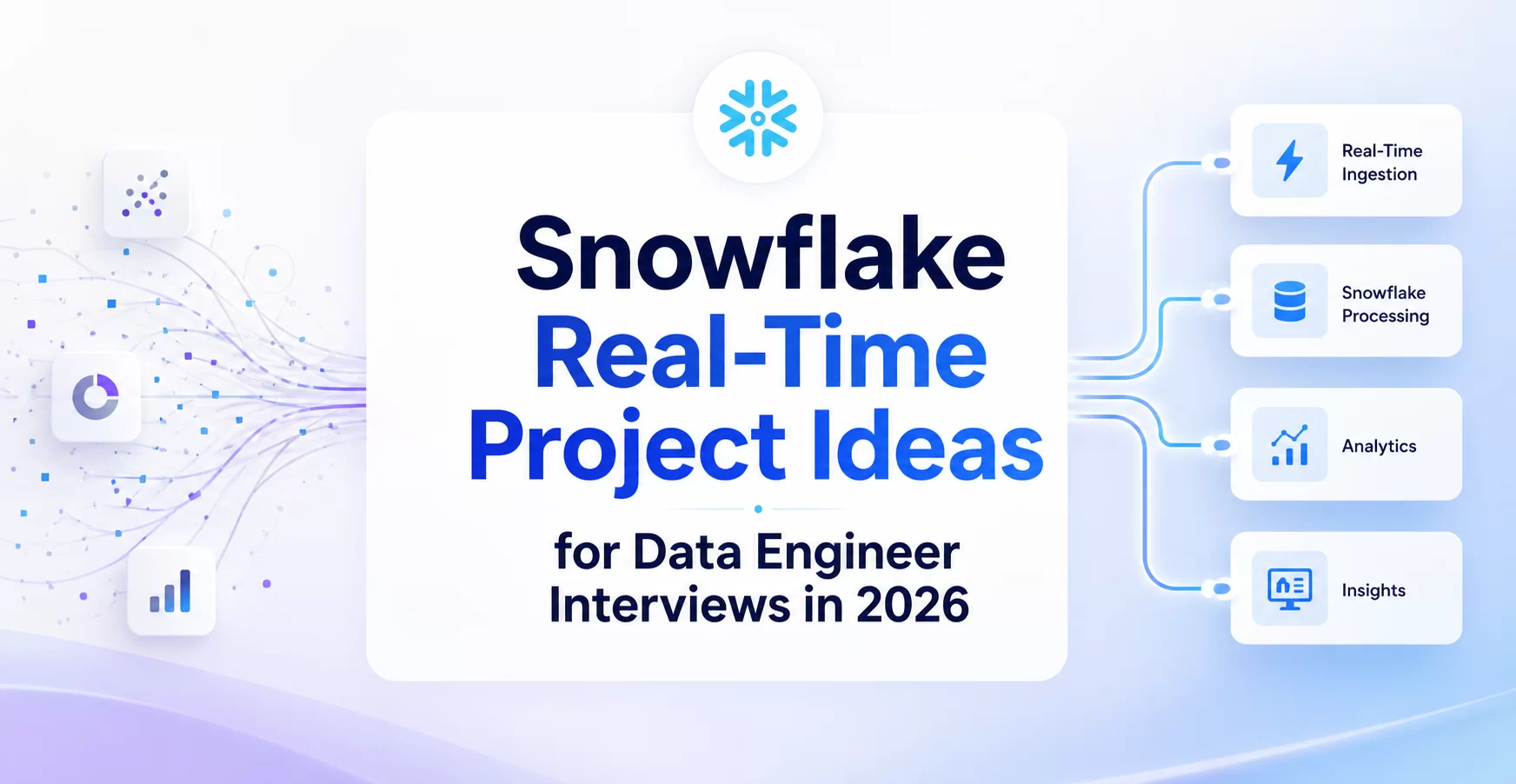
Snowflake Real-Time Project Ideas for Data Engineer Interviews in 2026
A strong Snowflake real-time project does one thing fast, it proves you can think like a data engineer, not only write SQL. Interviewers want to see pipeline design, data freshness, modeling choices, query performance, and cloud awareness in one clean story.
If you’re trying to choose a project, don’t pick the flashiest one. Pick the one you can finish, explain, and demo without getting lost halfway through. Let’s get into the ideas that do that well.
Quick summary:
The best interview project is small, clear, and close to real work. It should show how data lands in Snowflake, how it changes, and how someone uses it.
Key takeaway:
Your project name matters less than your design choices, latency target, and how well you explain tradeoffs.
Quick promise:
By the end, you’ll know which Snowflake project to build, what it proves in interviews, and how to make it look hiring-ready.
Why Snowflake real-time projects matter in data engineer interviews
They help you stand out because they show applied thinking. A good project tells interviewers you can handle freshness, reliability, and business logic under pressure.
What hiring teams look for beyond the project name
Here’s the thing, nobody is impressed just because you used Snowflake. They care about the choices behind it.
If you say you built a live pipeline, be ready to explain how data arrived, how often it refreshed, and what happened when something broke. That’s where the signal is.
Hiring teams usually look for proof of these basics:
- A clear ingestion path, such as files, events, or API payloads
- Simple transformation logic that turns raw data into usable tables
- A realistic latency goal, even if it’s near real-time instead of true streaming
- Data quality checks for nulls, duplicates, and bad records
- Alerting or monitoring so failures don’t stay hidden
- Cost awareness, because constant refreshes can get expensive
A small project with those pieces beats a bigger one with vague claims. Think of it like a house tour. If you only show the front door, nobody knows how the rest of it is built.
How real-time skills map to common data engineer interview questions
A real-time Snowflake project gives you real answers for common interview prompts. That matters more than memorized theory.
When an interviewer asks about schema changes, you can talk about new event fields showing up in raw tables. When they ask about incremental loads, you can explain how only fresh records moved into reporting tables. When they ask about failure recovery, you can describe retries, dead-letter handling, or backfills.
Projects like this also give you solid examples for questions around:
- Partitioning and clustering choices for query speed
- Late-arriving events and how metrics stay accurate
- Streams, tasks, or scheduled transformations
- Deduplication when the same event lands twice
That makes your answers feel grounded. You’re not guessing. You’re talking about work you already did.
The best Snowflake real-time project ideas to build for interviews
The best projects are small enough to finish and rich enough to show real engineering skill. You want one project that opens five interview conversations, not five half-built demos.
This quick comparison helps you pick the right angle:
| Project idea | What it proves in interviews |
| Live sales dashboard | Event ingestion, metrics, late data handling |
| IoT sensor alerts | Freshness, thresholds, monitoring logic |
| Support ticket triage | SQL modeling, updates, SLA thinking |
| Finance transaction monitoring | Auditability, rule logic, secure design |
| Marketing event tracking | Dimensions, attribution basics, dashboard readiness |
Live sales dashboard with event data from a mock e-commerce app
This is one of the safest and strongest choices. It’s easy to explain, easy to demo, and full of useful design decisions.
You can simulate click, cart, and order events from a small app or CSV stream, land them in Snowflake with Snowpipe, and build near real-time tables for revenue, conversion rate, and average order value. Then add logic for late orders or duplicate events.
That gives you a clean interview story. Raw events come in, transformations shape them, and a dashboard updates often enough to matter.
IoT sensor alert pipeline with anomaly detection
This project is great if you want to show event processing without a lot of business complexity. Sensor readings are simple, but the engineering ideas are strong.
You can ingest temperature, pressure, or vibration data into a time-based table, then write SQL or task logic that flags records crossing a threshold. If you want one more layer, add a moving average rule for unusual spikes.
In interviews, keep the anomaly logic simple. The point is not fancy data science. The point is freshness, alerting, and handling data that never stops arriving.
Customer support ticket triage system with streaming updates
If your strength is SQL, this one can shine. Ticket systems change all day, so they fit the real-time idea without needing huge scale.
You can stream ticket create and update events into Snowflake, then model current status, priority, assignee, and SLA risk. A simple dashboard can show open counts, aging tickets, and high-priority queues.
Why does this work so well? Because it sounds like real business work. You’re showing change handling, useful modeling, and a clear outcome people care about.
Finance transaction monitoring project for fraud or risk flags
This project works when you want to show careful thinking. Keep the claims modest. Don’t say you built a fraud engine. Say you built a rule-based monitoring pipeline.
Use transaction events such as amount, timestamp, account, merchant, and location. Then flag patterns like repeated payments in a short window, unusual amounts for a user, or sudden location shifts. Store both the raw transaction and the reason for the flag.
That last part matters a lot. Auditability makes the project stronger. Interviewers like projects where every alert can be traced back to data and logic.
Marketing event stream with campaign performance tracking
This is a business-friendly project, and that’s a good thing. It lets you connect data engineering work to a familiar outcome.
You can track ad clicks, signups, and purchases as events, then build fact tables and simple campaign dimensions in Snowflake. Near real-time metrics might include signups by channel, conversion lag, and purchase rate by campaign.
It also gives you an easy way to talk about freshness tradeoffs. Does marketing need second-by-second updates? Usually not. Five-minute or fifteen-minute refreshes can be enough, and that opens a smart cost discussion.
How to make a Snowflake project look interview ready
A project looks interview ready when it shows end-to-end thinking. Loading data into Snowflake is not enough, you need to show how the whole system works and why you built it that way.
Show the full flow from source to Snowflake to dashboard
Interviewers want to see the path, not only the destination. Show where data starts, how it lands, how it changes, and where users consume it.
A simple architecture diagram goes a long way. Add short notes for each step, source, ingestion, raw table, transformed table, and dashboard or alert. Keep it visual and plain.
Add the features that prove real production thinking
Small details make a project feel real. This is where many candidates stop too early.
Add a few practical touches:
- Incremental loading so you don’t rebuild everything every run
- Deduplication rules for repeated events
- Basic data quality checks on nulls and invalid values
- Error logging for failed records or broken jobs
- Refresh schedules and simple monitoring metrics
If you can’t explain why a feature exists, don’t add it. One clean reliability feature beats five random buzzwords.
Write a short project story you can say in an interview
Your explanation needs to fit in about two minutes. If it takes ten, the project is too messy.
Use this simple flow:
- Start with the business problem.
- Explain the source data and how it entered Snowflake.
- Share one challenge, like duplicates or late events.
- End with the output, dashboard, alert, or metric.
That’s it. Clear beats clever every time.
How to pick the right project for your experience level
The best project is the one you can finish well and explain with confidence. A smaller polished build usually wins over a large project that falls apart under questions.
Best choices for beginners who need a simple win
Start with one source and one outcome. A live sales dashboard or support ticket pipeline is usually enough.
Keep the scope tight. Use simple transformations, one dashboard, and maybe one quality check. Don’t pile on extra tools if they don’t help the story. Too many moving parts can make your demo feel blurry.
Best choices for candidates with stronger SQL and cloud skills
If you’ve got better SQL and some cloud comfort, step up to multiple event types or more frequent refresh logic. The marketing event stream or finance monitoring project fits this level well.
These projects let you show stronger modeling, performance thinking, and tradeoff decisions. This is the sweet spot for a lot of interview candidates.
When to choose an advanced project and when not to
Choose an advanced project only if you can finish it, explain the tradeoffs, and demo the result without hand-waving. If not, skip it.
A half-built streaming architecture doesn’t impress anyone. A focused project with clean documentation, a simple diagram, and solid answers usually lands better.
Frequently Asked Questions About Snowflake Real-Time Project Ideas for Data Engineer Interviews in 2026
What kind of Snowflake real-time project impresses interviewers in 2026?
A project that shows end-to-end streaming ingestion, near-real-time transformation, and a clear business use case gets attention fast. Strong examples include clickstream analytics, IoT event monitoring, fraud alert pipelines, and CDC flows that land data in Snowflake and power a live dashboard. Interviewers care less about a fancy front end and more about architecture, latency, reliability, and cost.
Which Snowflake features should a real-time project include?
A solid project usually includes Snowpipe or Snowpipe Streaming, Streams and Tasks, and Dynamic Tables if they fit the use case. Snowpark, secure staging, role-based access control, and an orchestration tool like Airflow or dbt can make the design look complete. If the project uses CDC, call out how changes move from the source system into Snowflake without breaking downstream tables.
What are the best real-time project ideas for a data engineer interview?
The best ideas are the ones that solve a real problem and give you room to talk about tradeoffs. Clickstream session tracking, payment fraud monitoring, ride-share or delivery tracking, and inventory updates from operational systems are all strong choices. Pick one where freshness matters, then show how Snowflake handles ingestion, transformation, and serving.
How do I explain the architecture during the interview?
Walk through the pipeline in a simple order, source, ingestion, storage, transformation, serving, and monitoring. Be ready to explain why you chose streaming, micro-batch, or a mixed approach, plus how you handle late data, retries, and schema changes. If you can talk through recovery and data quality checks, your answer gets much stronger.
What metrics should I track in a Snowflake real-time project?
Track end-to-end latency, ingestion throughput, query response time, warehouse credits, and data freshness. If the pipeline moves business data, include duplicate rate, failed record count, and source-to-target reconciliation. Those numbers show that you thought about more than just making the pipeline run.
What mistakes make these projects look weak?
The biggest mistake is building a pipeline that only copies rows and never answers a real question. Another common miss is ignoring cost, because a real-time setup that burns credits without control is a bad tradeoff. No monitoring, no recovery plan, and no explanation for schema design can also sink an otherwise decent project.
Conclusion
A focused Snowflake real-time project can show interview-ready skill fast. It proves you understand how data moves, changes, breaks, and turns into something useful.
Pick one project. Keep the scope tight. Then add the details that show real data engineering judgment, freshness goals, quality checks, and a story you can explain without scrambling.
That’s the project interviewers remember.