
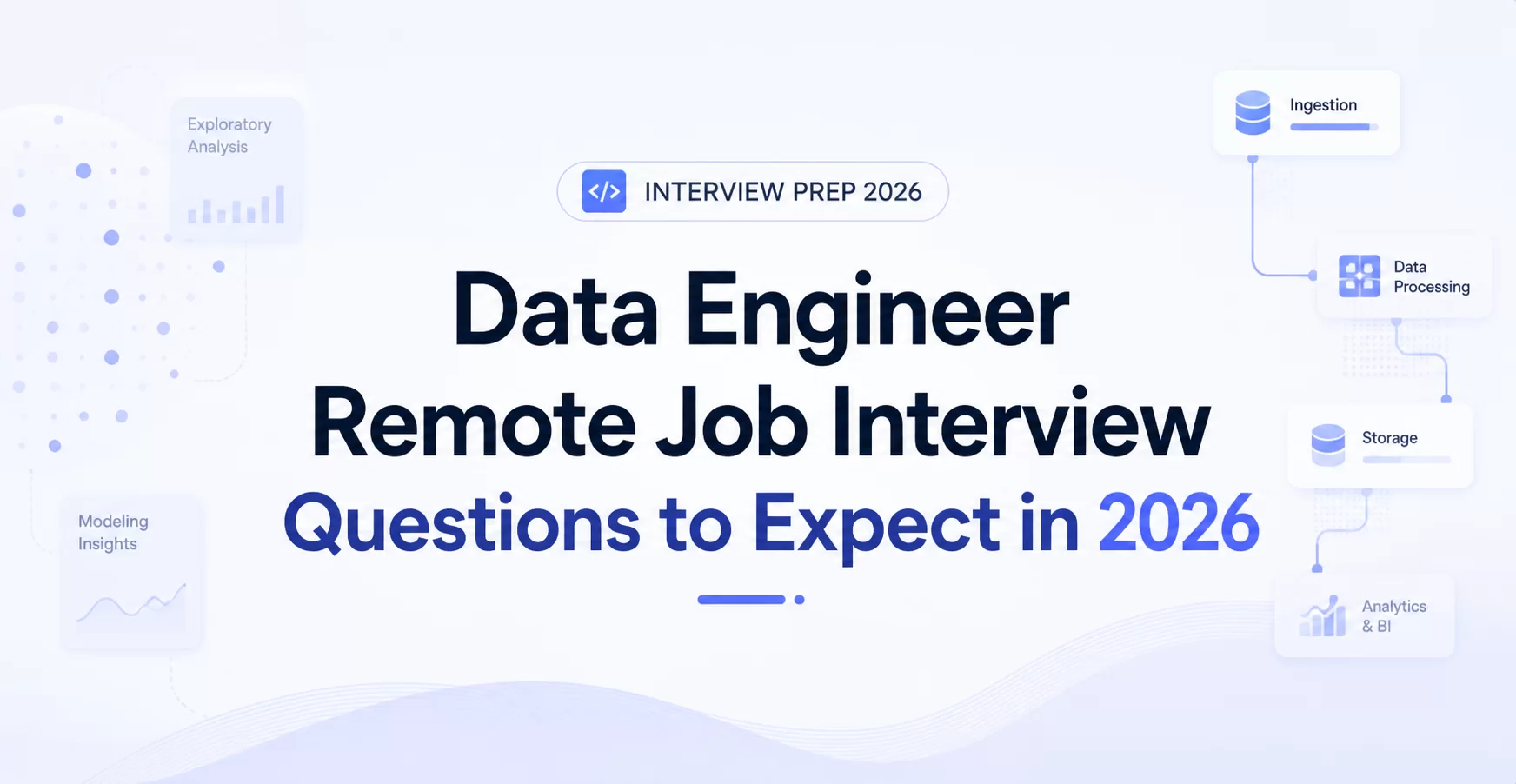
Data Engineer Remote Job Interview Questions to Expect in 2026
Remote data engineer interviews usually test SQL, Python, data pipelines, cloud tools, system design, and communication. That’s the short answer. If the role is remote, interviewers also look harder at how you work alone, how you update a team, and how clearly you explain technical choices.
That extra remote layer matters more than people think. You might know SQL cold, but if you can’t talk through tradeoffs, document your work, or handle async collaboration, you’ll feel the gap fast. Let’s make this easier, so you know what questions show up most, how to answer them, and how to prepare without sounding rehearsed.
Quick summary: Remote data engineer interviews check two things at once, technical skill and work style. You need to show you can write queries, build reliable pipelines, and communicate clearly when nobody is sitting next to you.
Key takeaway: Interviewers don’t want perfect textbook answers. They want clear thinking, solid fundamentals, and proof that you can solve data problems without getting lost or going silent.
Quick promise: By the end, you’ll know the common question types, the signals hiring teams care about, and a simple prep approach that helps your answers sound calm, clear, and credible.
The core skills interviewers check first
Most remote data engineer interviews start with SQL, Python, and data modeling. Hiring teams want proof that you can work with messy data, think clearly under pressure, and explain what you’re doing as you go.
SQL questions you should expect
SQL is usually the first filter. If you can’t query data cleanly, nothing else matters much.
Expect questions around joins, aggregations, CTEs, window functions, and debugging broken queries. Common prompts sound like this: find duplicate users, rank orders by customer, calculate rolling totals, or fix a slow query.
The big thing? Interviewers often care more about your reasoning than perfect syntax. Talk through your assumptions. Say why you chose a left join, why a window function fits, or why you filtered early to reduce data size.
Python and scripting questions that come up often
Python questions in data engineering interviews are usually practical, not fancy. You’re more likely to clean a file than build a complex algorithm.
Expect small tasks with lists, dictionaries, loops, functions, and file handling. Some teams ask about pandas, error handling, or how you’d write reusable code for a repeated task. If you get a coding prompt, keep it simple and readable.
A clean script with clear variable names often beats a clever answer nobody can follow.
Data modeling and warehouse basics
Interviewers also check whether you can structure data in a way people can trust and use.
You should be ready to explain fact tables, dimension tables, star schema, normalization, and denormalization. A common prompt is designing a model for orders, users, subscriptions, or event data. Good answers connect design choices to reporting needs, performance, and easier maintenance.
If you can explain when denormalized tables help analysts and when normalized models reduce redundancy, you’re in good shape.
Questions about pipelines, ETL, and workflow design
Remote data engineer interviews often test how well you can build, monitor, and fix pipelines end to end. You need to show that you understand how data moves, where it breaks, and how to keep it reliable.
Before you answer design questions, keep these terms straight:
| Term | Plain meaning | Typical use |
| Batch | Data moves on a schedule | Daily reports, nightly loads |
| Streaming | Data moves continuously or near real time | Events, monitoring, live apps |
| ETL | Transform before loading | Older systems, stricter preprocessing |
| ELT | Load first, transform in the warehouse | Modern cloud warehouses |
The takeaway is simple: know the difference, then tie your answer to the business need.
How interviewers test your pipeline design thinking
A classic prompt is, “How would you build a pipeline from an API into a warehouse?” Another is, “How would you handle a daily refresh for sales data?”
A strong answer usually covers the same building blocks: the source, extraction method, storage, transformations, scheduling, validation, and failure handling. You don’t need buzzwords. You need a logical path.
Think of it like explaining a delivery route. Where does the package start? Where does it go next? What if the truck breaks down? That is how good pipeline answers sound.
What to say about data quality and reliability
Teams care a lot about trust. In remote roles, that matters even more because broken data isn’t always spotted in a hallway conversation.
Talk about checks for missing values, duplicate records, schema changes, null spikes, and late-arriving data. Mention alerts, logs, retries, and simple tests after each load. If you use dbt tests, Airflow alerts, or custom checks, say so. If not, explain the logic.
A strong answer doesn’t stop at “I’d monitor it.” It says what you’d monitor, when you’d alert, and what you’d do next.
Cloud tools and modern stack questions
You don’t need to know every tool equally well. You do need to explain what common tools do and how they fit together.
You may get asked about AWS, Azure, or GCP, then tools like Snowflake, Databricks, Airflow, Spark, and dbt. Keep your answer broad unless the job posting goes deep on one stack. For example, Snowflake is often the warehouse, Airflow handles orchestration, Spark helps with large-scale processing, and dbt manages transformations inside the warehouse.
If you haven’t used a tool, don’t fake it. Explain the similar tool you’ve used and how the concepts transfer.
Remote-specific interview questions that are easy to miss
Remote data engineer interviews almost always include questions about communication, teamwork, time management, and working without close supervision. These questions matter because remote teams need people who can own work and keep others informed without being chased.
How you handle async communication and handoffs
Interviewers may ask how you share progress across time zones or how you document work for teammates who aren’t online when you are.
Good answers mention clear status updates, well-written tickets, useful documentation, and simple explanations of blockers. If you can explain a broken pipeline to an analyst without drowning them in jargon, that helps. If you can leave notes that let another engineer pick up the work later, that helps even more.
What interviewers want to know about self-management
Nobody expects perfection. They want structure.
Be ready to explain how you prioritize tasks, track deadlines, and protect focus time at home. Maybe you use a task board, a calendar, daily planning, or regular check-ins with your manager. That’s enough. The point is to show that you don’t drift.
A remote role gives freedom. It also removes excuses.
How to show you can work well with product, analysts, and engineers
Remote data engineers rarely work in a bubble. You’re often translating between people who care about different things.
Talk about how you clarify requirements, ask follow-up questions, and confirm what success looks like before you build. That avoids the most expensive mistake of all, building the wrong thing well.
Behavioral questions that reveal how you think
Behavioral questions show how you handle mistakes, pressure, learning, and change. Interviewers use them to figure out whether you’re steady when things get messy, because data work gets messy.
Stories about fixing broken data or missed deadlines
You may hear, “Tell me about a pipeline failure,” or “Describe a project that went off track.”
A strong answer has four parts: what happened, what you did, how you communicated, and what changed after the fix. Keep the story tight. Don’t hide the problem. Show ownership. If you missed a deadline but improved the process after, say that clearly.
That kind of answer feels real, and real beats polished every time.
Questions about learning new tools quickly
Remote teams often switch tools, expand stacks, or ask you to use something new fast.
If you’re asked about a tool you didn’t know at first, explain how you learned it. Maybe you read the docs, built a small test project, watched a focused tutorial, and asked targeted questions after trying it yourself. That shows initiative and a clean learning process.
How to talk about ownership and impact
Hiring managers want people who don’t stop at “I completed the task.”
Talk about results in simple terms. Maybe you reduced pipeline failures, sped up a refresh, improved data accuracy, or made reporting easier for analysts. You don’t need inflated claims. You need a clear before-and-after story that shows your work helped someone.
How to prepare so your answers sound confident
The best prep is not memorizing scripts. It’s practicing clear answers to likely questions until your thinking sounds organized, natural, and easy to follow.
Build a short story bank before the interview
Prepare a few short examples from work, school, internships, freelance projects, or personal builds.
Make sure you have stories for:
- a SQL problem you solved
- a pipeline or data issue you fixed
- a time you worked with others to clarify requirements
- a challenge you handled under pressure
You don’t need ten stories. Four or five good ones can cover a lot.
Practice explaining technical choices out loud
Remote interviews often reward clear speaking almost as much as technical skill. If your answer makes sense out loud, you’re ahead.
Practice with a friend, record yourself, or do a mock interview. Listen for rambling. Listen for vague words. Tighten your answer until it sounds calm and structured. The goal isn’t to sound robotic. It’s to sound like someone who knows what they’re doing.
Conclusion
Remote data engineer interviews usually come back to the same core areas: SQL, Python, pipeline design, cloud tools, behavioral judgment, and remote work habits. The people who do well aren’t always the ones with the flashiest stack. They’re the ones who answer clearly, use real examples, and show steady ownership.
If you prepare a small set of project stories, practice explaining tradeoffs out loud, and stay simple in your answers, the interview gets a lot less intimidating. That’s the whole game, clear thinking, clear communication, and proof that you can do the work from anywhere.