
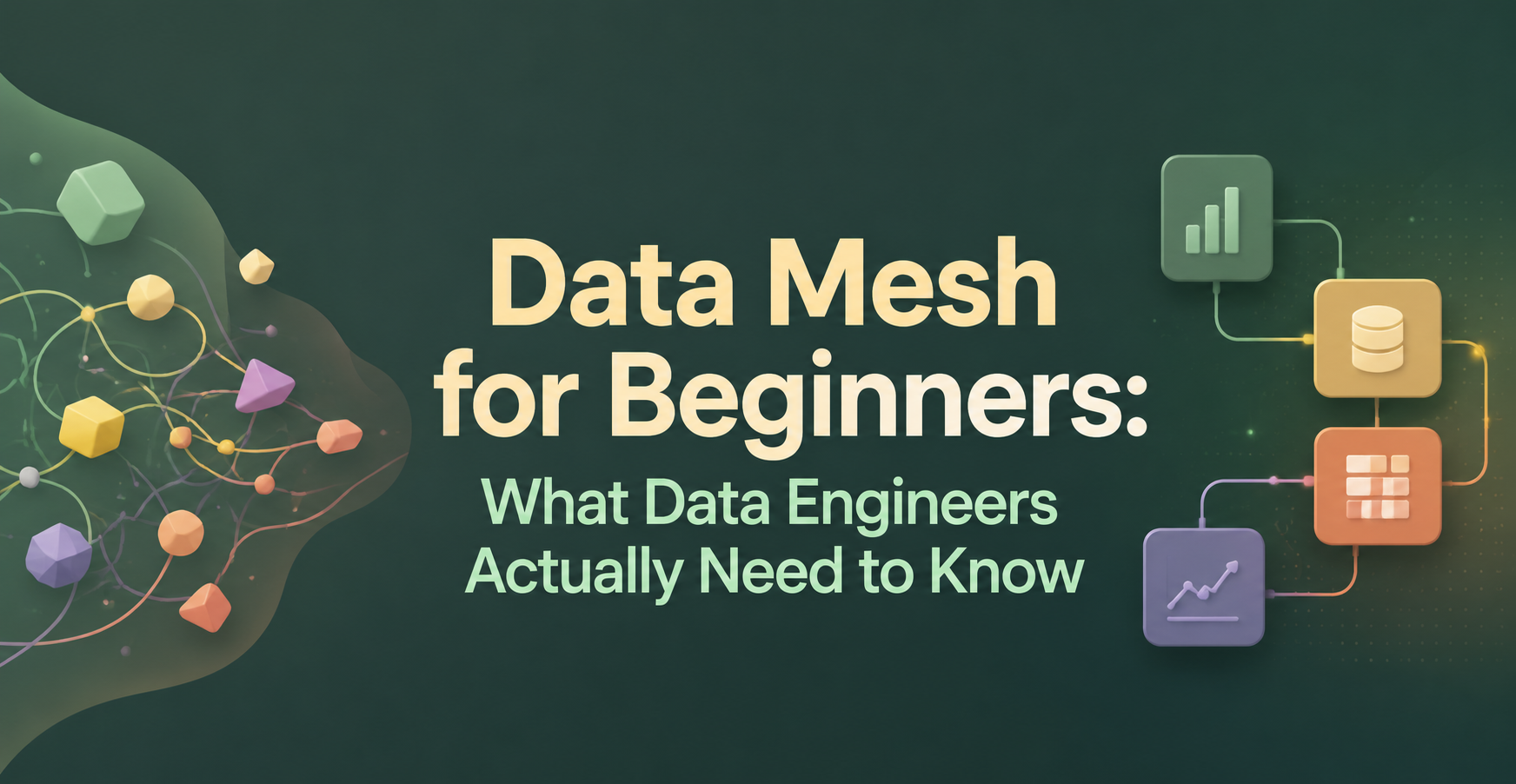
Data Mesh for Beginners: What Data Engineers Actually Need to Know
Data mesh is a way to organize data work around business domains, not one central data team. In data engineering, that means sales data stays close to the sales domain, finance data stays close to finance, and each team owns what it publishes. You should care because if you build pipelines, models, or platforms, a mesh changes what “done” looks like.
This isn’t hype or a new storage trick. It’s an operating model shift, and it changes how engineers build, document, govern, and support data.
Key Points
- Data mesh moves ownership from one central team to domain teams.
- It treats data as a product with clear quality, docs, and support.
- Data engineers still build pipelines, but they also help publish trusted data products.
- A shared platform and shared standards matter as much as local ownership.
- Many teams use both a warehouse and data mesh principles at the same time.
Quick summary: Data mesh helps large or busy organizations stop routing every request through one overloaded team.
Key takeaway: For data engineers, the job shifts toward ownership, reliability, and consumer trust.
Quick promise: You’ll leave with a practical view of what to learn first, and what to ignore.
What data mesh is, and why it came about
Data mesh grew out of a common problem. As companies add more teams, products, and reporting needs, a central data team becomes a queue. Work piles up, context gets lost, and delivery slows down. Zhamak Dehghani popularized data mesh as a response to that pattern.
A mesh is both an organizational model and a set of design principles. It says the team closest to the data should own it, publish it, and maintain it, while a shared platform makes that work easier.
Why central data teams start to slow down
Central teams often begin with good intent. They build the warehouse, model key tables, and help the business move faster. Then every new dashboard, metric fix, and source ingestion lands in the same backlog.
Soon, that team becomes the gatekeeper for every request. Handoffs grow, business context fades, and simple changes wait behind bigger platform work.
The four ideas behind data mesh
A data mesh rests on four simple ideas. First, domain ownership means teams own the data they create. Second, data as a product means data needs clear schemas, docs, quality checks, and support. Third, self-serve infrastructure gives teams common tooling so they don’t rebuild basics. Fourth, federated governance keeps shared rules in place across many teams.
How data mesh changes the daily work of a data engineer
For engineers, the biggest shift is scope. You don’t only move data from source to warehouse. You help a domain publish something others can find, trust, and use.
That usually means closer work with product managers, analysts, software engineers, and platform teams. Technical choices also change. You start asking who owns this dataset, what freshness consumers need, what happens when the schema changes, and how people will discover it.
From pipeline builder to data product builder
A pipeline can run and still fail the business. If nobody trusts the output, can’t find the owner, or doesn’t know what a field means, the job isn’t done.
In a mesh setup, engineers help define freshness, schema contracts, tests, and documentation. They also make the consumer clear. A churn model for marketing, for example, should state who owns it, how often it updates, and what “active customer” means.
What data engineers still own in a mesh setup
The technical work stays. You still care about ingestion, transformation, orchestration, observability, access control, and cost.
What’s different is the boundary. Platform teams may provide templates, storage, and monitoring, while domain teams own the meaning and product quality of their data. Good mesh teams share responsibility without blurring ownership.
The parts of a real data mesh setup you need to know
A real mesh has a few moving parts. The basics are domains, data products, discovery, interoperability, governance, and a platform layer. If one is missing, the model gets messy fast.
Domain ownership and why it matters
A domain is a business area such as sales, finance, growth, or support. The team closest to that work usually understands the source systems, edge cases, and business definitions best.
Because of that, domain ownership improves speed and context. It also reduces the endless cycle where a central team guesses what “customer,” “order,” or “refund” should mean.
Data products, not just datasets
A data product is more than a table. People should be able to find it, understand it, trust it, and know who to contact.
Useful products usually include a stable schema, documentation, tests, lineage, an owner, and an SLO for freshness or availability. If consumers can’t rely on it, it’s still a raw dataset.
Federated governance without the gatekeeping
Governance still matters. Privacy rules, naming rules, lineage, access controls, and minimum quality standards don’t disappear in a mesh.
The difference is how teams apply them. A shared group defines standards and tooling, while domains follow those standards in their own workflows. That keeps order without forcing every change through one approval queue.
Data mesh vs. data warehouse: what is actually different?
A data warehouse is a storage and analytics pattern. Data mesh is an ownership and operating model. That’s why they are not enemies. Many companies use Snowflake, BigQuery, Redshift, or Databricks as part of a mesh.
This quick view helps separate the two:
| Area | Central warehouse model | Data mesh model |
| Ownership | Central data team | Domain teams |
| Delivery | Queue-based | Distributed |
| Context | Often weaker | Closer to source |
| Governance | Central review | Shared standards |
| Storage | Usually one core platform | Often same platform |
The biggest beginner mistake is assuming mesh replaces the warehouse. It doesn’t. A warehouse can still be the storage layer while ownership shifts outward.
When a warehouse is enough, and when it is not
A central warehouse often works well for smaller companies, simple reporting, or teams with one main product line. It can stay the right choice for a long time.
A mesh starts to make sense when many domains depend on one backlog, definitions drift, and delivery slows because one team owns too much.
Why data mesh is not just a new storage layer
Buying a new lakehouse or catalog won’t create a mesh. If ownership, support, and standards stay unclear, the same bottlenecks remain.
Skills and tools data engineers should focus on first
Beginners don’t need a “mesh tool.” They need core engineering habits that make data trustworthy and reusable.
The must-have skills are still familiar. SQL helps you model and validate data. Python helps with ingestion and automation. Data modeling keeps product boundaries clear. Orchestration, testing, documentation, and observability make products reliable.
The must-have skills for working in a mesh model
- Strong SQL for modeling, quality checks, and debugging.
- Python for ingestion, automation, and service glue.
- Data modeling so tables reflect business meaning.
- Testing and observability so consumers can trust outputs.
- Documentation and communication because ownership must be visible.
The tools that often support data mesh
The stack varies by company. Still, you’ll often see dbt for transformations, Airflow for orchestration, Spark for large-scale processing, and Snowflake or Databricks for storage and compute. Cloud basics on AWS or Azure also matter, because platform teams often build shared patterns there.
The biggest mistakes beginners make with data mesh
The first mistake is treating data mesh like a trend word. The second is copying the model before the team is ready. Small teams usually need clear ownership and better quality first, not a full re-org.
A mesh without shared standards turns into inconsistent tables with better marketing.
Thinking data mesh means no central standards
A mesh still needs naming rules, access policies, and common quality bars. Without them, every domain creates its own version of “clean.”
Trying to rebuild everything at once
Start with one domain and one useful data product. Prove the ownership model, document the contract, and fix the rough edges before expanding.
One-minute summary
- Learn data mesh as an ownership model, not a tool choice.
- Focus on domain context, not only pipeline speed.
- Treat each important dataset like a product with consumers.
- Keep shared governance, even when teams own local data.
- Start small, then expand after one domain shows clear value.
Glossary
- Domain: A business area that owns its data.
- Data product: Trusted, documented, reusable data for consumers.
- Federated governance: Shared standards applied across many teams.
- Schema contract: An agreed structure for data fields.
- Lineage: The path from source to final output.
- Observability: Monitoring data health, freshness, and failures.
- SLO: A target for reliability or freshness.
- Self-serve platform: Shared tooling domains can use directly.
Conclusion
Data mesh changes who owns data and how teams serve it. For data engineers, that means thinking beyond pipelines and caring more about domains, data products, and shared governance.
You don’t need to master the whole model at once. Start with one domain-focused project, add stronger docs and tests, and make one dataset feel like a real product.
FAQ
What is data mesh in simple terms?
Data mesh is a way to organize data by business domain. Each team owns the data it creates, while a shared platform and shared standards help everyone publish usable, trusted data.
Is data mesh worth learning for beginners in 2026?
Yes, because the ideas show up even in teams that never use the label. Ownership, documentation, testing, and consumer-focused data products are already part of many data engineering jobs.
Do data engineers need data mesh to get hired?
No. You can get hired without mesh experience. Still, understanding domain ownership, governance, and data product thinking makes you stronger in modern platform and analytics teams.
Can a company use a data warehouse and data mesh together?
Yes. Many do. The warehouse stays as storage and compute, while mesh principles change who owns the data, how teams publish it, and how governance works across domains.
What’s the best first project to practice these ideas?
Pick one domain, such as sales or support. Build one dataset with an owner, docs, tests, freshness targets, and clear business definitions. That teaches more than renaming folders “mesh.”
Is dbt enough to build a data mesh?
No. dbt helps with modeling, testing, and docs, which is useful. But a mesh also needs domain ownership, platform support, access rules, and teams willing to maintain data products.
How do I know if my team is ready for data mesh?
Look for repeated bottlenecks, too many handoffs, unclear ownership, and growing metric conflicts. If those problems are small, improve your current setup before you spread ownership wider.
Where can I practice data mesh skills next?
Start with a domain project that includes SQL, modeling, orchestration, tests, and docs. If you want guided practice, Data Engineer Academy’s personalized training can help.