

Azure App Service takes off the fundamental server administration, making designing, deploying, and scaling web apps easier. It provides a stable platform with a wide range of capabilities and integrations, allowing developers to concentrate on developing applications and providing value to their users.
Developers can concentrate on creating applications and providing value to their users while Azure manages the underlying infrastructure and platform.
What is Azure App Service?
Azure App Service is a fully managed platform-as-a-service (PaaS) product from Microsoft Azure. This enables you to create, deploy, and scale web apps, mobile backends, and RESTful APIs without having to manage the underlying infrastructure.
It supports multiple programming languages, frameworks, and platforms, including .NET, Java, Node.js, Python, and PHP. It includes built-in support for popular content management systems (CMS) such as WordPress and Joomla and connectivity with numerous databases and services.
Azure App Service Provides:
- Web App Hosting: Azure App Service allows you to host a variety of web apps, including static websites, dynamic websites, and single-page apps (SPAs). You can choose from a variety of programming languages and frameworks, including .NET, Java, Node.js, Python, PHP, and Ruby. This adaptability allows you to utilize your favorite tools and technologies for application development.
- Scalability and Elasticity: It offers automatic scaling capabilities to manage different levels of application load. Scale criteria can be configured based on parameters like CPU consumption, memory usage, or incoming requests. This enables your application to scale up or down dynamically to meet demand without requiring manual intervention. Scaling can be done horizontally by adding more instances or vertically by increasing the resources allocated to each instance.
- Deployment choices: App Service provides a variety of deployment choices to meet your specific requirements. You can deploy your application code using Git, Azure DevOps, FTP, or straight from the Azure portal. It also offers deployment slots, which let you deploy distinct versions of your application for staging, testing, and production environments. You can change the deploy slot to promote new versions of your application easily.
- Integration with Azure DevOps and Continuous Integration/Deployment (CI/CD):
Azure App Service integrates seamlessly with Azure DevOps and other popular version control systems like Git. This integration enables you to set up automated CI/CD pipelines to build, test, and deploy your applications. When updates are pushed to your repository, deploys may be triggered automatically, resulting in a streamlined and efficient development workflow.
- High Availability and Fault Tolerance: App Service is meant to provide high availability and fault tolerance for your apps. It intelligently distributes incoming traffic among numerous instances of your application, ensuring that it remains available even if individual instances fail. In addition, App Service deploys OS and framework patches regularly to keep your application secure and up to date with no downtime.
- Authentication and Authorization: It supports several different authentication and authorization protocols. You may easily interface with Azure Active Directory (AAD) for authentication and authorization, providing safe access to your applications through AAD accounts or other identity providers such as Google, Facebook, or Twitter. It also supports custom identity solutions if you have specific authentication needs.
- Integration with Azure Services: It connects easily with other Azure services, allowing you to harness their features within your apps. For example, you can simply integrate with Azure SQL Database to store and retrieve data, Azure Storage for file storage, Azure Functions for serverless computing, Azure Cognitive Services to add storing and retrieving data, Azure Storage for file storage, Azure Functions for serverless computing, and Azure Cognitive Services for adding AI capabilities to your applications. These connectors allow you to create advanced and feature-rich applications.
- Monitoring and Troubleshooting: It includes monitoring and troubleshooting capabilities. You can monitor multiple metrics, such as CPU usage, memory usage, and response times, to gain insights into the performance of your application. It also supports application logging and request tracing, allowing you to identify problems and get insight into application behavior. You can also set up alerts based on specified thresholds to discover and respond to problems in real-time.
- DevOps and DevTest Integration: App Service works smoothly with Azure DevOps and Azure DevTest Labs. You may use Azure DevOps to automate application deployment and establish a DevOps workflow. Azure DevTest Labs allows you to quickly create and manage development and testing environments, guaranteeing a consistent and efficient development process.
- Pricing and Scaling: It provides numerous pricing choices, including a pay-as-you-go model and reserved instances for cost optimization. You can select the right pricing tier based on your application’s needs, such as the number of instances, CPU power, memory, and storage. App Service enables you to smoothly scale up or down as your application’s requirements change.
Why we used Azure App Service?

Azure App Service is a cloud-based platform that facilitates the development and management of web applications, mobile backends, and APIs. It provides a completely managed environment, allowing developers to focus on code rather than infrastructure setup and upkeep. It support multiple programming languages and frameworks, and App Service allows different development needs. It connects seamlessly with Azure DevOps for seamless CI/CD workflows.
App Service provides scalability features to accommodate variable workloads as well as automatic patching to ensure application security. It provides simple integration with other Azure services, such as databases and storage, for greater functionality. With built-in monitoring and diagnostics, developers can watch application performance and troubleshoot issues quickly. Overall, Azure App Service simplifies the development and deployment processes, making it an excellent choice.
What exactly is the Azure web app?

Platform as a Service (PaaS) is a service that Microsoft Azure offers with Azure Web App. It enables you to create, launch, and scale web apps and APIs without having to worry about managing the underlying infrastructure. It provides a fully managed and scalable environment for hosting your web apps, allowing you to focus on your application code rather than infrastructure setup and maintenance.
Create an App Service Plan Using Azure Portal
Follow these steps to create an App Service plan using the Azure Portal:
- Log in to the Azure Portal (portal.azure.com) with your Azure account credentials.

- Enter “App Service plan” in the search bar field and choose “App Service plan” from the results.
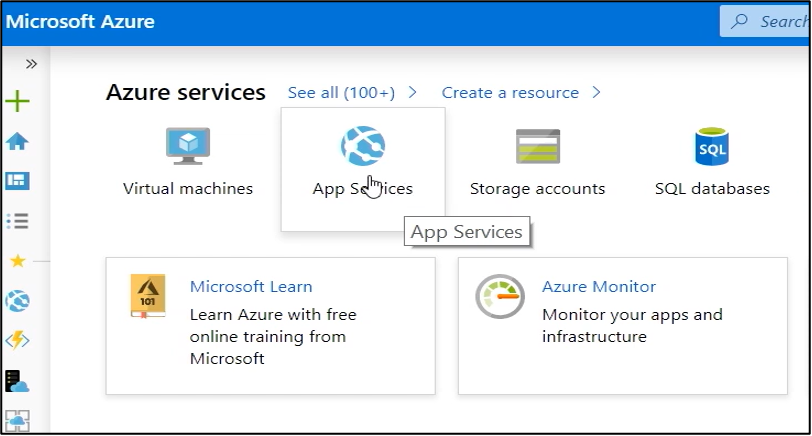
- In the Azure Portal dashboard, click the “Create a resource” button (+) in the upper-left corner.

- Click on the “Web App” button on the App Service plan page.

- In the “Basics” tab of the App Service plan creation wizard, set up the following settings:

- Subscription: Select an Azure subscription to utilize.
- Resource Group: Choose from the available resource groups or start a new one.
- Name: Give your App Service plan a distinct name.
- Publish: Select any one option you want.
- Runtime Stack: Choose a programming language.

- Operating System: Select an operating system (Windows or Linux) for your App Service plan.
- Location: Choose where you want your App Service plan to be deployed.

- App service plan: Select a pricing tier depending on your application’s needs and budget.


- After selecting click on the “Next: Monitoring” button

- Click the “Next: Tags” button to move on to the next tab, where you can add tags if necessary. Tags are an optional feature that can be used to organize and categorize resources.

- Click on the “Next Review and Create” button to review your settings. Check that all of the information is correct.

- After reviewing, click the “Create” button to create the App Service plan. Azure will start supplying resources based on your configuration.
- Your deployment is underway wait for some time.
- After finishing the deployment process, you may access your newly established App Service plan through the Azure Portal. You can now use this App Service subscription to host your web applications, mobile backends, or APIs.
App Service Plan in Azure
Linux System

Windows System

Please keep in mind that the rates listed above are estimates and may vary depending on specific criteria such as instance size, additional features, and any applicable discounts or bookings.
Applications of the Azure App Service

Web Applications
The Azure App Service is ideal for hosting web applications. Developers can use Azure App Service to swiftly launch and scale their applications, whether they are basic websites or large web applications. Its support with multiple programming languages and frameworks makes it an excellent choice for web development.
Backend for Mobile Applications
It is an ideal backend for mobile applications. It includes capabilities like offline sync, push alerts, and data storage choices that allow developers to create robust and scalable mobile app backends. With tools like Easy Tables and Mobile Apps SDKs, developers can accelerate mobile app development while focusing on the frontend experience.
RESTful APIs
RESTful APIs are frequently built with Azure App Service. It provides the infrastructure and scalability required to process API calls successfully. API Management and Azure Functions are two tools that developers can use to effectively build, secure, and manage their APIs.
Serverless Functions
It interfaces with Azure Functions, allowing developers to create serverless applications. By combining the capability of Azure App Service and Azure Functions, developers can construct event-driven architectures, implement serverless workflows, and run code in response to multiple triggers.
Benefits of using Azure App service

There are various advantages to using Azure App Service to host your web applications, mobile backends, and APIs. Here are a few significant benefits:
- Simple Deployment and Management: It delivers a completely managed platform, eliminating the need for infrastructure management. You may quickly deploy your applications using multiple deployment techniques and manage them using the Azure interface, CLI, or APIs.
- Flexibility and Language Support: App Service supports several programming languages and frameworks, allowing you to utilize the language and tools of your choice. It supports .NET, Java, Node.js, Python, PHP, and other programming languages, making it adaptable to a variety of development requirements.
- Scalability and autoscaling: With App Service, you may scale your applications without any noticeable lag. It has autoscaling features that dynamically alter the number of instances based on workload, guaranteeing that your application can meet large traffic demands without manual intervention.
- High Availability: App Service ensures the high availability of your applications with built-in load balancing and automatic backups. It splits up incoming traffic among several instances, lowering the possibility of downtime and giving customers a reliable experience.
- Security and compliance: App Service offers integrated security features and compliance certifications, ensuring secure access to apps and data.
- Cost-Effective price: It provides variable price options, allowing organizations to select economical plans by their needs for the applications they are using.
FAQs on What is Azure App Service
What is Azure App Service?
Azure App Service is a fully managed platform-as-a-service from Microsoft Azure for building, deploying, and scaling web apps, APIs, and mobile backends. It removes most server management so developers can focus on application code.
What is the difference between Azure App Service and Azure Web App?
Azure App Service is the broader platform. Azure Web App is one part of that platform, focused on hosting web applications, while App Service also supports APIs and mobile backend scenarios.
Why do you use an App Service Plan in Azure?
An App Service Plan defines the compute resources behind your app, including pricing tier, region, operating system, and scaling options. It is what determines how your Azure App Service app runs and what resources it can use.
Which programming languages does Azure App Service support?
Azure App Service supports several common languages and frameworks, including .NET, Java, Node.js, Python, and PHP. That flexibility makes it useful for different teams and existing codebases.
Is Azure App Service secure?
Azure App Service includes security features like authentication, authorization, and SSL/TLS support. It also integrates with Azure Active Directory and other identity providers for controlled access.
