
Essential Data Engineering Skills: A Practical Guide for Career Transitioners
Introduction
Data engineering is one of the fastest-growing technical disciplines in the industry, and the demand for qualified professionals is outpacing the supply. That gap is an opportunity but only for people who show up with the right skills.
If you are transitioning into data engineering from a neighboring role – analytics, IT, software-adjacent work, technical support, or business intelligence; you already have more relevant experience than you might think. The question is not whether you have potential. The question is whether you have the specific, demonstrable skills that data engineering roles require.
This guide covers the essential data engineering skills that hiring teams look for, explains what each skill actually involves in practice, and gives you a clear picture of what to build and learn at each stage of your transition. These are not abstract concepts. They are the capabilities you will use on day one of a data engineering role and every day after.
What Data Engineers Actually Do
Before covering the skills, it helps to understand what the role produces.
A data engineer designs, builds, and maintains the infrastructure that makes data usable across an organization. That means building pipelines that move data from source systems into storage, transforming raw data into reliable, queryable structures, and ensuring that analysts, data scientists, and business stakeholders can trust what they are looking at.
Data engineering sits at the intersection of software development and data science. It is less about analyzing data and more about building the systems that make analysis possible at scale.
Core data engineer responsibilities include:
- Building and maintaining data pipelines
- Designing data storage architecture
- Ingesting data from internal and external sources
- Transforming raw data into clean, structured formats
- Enforcing data quality and governance standards
- Supporting downstream teams: analysts, scientists, product managers
The skills required to do this work well span technical depth, systems thinking, and cross-functional communication.
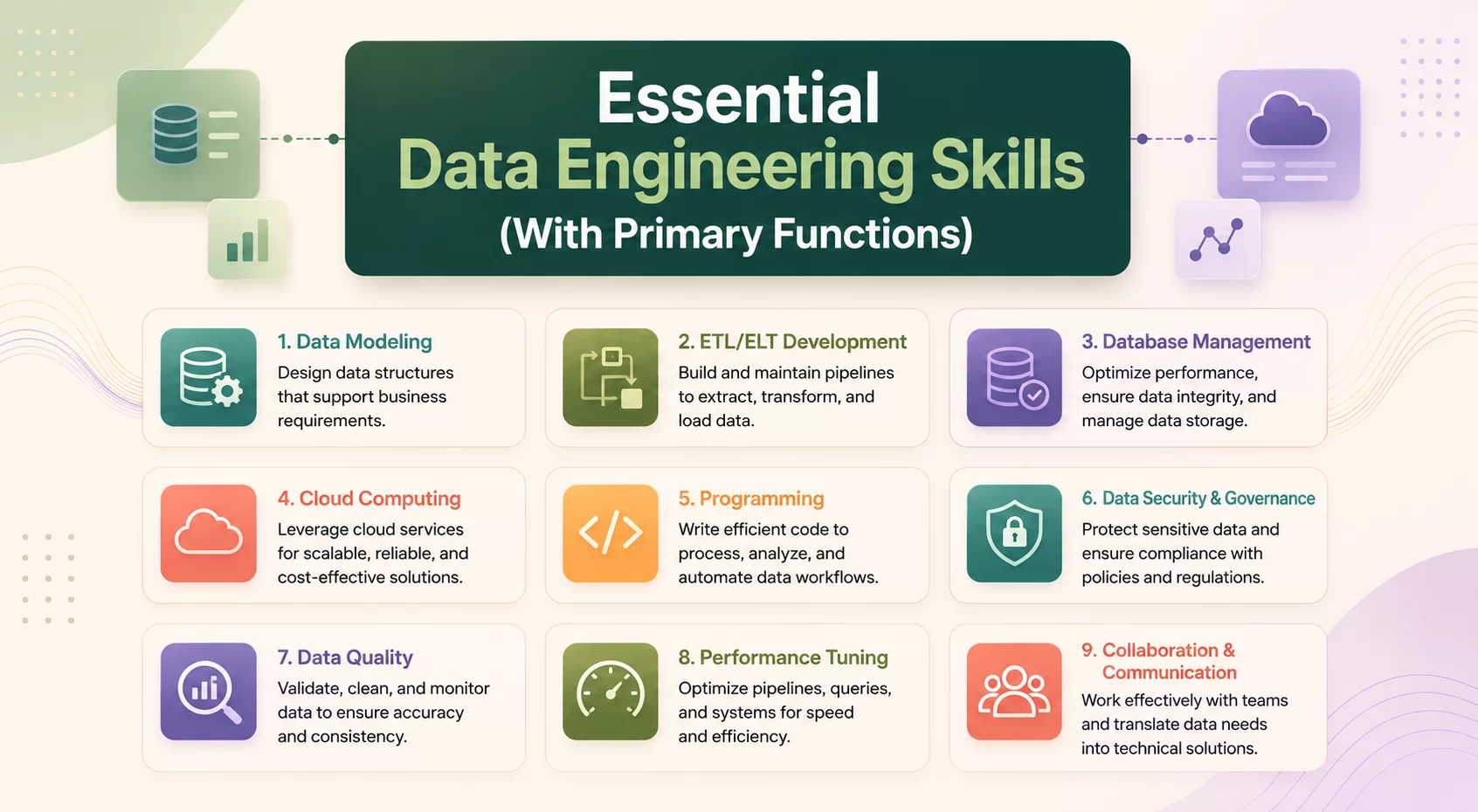
The Essential Data Engineering Skills for Career Transitioners
1. Programming
What it is: The ability to write code that automates data movement, transformation, and processing.
Programming is the foundation of data engineering. You do not need to be a software engineer with ten years of experience, but you do need to write code that is clean, modular, and reliable enough to run in production without breaking.
The languages that matter most for data engineering:
| Language | Why It Matters |
| Python | The dominant language for pipeline development, API ingestion, and data transformation |
| Scala | Used with Apache Spark for large-scale distributed processing |
| Java | Relevant in enterprise environments and some big data tooling |
| SQL | Not a general-purpose language but foundational to data transformation |
| Bash/Shell | Essential for scripting, automation, and working in Linux environments |
For career transitioners: Start with Python. It has the broadest application in modern data engineering, the largest community, and the most available learning resources. Once Python is solid, SQL for data engineering is the next priority.
What good looks like: You can write a Python script that pulls data from an API, handles errors gracefully, logs its progress, and loads records into a database and that script still works correctly when you run it again tomorrow.
Common mistake: Treating programming as a box to check rather than a craft to develop. Knowing the syntax of Python is different from writing Python that other engineers can read, maintain, and extend.
2. SQL and Database Systems
What it is: The ability to design, query, and manage structured data in relational database systems.
SQL is the most consistently required skill across every data engineering job description, at every level, across every industry. But the SQL used in data engineering is different from the SQL used in ad-hoc reporting.
Data engineering SQL goes beyond basic queries:
- Writing transformations that run on a schedule without duplicating or corrupting data
- Deduplication logic to prevent fan-out in aggregations
- Window functions for row-level calculations (ROW_NUMBER, LAG, LEAD, RANK)
- Incremental load patterns that only process new or changed records
- Data validation queries that catch quality issues before they reach downstream consumers
- Query optimization for large datasets using indexes, partitions, and execution plans
Beyond SQL, data engineers need familiarity with:
- Relational databases: PostgreSQL, MySQL
- Cloud data warehouses: Snowflake, BigQuery, Amazon Redshift
- The difference between OLTP systems (application databases) and OLAP systems (analytical warehouses)
- Schema design: primary keys, foreign keys, normalization, and when to denormalize
What good looks like: You can design a table schema, write a transformation that loads data incrementally, validate the output with quality checks, and explain why your query performs efficiently at scale.
3. Data Warehousing
What it is: Understanding how organizations store, organize, and retrieve data for analysis and business intelligence.
Data warehousing is one of the core disciplines of data engineering. A data warehouse is an analytical system that separate from the operational databases that power applications; designed specifically for fast, flexible querying across large volumes of historical data.
Key concepts career transitioners need to understand:
- The difference between a data warehouse, a data lake, and a data lakehouse
- Star schema design: fact tables for measurable events, dimension tables for descriptive context
- Slowly changing dimensions (SCDs): how to handle records that change over time
- Partitioning and clustering: how to organize data for query efficiency and cost control
- Materialized views: pre-computed query results for performance-sensitive use cases
- Grain: what one row in a table represents; the most fundamental data modeling concept
Common modern data warehouse platforms:
Snowflake, Google BigQuery, Amazon Redshift, Databricks SQL Warehouse, Azure Synapse Analytics.
What good looks like: You can design a warehouse schema for a real business domain, explain the grain of each table, and load data into it in a way that supports fast, reliable analytical queries.
4. Data Pipeline Design and ETL/ELT
What it is: Building automated, repeatable systems that move data from sources to destinations while handling failures, scheduling, and data quality.
Pipeline thinking is where most career transitioners have the largest gap. A pipeline is not a script that runs once. It is a system that runs every day handling late data, schema changes, upstream failures, and downstream dependencies without manual intervention.
The core pipeline concepts to understand:
- ETL vs ELT: Extract-Transform-Load (transform before loading) vs Extract-Load-Transform (load raw, transform in the warehouse). Modern cloud architectures favor ELT.
- Batch vs streaming: Batch pipelines process data on a schedule. Streaming pipelines process data continuously as it arrives.
- Idempotency: A pipeline is idempotent if running it multiple times produces the same result. This matters because pipelines fail and need to be rerun.
- Incremental loading: Only processing new or changed records, rather than reloading everything each run.
- Backfills: Reprocessing historical data when a pipeline logic changes.
- Dependency management: Ensuring that Task B only runs after Task A completes successfully.
What good looks like: You can describe the architecture of an end-to-end batch pipeline, explain what happens when a step fails, and demonstrate that the pipeline can be safely rerun without side effects.
5. Cloud Computing
What it is: Using cloud-based infrastructure, storage, compute, databases, and managed services to build and run data systems at scale.
Modern data engineering happens almost entirely in the cloud. Organizations are not running on-premise Hadoop clusters anymore. They are using managed cloud services to store data cheaply, process it at scale, and pay only for what they use.
The architecture pattern to understand:
- Raw data lands in object storage (AWS S3, Google Cloud Storage, Azure Data Lake)
- Compute processes or transforms it (Glue, Dataflow, Azure Data Factory)
- Results land in a cloud warehouse (Redshift, BigQuery, Synapse)
- Access is controlled through identity and access management (IAM)
- Costs and failures are monitored through cloud-native tooling
Key services by platform:
| AWS | GCP | Azure |
| S3 (storage) | Cloud Storage | Azure Data Lake Storage |
| Glue (ETL) | Dataflow | Azure Data Factory |
| Redshift (warehouse) | BigQuery | Synapse Analytics |
| Lambda (serverless) | Cloud Functions | Azure Functions |
| CloudWatch (monitoring) | Cloud Monitoring | Azure Monitor |
| IAM (access control) | IAM | Azure Active Directory |
For career transitioners: You do not need to memorize every service on every platform. Learn the pattern first storage, compute, warehouse, access control, monitoring, then learn how one cloud provider implements it. The pattern transfers across platforms.
What good looks like: You can describe a cloud data architecture, explain how data moves from storage to warehouse, and demonstrate that you understand how access is controlled and costs are managed.
6. Operating Systems and the Command Line
What it is: Proficiency in Linux-based environments, including navigating the file system, running scripts, managing processes, and reading logs from the terminal.
Data pipelines run in server environments, containers, and cloud compute instances not in a local graphical interface. If you can only work in a GUI, you will be blocked the first time you need to debug a production pipeline.
Practical CLI skills for data engineers:
- Navigating directories: cd, ls, pwd
- Reading files: cat, head, tail, less
- Searching logs: grep, awk
- File permissions: chmod, chown
- Managing environment variables: export, .env files
- Running Python scripts from the terminal
- Installing packages and managing dependencies
- SSH into remote servers
- Basic shell scripting for automation
- Reading and interpreting log output
Why Linux specifically: Most cloud compute environments run Linux. Most Docker containers run Linux. Most data pipeline schedulers run in Linux environments. Windows proficiency is useful, but Linux is the operating environment of production data engineering.
What good looks like: You can SSH into a server, navigate to a pipeline directory, run a script, check its logs, and identify a basic failure all from the command line.
7. Data Warehousing and Storage Formats
What it is: Understanding how data is physically stored, organized, and accessed including file formats optimized for analytical workloads.
Beyond the conceptual understanding of data warehousing, data engineers need to understand how data is stored at the file level and why those choices affect performance and cost.
Key storage formats:
- Parquet: A columnar storage format widely used in data lakes and cloud pipelines. Parquet is highly compressed and optimized for analytical queries that read specific columns across many rows.
- Delta Lake: An open-source storage layer built on Parquet that adds ACID transaction support, schema enforcement, and time travel to data lake storage.
- Avro: A row-based format often used in streaming systems like Kafka.
- JSON: Common for raw API responses. Useful for ingestion but expensive to query at scale.
- CSV: Simple and widely compatible but inefficient for large-scale processing.
What good looks like: You can explain why you would store transformed data in Parquet rather than CSV, how partitioning affects query cost in a cloud warehouse, and what Delta Lake adds to a basic data lake.
8. Machine Learning Fundamentals (Enough to Collaborate)
What it is: A working knowledge of machine learning concepts sufficient to understand what data scientists need and build the infrastructure that supports their work.
Data engineers do not build machine learning models. But they frequently work alongside data scientists and machine learning engineers and the quality of that collaboration depends on whether the data engineer understands what those teams need.
What data engineers need to understand about machine learning:
- Feature engineering: transforming raw data into the inputs ML models require
- Training vs serving data: the difference between historical data used to train models and real-time data used to generate predictions
- Data versioning: how ML teams need to track which version of data was used to produce a model
- Feature stores: infrastructure for storing and serving pre-computed features to ML pipelines
- The difference between batch predictions and real-time inference from a data infrastructure perspective
What this does not mean: You do not need to understand gradient descent, hyperparameter tuning, or model evaluation metrics at a deep level. You need to understand the data requirements of ML workflows well enough to build pipelines that support them.
What good looks like: A data scientist asks you to build a pipeline that produces daily training data for a churn prediction model. You understand what they need, you ask the right clarifying questions, and you build something they can actually use.
9. Data Security and Governance
What it is: The ability to implement and maintain controls that protect sensitive data, ensure compliance, and maintain data integrity across its lifecycle.
As organizations collect more data from more sources, about more people, the responsibilities around how that data is stored, accessed, and protected have grown significantly. Data engineers sit at the center of those responsibilities.
What data security looks like in practice:
- Encryption at rest and in transit: Ensuring data is encrypted in storage and during movement between systems
- Access control: Using IAM roles and policies to ensure that only authorized users and systems can access sensitive data
- Secrets management: Storing API keys, database credentials, and other sensitive configuration outside of code (environment variables, secrets managers like AWS Secrets Manager or HashiCorp Vault)
- Data masking and tokenization: Replacing sensitive fields with masked or tokenized versions for use in non-production environments
- Audit logging: Maintaining records of who accessed what data and when
- Compliance awareness: Understanding basic requirements of regulations like GDPR and CCPA as they apply to data storage and processing
What good looks like: You never hardcode credentials in a script. You understand how IAM roles control access to cloud resources. You know how to handle PII in a pipeline responsibly.
10. Data Analysis and Validation
What it is: The ability to examine, interrogate, and validate data to ensure it is accurate, complete, and trustworthy before it reaches downstream consumers.
Data engineers are responsible for the quality of data in the systems they build. That responsibility does not end when the pipeline runs successfully. It extends to verifying that the data the pipeline produced is actually correct.
Data quality checks every data engineer should know how to build:
- Null checks: Critical fields must not be null
- Uniqueness checks: Primary keys must be unique
- Referential integrity: Foreign keys must match existing records in the referenced table
- Accepted value checks: Categorical fields should only contain expected values
- Freshness checks: Data should have arrived by a defined time threshold
- Volume checks: Row counts should fall within expected ranges
- Duplicate detection: No row should appear more than once when it should be unique
Tools for data quality in production:
- dbt tests (built-in and custom)
- Great Expectations
- Soda
- Custom Python validation functions integrated into pipeline logic
What good looks like: Your pipeline does not just run; it validates its output before marking a run as successful. If data quality checks fail, the pipeline stops and alerts someone before bad data reaches a dashboard.
11. Orchestration
What it is: Coordinating the order, timing, and dependencies of pipeline tasks using a scheduling and workflow management system.
Once you have pipelines, you need something to run them reliably on schedule, in the right order, with retries when tasks fail, and with visibility into what succeeded and what did not.
What orchestration is not: Orchestration tools do not perform your data transformations. They coordinate the work. Your Python scripts and SQL models run elsewhere. The orchestrator decides when they run, in what sequence, and what happens when something goes wrong.
Common orchestration tools:
- Apache Airflow (most widely used in the industry)
- Dagster
- Prefect
- AWS Step Functions
- Azure Data Factory (workflow mode)
- Google Cloud Composer (managed Airflow)
Core orchestration concepts:
- DAGs (Directed Acyclic Graphs): a map of tasks and their dependencies
- Scheduling: cron-based timing or event-based triggers
- Retries and retry delays: automatically re-running failed tasks
- Sensors: tasks that wait for a condition before proceeding
- Backfills: reprocessing historical date ranges
- Alerting: notifications when a pipeline fails
What good looks like: You can build an Airflow DAG that orchestrates extraction, transformation, and loading with task dependencies, retry logic, and failure alerts and explain how each component works.
12. Distributed Processing
What it is: Processing large volumes of data across multiple machines in parallel, using frameworks designed for scale.
Not every data engineering role requires deep Spark expertise from day one. But understanding when and why distributed processing is used and what it looks like in practice is part of a complete data engineering skill set.
The core problem it solves:
Pandas and standard SQL work well when data fits comfortably in memory or in a single database. When data grows to hundreds of gigabytes or terabytes, single-machine processing becomes a bottleneck. Distributed processing frameworks split data across many machines and process partitions in parallel.
Main tools:
- Apache Spark / PySpark (most widely used)
- Databricks (managed Spark platform)
- AWS EMR (managed Spark and Hadoop on AWS)
- Google Dataproc (managed Spark on GCP)
Key concepts to understand:
- DataFrames and transformations in PySpark
- Lazy evaluation: nothing executes until an action is triggered
- Partitions: how data is divided across the cluster
- Shuffles: the expensive operation of redistributing data across partitions
- File formats: Parquet and Delta Lake at scale
- When Spark is appropriate vs when standard SQL is sufficient
What good looks like: You understand why a Spark job is slow (shuffle, skew, small files), not just that it is slow. You know when to reach for Spark and when simpler tools will do the job faster and cheaper.
13. Git and Software Engineering Practices
What it is: Using version control, code review, modular design, and software engineering discipline to build data pipelines that can be maintained by a team over time.
A data engineer who works only in notebooks and scripts without version control is an engineer whose work is difficult to audit, extend, or hand off. Professional data engineering requires the same software engineering discipline applied to data pipeline code.
Core Git and engineering skills:
- Git basics: init, add, commit, push, pull, merge
- Branching strategies: feature branches, pull requests, code review
- Project structure: organizing pipeline code, configuration, tests, and documentation
- Dependency management: requirements.txt, virtual environments, Docker
- Environment variables: keeping secrets and configuration out of code
- Testing: unit tests for transformation logic, integration tests for pipeline behavior
- CI/CD basics: automated testing when code is pushed to a repository
- README and documentation as professional standards, not optional extras
What good looks like: Your portfolio project lives in a structured GitHub repository with meaningful commits, a clear README, organized folders, and evidence that you treat pipeline code with the same discipline as application code.
14. Critical Thinking and Problem-Solving
What it is: The ability to investigate unexpected behavior, trace data issues to their source, and make sound architectural decisions under conditions of ambiguity.
Production data systems break in unexpected ways. Upstream data arrives late. APIs return different schemas than documented. A query that ran in two seconds last week now takes forty. A dashboard shows numbers that contradict another dashboard.
Data engineers who wait for someone to hand them a solution do not last long in the role. The job requires genuine investigative instinct following a problem thread until you find the root cause, not just until you find a workaround.
What critical thinking looks like in data engineering practice:
- When a pipeline fails, reading error logs carefully before asking for help
- When data looks wrong, tracing it upstream table by table until the discrepancy is found
- When performance degrades, checking execution plans, partition sizes, and query patterns
- When designing a pipeline, thinking through failure modes before they happen
- When requirements are ambiguous, identifying the unstated assumptions before building
Why this matters for career transitioners: If you come from analytics, you already have investigative instincts; you have traced metrics upstream through reports and identified where numbers broke. That same instinct applies directly to debugging pipelines and tracing data quality issues.
15. Interpersonal Communication and Stakeholder Collaboration
What it is: The ability to communicate clearly across technical and non-technical audiences, manage expectations, document your work, and collaborate effectively with data scientists, analysts, product managers, and business stakeholders.
Data engineering is not a solo discipline. The systems data engineers build are consumed by analysts, data scientists, product managers, and business leaders. If those stakeholders cannot understand what the pipeline produces, cannot trust the data it delivers, or cannot get clear answers when something breaks the technical work has not fully done its job.
What this looks like in practice:
- Writing documentation that a new team member could follow without asking you questions
- Explaining a pipeline failure to a non-technical stakeholder in plain language
- Asking the right clarifying questions before building something, rather than after
- Pushing back on a poorly defined requirement clearly and constructively
- Following up after delivering a pipeline to verify it is meeting the actual business need
The specific skills that matter:
- Written communication: READMEs, pull request descriptions, data dictionaries, incident summaries
- Oral communication: status updates, architecture walkthroughs, incident explanations
- Listening: understanding what a stakeholder actually needs, not just what they asked for
- Documentation as a professional standard: treating it as part of the definition of done, not an afterthought
What good looks like: A data analyst can use a table you built without asking you what it means. A pipeline failure you wrote up is understood by a product manager who has never heard of Airflow. A stakeholder trust the data in your pipelines because they understand how quality is enforced.
How These Skills Fit Together
No single skill on this list operates in isolation. Here is how they stack in practice:
| Layer | Skills Involved |
| Foundation | Programming, SQL, operating systems, Git |
| Storage | Data warehousing, storage formats, cloud platforms |
| Movement | Pipeline design, ETL/ELT, APIs, ingestion tooling |
| Scale | Distributed processing, cloud compute |
| Reliability | Orchestration, data quality, monitoring |
| Trust | Data security, governance, documentation |
| Collaboration | Communication, critical thinking, stakeholder management |
Career transitioners do not need to master all of these before applying for roles. A solid foundation in programming, SQL, pipeline design, data warehousing, and cloud fundamentals demonstrated through a real portfolio project is competitive for many entry-level and junior positions.
How to Become a Data Engineer: A Practical Progression
Step 1: Build the Technical Foundation
Focus on SQL for data engineering, Python for data movement, and Linux command-line basics. These three skills unlock everything else on the list.
Step 2: Learn Cloud Fundamentals
Pick one cloud platform AWS, GCP, or Azure and learn the core data services: object storage, a managed warehouse, and IAM basics. Most enterprise roles expect at least one platform’s familiarity.
Step 3: Build and Document a Real Project
Do not stop at tutorials. Build a pipeline that ingests real data, transforms it, loads it into a warehouse, validates the output, and runs on a schedule. Document it clearly. Put it on GitHub.
Step 4: Get Certified (Selectively)
Certifications that carry genuine weight in data engineering hiring include:
- Google Cloud Professional Data Engineer
- AWS Certified Data Analytics Specialty
- Databricks Certified Associate Developer for Apache Spark
- dbt Analytics Engineering Certification
Step 5: Apply Deliberately
Target roles that match your current skill level: junior data engineer, data engineer I, associate data engineer, or analytics engineer. These roles are designed for people earlier in their career and expect a growth trajectory, not a complete skill set on day one.
Frequently Asked Questions
What is the most important data engineering skill to learn first?
SQL for data engineering. It is required at every level, across every industry, in every data engineering role. If you already know analytics SQL, the next step is learning how SQL fits inside a reliable transformation layer incremental loading, deduplication, data quality checks, and query optimization.
Do data engineers need to know machine learning?
Not deeply. Data engineers need enough understanding of machine learning workflows to build the infrastructure that supports data scientists. That means understanding feature engineering, training data pipelines, and the data requirements of ML systems, not building models yourself.
How important is cloud computing for data engineering?
Very important. The majority of modern data engineering work happens on cloud platforms. AWS, GCP, and Azure all have managed services that data engineers use daily for storage, compute, warehousing, and orchestration. Start with one platform and learn the pattern.
Is a computer science degree required to become a data engineer?
No. Many working data engineers transitioned from analytics, IT, or software-adjacent roles without a CS degree. What matters is demonstrable skill and a portfolio that shows you can build production-style systems. Certifications and a strong GitHub profile carry significant weight with hiring teams.
What programming languages do data engineers use most?
Python is the most widely used. SQL is essential. Bash scripting is practical for working in Linux environments. Scala is relevant in Spark-heavy environments but is not typically required for entry-level roles. Start with Python and SQL.
How long does it take to transition into data engineering?
For someone with a technical background SQL, some Python, analytics or IT experience; a focused six to twelve months of building and learning can produce a portfolio competitive for junior roles. Passive tutorial watching does not count. Active building does.
Final Thoughts
The skills on this list are not barriers. They are a roadmap.
Each one is learnable. Each one has a clear starting point. And each one connects directly to the work you will do in a real data engineering role; not in theory, but in practice.
If you are transitioning from analytics, BI, IT, or a software-adjacent role, you have a head start. You already understand data. The transition is about learning to build the systems that make data reliable, scalable, and trusted at an organizational level.
Start with the foundation. Build something real. Document it thoroughly. Apply deliberately.
The path is clear. The demand is real. The skills are learnable.
P.S. If you are not sure where to start, start with one project: pick a public API, write a Python script to pull data from it, load it into PostgreSQL or BigQuery, write a SQL transformation, and put the whole thing on GitHub with a clear README. That one project, done well and documented thoroughly, demonstrates more relevant skill than ten incomplete tutorials.