
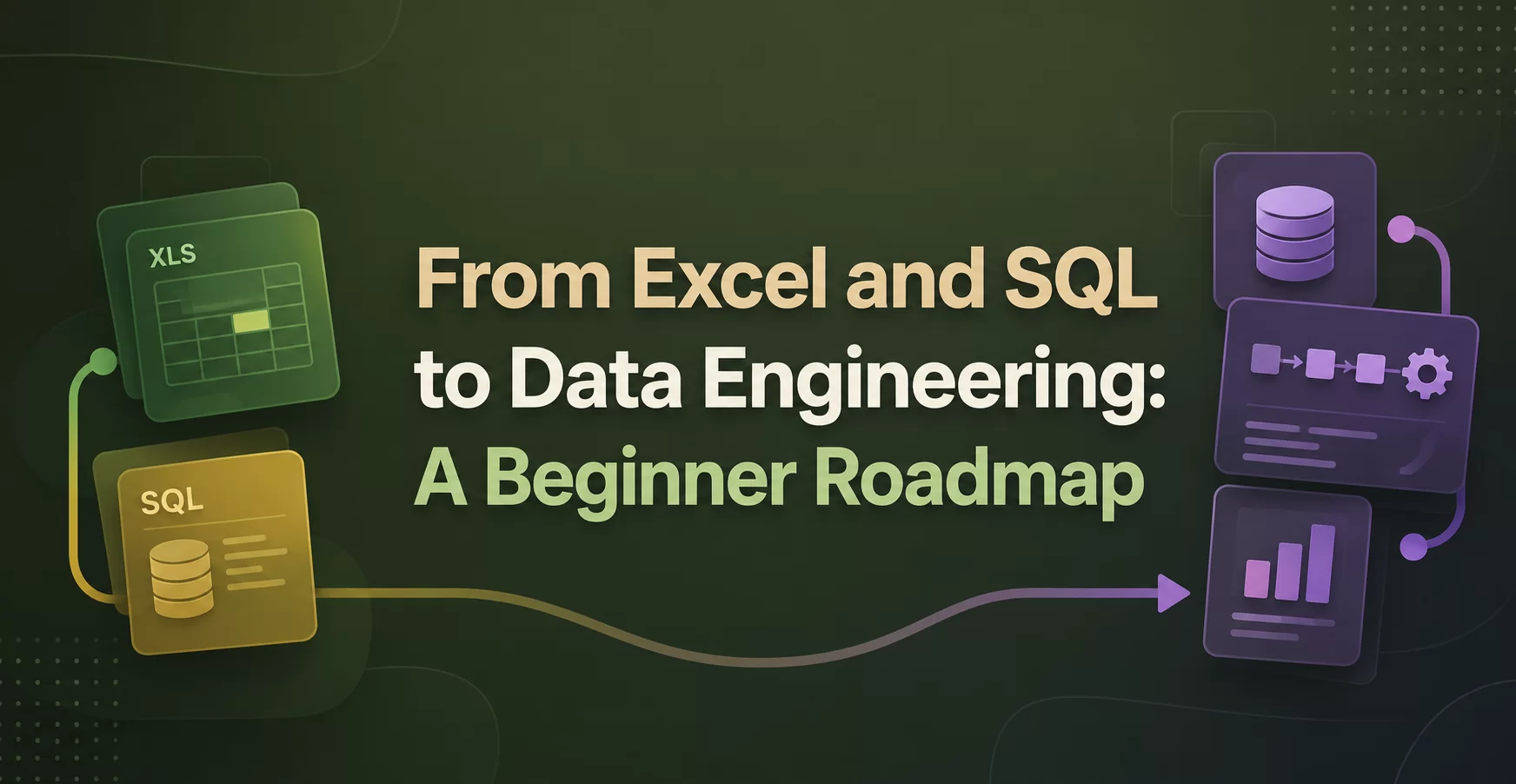
From Excel and SQL to Data Engineering: A Beginner Roadmap
Excel and SQL are strong starting points for a move into data engineering, because both teach you how businesses store, clean, and question data. To work as a data engineer, add practical Python, data modeling, cloud tools, pipelines, and software habits. You don’t need to learn every platform before you build useful projects.
The path works best when you turn familiar reporting tasks into repeatable, tested data processes.
Key Points
- Excel experience builds structured thinking and data-quality awareness.
- Strong SQL is essential for both data engineering interviews and daily work.
- Python helps automate file handling, API calls, and repeatable pipeline tasks.
- Data modeling prevents duplicate records and confusing business metrics.
- One well-documented cloud project beats a collection of unfinished tutorials.
Quick summary: Start with the skills you already use, then move recurring spreadsheet work into SQL and Python. Build small pipelines before adding cloud services or complex orchestration tools.
Key takeaway: Data engineering is the practice of moving, shaping, testing, and delivering dependable data, not only writing queries or building dashboards.
Quick promise: By following this roadmap, you can create a portfolio project that shows real data engineering judgment, not only course completion.
What the Journey From Excel and SQL to Data Engineering Looks Like
Spreadsheet work usually focuses on one report or decision. SQL analysis queries data already stored in a database. Analytics engineering turns raw warehouse data into trusted tables for reporting. Data engineering builds and maintains the systems that collect, store, transform, and deliver that data.
The progression is practical: understand business data, master relational databases, learn Python, model tables, build pipelines, use a cloud platform, and adopt production habits. You can build projects while learning each layer.
| Skill area | What you may already know | What to learn next |
| Business reporting | Excel formulas, pivots, charts | Data definitions and validation rules |
| Relational data | SQL filters and aggregates | Keys, joins, indexes, transactions |
| Automation | Manual file updates | Python scripts and APIs |
| Analytics | Reports and dashboards | Data models and warehouse tables |
| Engineering | Repeatable steps | Testing, Git, scheduling, monitoring |
Turn Excel Skills Into Data Engineering Foundations
Formulas, pivot tables, filters, and cleanup work already teach useful habits. You know how to spot missing values, reconcile totals, and ask what a stakeholder means by “active customer.”
However, spreadsheets struggle with manual updates, version conflicts, large files, and weak audit trails. Keep Excel for exploration and business communication. Move repeatable transformations into SQL and code, where teammates can review and rerun them.
Use SQL to Move From Reporting to Reliable Data Work
Learn SELECT, WHERE, JOIN, GROUP BY, CASE, subqueries, common table expressions, and window functions. Then learn why primary keys identify rows, foreign keys connect tables, NULL needs careful handling, indexes can speed reads, and transactions protect changes.
Practice in PostgreSQL. Load a sales CSV, answer revenue and customer questions, then document assumptions such as how you treat refunds. Strong SQL matters in interviews because it shows whether you can reason about real data.
Build the Core Skills You Need for Entry-Level Data Engineering
Python is the next priority after SQL. Focus on variables, functions, loops, lists, dictionaries, exceptions, modules, virtual environments, file reading, and API requests. You don’t need advanced algorithms before you can automate useful work.
Use pandas for tabular cleanup and exploration. For database transformations, SQL is often clearer and faster to review. Plain Python works well for API calls, file movement, and control flow.
A strong beginner project pulls data from a public API, cleans it, and writes it to PostgreSQL. Add a configuration file instead of placing credentials in code.
Understand Data Modeling Before Adding More Tools
A data model defines tables, relationships, and the meaning of each row. Normalization reduces duplicate facts in operational systems. Analytics teams often use fact tables for events and dimension tables for descriptive context.
Practice with customers, products, orders, and payments. Define the grain of an orders table, such as one row per order line. Then use surrogate keys and learn slowly changing dimensions for attributes that change over time. Star schemas are common in analytics warehouses because they make reporting easier.
Add Engineering Habits That Make Pipelines Trustworthy
A script that runs once isn’t a dependable pipeline. Daily jobs need Git history, readable README files, logging, retries, validation, tests, and clear failure alerts.
Use Git branches for changes, pytest for Python tests, and Docker when you need consistent local environments. Great Expectations is one option for data checks, although simple SQL assertions can also catch nulls, duplicates, and unexpected row counts.
Use this progress check:
- You can write multi-table SQL queries and explain the result.
- You can load API or file data into PostgreSQL with Python.
- You can model a small dataset with documented grain and keys.
- You can test, version, and rerun your pipeline safely.
Learn Modern Data Pipelines and Cloud Tools Without Getting Overwhelmed
Batch pipelines process data on a schedule, such as every night. Streaming pipelines process events with low delay. Start with batch work because it exposes the same core concerns: sources, storage, transformations, testing, and failures.
A realistic starter stack uses PostgreSQL or an API as a source, Python for extraction, Amazon S3 for object storage, BigQuery, Snowflake, or Amazon Redshift for warehousing, and dbt for SQL transformations.
API or PostgreSQL -> Python extract -> S3 or cloud storage -> warehouse -> dbt models -> dashboard
Airflow schedules tasks and manages dependencies. Managed options, such as Amazon Managed Workflows for Apache Airflow, reduce setup work. Learn the concepts before collecting tools.
Choose One Cloud Platform and One Warehouse First
Choose AWS, Azure, or Google Cloud based on target jobs, your employer’s stack, course access, and budget. Each teaches transferable ideas: object storage, identity and access management, compute, networking, and cost controls. Set billing alerts before testing any free tier.
A data lake stores raw files, usually in object storage. A data warehouse stores structured data for analysis. A lakehouse combines lake-style storage with warehouse-style table management.
Understand Orchestration, Transformation, and Data Quality
Orchestration manages task order. A daily pipeline might extract data, load raw tables, transform models, run tests, and alert the team if a step fails.
dbt supports SQL-based transformations, documentation, and tests inside a warehouse. Review every pipeline with three questions:
- What happens if the source schema changes?
- What happens if a task fails halfway through?
- What happens if data arrives late or twice?
Create a Portfolio That Proves You Can Work Like a Data Engineer
Build two or three end-to-end projects instead of copying many tutorials. Each project needs a business problem, source data, architecture diagram, transformations, tests, schedule, documentation, and a short explanation of tradeoffs.
Publish projects on GitHub with setup instructions, sample queries, and data-quality rules. A dashboard can show the final result, but it doesn’t prove pipeline skills by itself.
Build a Project From Excel or CSV to a Cloud Warehouse
Start with a messy Excel or CSV sales file. Use Python to validate dates, standardize categories, and reject duplicate order IDs. Load raw data into PostgreSQL or cloud storage, transform it with SQL or dbt, then publish a simple dashboard.
Show before-and-after data quality examples. Add incremental loading so the project processes new records without rebuilding everything. Explain the model and why each test exists.
Use a 90-Day Learning Plan You Can Finish
During days 1 through 30, practice advanced SQL, Python basics, Git, and PostgreSQL. During days 31 through 60, learn modeling, APIs, Docker, and batch pipelines. During days 61 through 90, use one cloud warehouse, add orchestration and tests, then polish your portfolio.
Consistent weekly practice beats passive course completion. Ship small working projects and improve them after feedback.
Prepare for Interviews and Your First Role
Practice SQL exercises, Python debugging, data models, and pipeline design. Explain tradeoffs, such as batch versus streaming or a warehouse versus a lake.
Track applications, ask for code reviews, and practice mock interviews. Search for data engineer, analytics engineer, ETL developer, and data platform associate roles. Tailor your resume with project details, tools, data volume, tests, and decisions you made.
Data Engineering Glossary and One-Minute Action Plan
- Strengthen SQL before chasing cloud certifications.
- Write one Python script that loads data into PostgreSQL.
- Model a small ecommerce dataset and document its grain.
- Add tests before adding more pipeline tools.
- Choose one cloud platform for your first warehouse project.
- Publish a working project with clear setup instructions.
ETL: Extract, transform, load. Data changes before it reaches the target system.
ELT: Extract, load, transform. Data loads first, then transforms inside a warehouse.
Data pipeline: A repeatable process that moves and prepares data.
Data warehouse: A system designed for analytical queries and reporting.
Data lake: Low-cost storage for raw files and varied data formats.
Orchestration: Scheduling tasks and managing their dependencies.
Data modeling: Designing tables, relationships, keys, and row-level meaning.
Batch processing: Processing data at planned intervals.
Streaming: Processing events as they arrive with low delay.
dbt: A tool for SQL transformations, tests, and documentation in warehouses.
API: A defined way for software systems to exchange data.
Data quality: The accuracy, completeness, consistency, and timeliness of data.
Build Your Data Engineering Path One Step at a Time
The practical sequence is simple: strengthen SQL, learn Python for automation, understand data models, build tested pipelines, then choose one cloud stack. Your first goal isn’t a flawless platform. It’s a small pipeline that runs again tomorrow.
Complete one CSV-to-PostgreSQL pipeline this week and publish the result with a README. Data Engineer Academy offers guided projects, mentorship, resume reviews, and mock interviews when you’re ready for structured practice.
Beginner Data Engineering FAQ
Is Excel experience useful for data engineering?
Yes. Excel teaches data cleanup, validation, business reporting, and how stakeholders use metrics. Those skills transfer directly to pipeline requirements and quality checks. Data engineers still work with spreadsheet exports and business teams, although repeatable logic should move into SQL and code.
How much SQL do I need for data engineering?
You need confident SQL, not only basic filters. Learn joins, aggregations, common table expressions, window functions, CASE, null handling, keys, and query performance basics. You should also explain why a query produces duplicate rows and how you would fix it.
Do data engineers need Python?
Yes, practical Python is widely useful. It helps you call APIs, process files, automate database loads, write tests, and connect pipeline steps. Start with scripts and functions. You don’t need advanced computer science topics before building a useful batch pipeline.
Do I need a computer science degree to become a data engineer?
No. A degree can help, but projects and technical evidence matter more for many entry-level paths. Show SQL skill, Python code, a clear data model, tests, and documentation. Career switchers should also connect prior business knowledge to their project decisions.
How long does it take to transition into data engineering?
Most beginners need several months of steady practice, but the timeline depends on SQL experience, programming background, and weekly study time. Focus on completed projects rather than calendar promises. A working portfolio gives you better evidence of progress than course certificates alone.
Which cloud platform should beginners choose?
Choose the platform that appears in your target job listings or current workplace. AWS, Azure, and Google Cloud share core ideas, including storage, IAM, compute, and networking. Start with one platform, set billing alerts, and learn its warehouse services before studying another.
Are cloud certifications enough to get a data engineering job?
No. Certifications can show familiarity with a platform, but they don’t show whether you can debug a failing pipeline or model messy data. Pair any certification with GitHub projects, SQL practice, Python tests, and clear explanations of your technical choices.
Is data engineering still worth learning in 2026?
Yes, because organizations still need reliable systems to collect, govern, transform, and deliver data. AI tools can speed coding, yet teams still need people who understand schemas, quality failures, costs, access controls, and business definitions. Build durable fundamentals instead of chasing every new tool.