
Hybrid Search for RAG: Vector, Keyword, and Reranking Pipelines
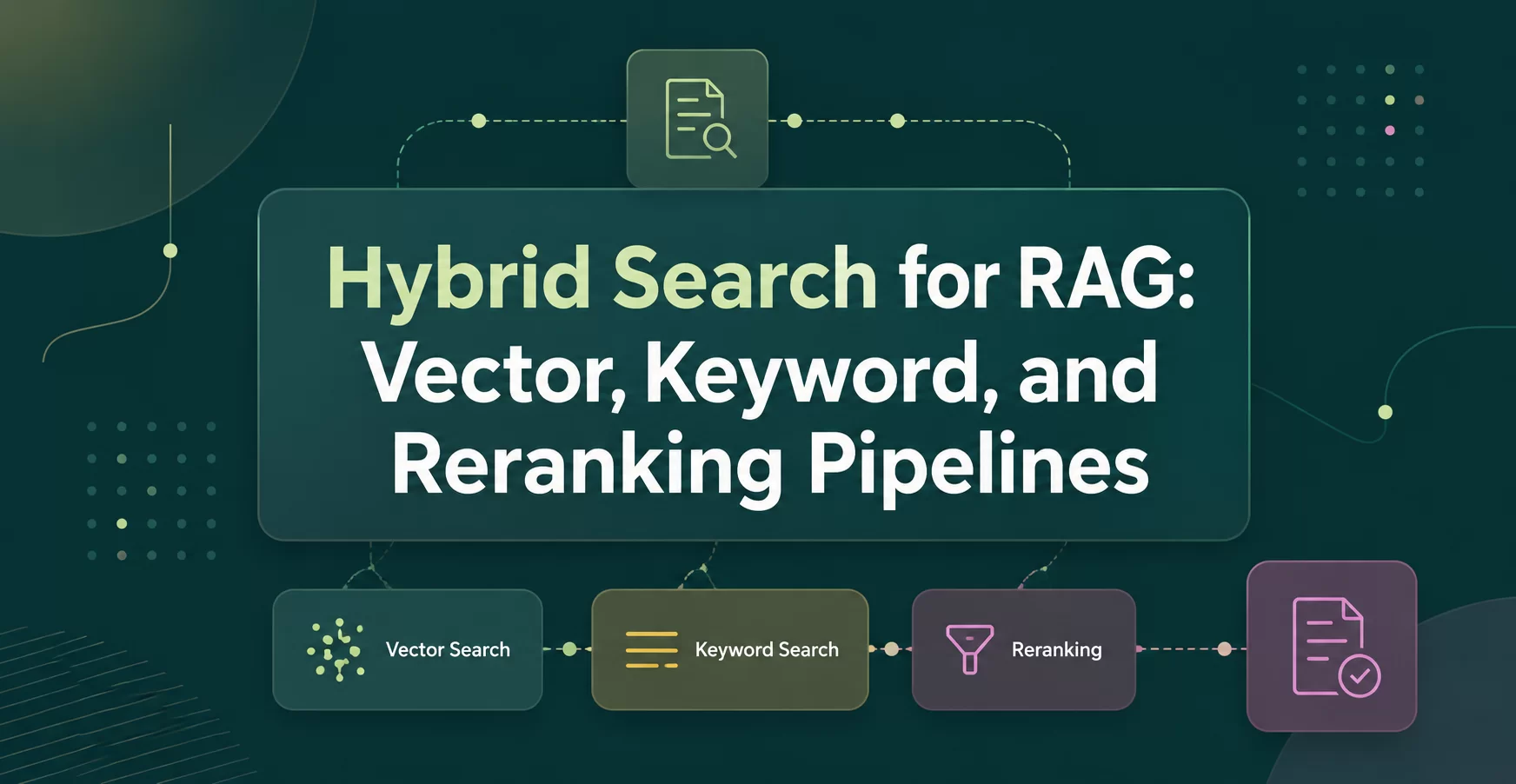
Hybrid search for RAG combines vector search, keyword search, and reranking so the system finds both semantic matches and exact terms. That mix improves retrieval quality, reduces missed evidence, and gives the LLM stronger grounding. No single method is enough for every query, because fuzzy questions, product codes, acronyms, and policy names behave differently.
When retrieval is weak, the model may answer from the wrong context and still sound sure. A hybrid pipeline widens recall first, then sharpens precision before generation.
Key Points
- Vector search is good at meaning, paraphrases, and loose wording.
- Keyword search is good at exact terms, IDs, and technical tokens.
- Fusion combines both result sets into a better shortlist.
- Reranking sorts that shortlist so the best evidence appears first.
Quick summary: Hybrid retrieval works because it covers two kinds of search intent at once, meaning and exact match, then uses reranking to clean up the final context.
Key takeaway: If your RAG system misses answers that are clearly in the source data, weak retrieval is usually the first place to look.
Quick promise: With a simple hybrid pipeline, you can cut noisy context, recover missed documents, and improve grounded answers without changing your LLM.
Why RAG search needs more than one retrieval method
RAG fails when retrieval fails. The model can only answer from what it sees, so a bad shortlist leads to weak answers, missing details, or grounded hallucinations.
Vector and keyword retrieval solve different problems. One catches meaning even when wording shifts. The other catches exact strings that matter a lot in technical data. If you rely on only one, you leave blind spots.
Where vector search works well, and where it falls short
Vector search maps text into embeddings and looks for semantic similarity. In plain terms, it can match “how do I reset my password” with a document titled “account recovery steps.” That helps when users paraphrase, use incomplete wording, or describe an idea without the exact phrase.
It also handles related concepts well. A search for “billing issues after upgrade” may retrieve content about plan migration or payment retries, even if those words do not overlap much.
Still, vector search can struggle with exact strings. Error codes like ERR_AUTH_Z17, names like ACME-42, acronyms like SAML, and rare policy phrases may not rank well. Those terms often matter most in support, logs, compliance, and internal docs.
Why keyword search still matters in modern RAG
Keyword retrieval, often powered by BM25 or similar methods, still earns its place because exact terms carry meaning. If a user types a product name, ticket ID, or log message, exact-match ranking can rescue a query that embeddings miss.
This matters in policy search, API docs, incident notes, and support tickets. Queries such as “SOC 2 retention policy,” “429 retry-after,” or “invoice batch job” depend on precise words. Keyword search also supports filters well, which helps when you need to limit results by team, product, date, or document type.
A good RAG system treats keyword retrieval as a practical tool, not an old one.
How a hybrid retrieval pipeline is usually built
Most hybrid pipelines follow the same shape. The query goes into two retrievers in parallel, one vector-based and one keyword-based. Each retriever generates candidates, then the system merges those candidates and sends the shortlist to a reranker.
That first step is about recall. You want enough good options in the pool. The second step is about precision. You want the strongest passages at the top before the LLM sees them.
Combining results from vector and keyword retrieval
The simplest merge strategy takes the top N results from each retriever and deduplicates them. That already works better than many single-method setups.
More mature systems use score fusion. Some normalize scores from both retrievers and combine them. Others use reciprocal rank fusion, which rewards documents that rank well in either list without trusting raw scores too much. That method is popular because vector scores and keyword scores do not live on the same scale.
The goal is not to keep everything. The goal is to build a tight shortlist with high odds of containing the right evidence.
Why reranking improves answer quality
Reranking is the final sort. A reranker looks at the query and each candidate passage together, then scores how relevant that passage is.
This step helps when the first retrieval pass returns many decent matches that are close to each other. A reranker can spot which passage truly answers the query, which one only shares terms, and which one is near the topic but not useful.
In reranking for RAG, precision matters because the LLM reads top results first. Better ordering means less noisy context, stronger grounding, and fewer chances for the model to drift.
Choosing the right mix of vector, keyword, and reranking
The best pipeline depends on your data, your users, and your budget. A public FAQ bot has different needs than an internal assistant for logs, runbooks, and policy files.
Latency matters too. If your app must answer in under a second, you may need a lighter setup. If a wrong answer could mislead a customer or an analyst, higher precision is worth more compute.
This quick framework helps match retrieval design to the job:
| Use case | Good starting mix | Why it fits |
| FAQ search | Vector search | Wording varies, and content is small |
| Technical docs | Vector + keyword | Queries mix concepts with exact tokens |
| Support tickets | Vector + keyword + reranking | Noise is high, and phrasing shifts a lot |
| Internal knowledge base | Hybrid, then test reranking | Content is mixed, so recall usually needs help |
For most teams, the safest path is to start small, measure, then add one layer at a time.
When a lighter pipeline is enough
A lighter pipeline works when the corpus is small, the stakes are low, or the query patterns are simple. Many internal FAQs do fine with vector search alone. If exact terms show up often, adding keyword retrieval may be enough.
This is also a good starting point when latency is tight. You can skip reranking at first, inspect failures, and add it only when the quality gap is clear.
When to add reranking from the start
Add reranking early when precision matters more than speed. That includes customer support assistants, legal or policy lookup, technical troubleshooting, and dense knowledge bases with many similar passages.
It also helps with noisy corpora. Ticket threads, duplicated docs, copied runbooks, and long wiki pages often produce messy first-pass results. In those cases, the cost of a bad answer is higher than the cost of an extra model call.
A practical stack for building hybrid search in RAG
You do not need a huge platform to build this pattern. The same design works in PostgreSQL, classic search engines, vector databases, or managed services.
A common setup uses PostgreSQL with pgvector hybrid search when you want one store for metadata, embeddings, and app data. Another uses Elasticsearch or OpenSearch for keyword retrieval and a vector index beside it. Some teams keep both retrieval paths in one system, while others split the jobs across services.
Common tools and where they fit in the pipeline
PostgreSQL with pgvector can store embeddings and structured metadata. Elasticsearch and OpenSearch are strong choices for keyword retrieval, filtering, and ranking over large text collections. Dedicated vector databases can handle embedding search at scale. For reranking, cross-encoder models are a common fit because they score query-passage pairs directly.
The best tool choice depends on where your data already lives. One-store designs are easier to operate. Split-service designs can offer more flexibility when search is core to the product.
What to watch for in latency, cost, and evaluation
Every extra retrieval step adds time and cost. Larger candidate sets improve recall, but they also increase merge time and reranker load. That tradeoff matters in production.
Measure the pipeline instead of guessing. Track retrieval metrics such as recall@k or MRR on labeled queries. Then review answer quality on real prompts, because a retriever that looks good in isolation can still feed poor context to the LLM.
Practical rule: If the right passage is not making it into the candidate pool, fix retrieval first. If it is present but ranked too low, fix reranking.
Conclusion
Hybrid search works for RAG because it balances meaning, exact match, and final relevance. Vector search broadens recall, keyword search protects exact terms, and reranking makes the shortlist useful.
A solid next step is to test the lightest pipeline that fits your data, then measure failures on real queries. If you want hands-on practice, a good next read is a build focused on pgvector hybrid search in PostgreSQL, and guided GenAI/LLM projects can help turn the pattern into something production-ready.
FAQ
Is vector search alone enough for RAG?
Vector search alone is enough for some cases, especially small FAQ-style corpora with loose natural-language queries. It usually falls short when users search for IDs, acronyms, product names, error codes, or policy terms. If those exact strings matter, add keyword retrieval.
What is reranking in a RAG pipeline?
Reranking is a second-pass ranking step that scores a small shortlist more carefully. It checks the query against each candidate passage and sorts the best evidence to the top. That improves precision and reduces noisy context before the LLM generates an answer.
Does hybrid search make RAG too slow?
Hybrid search adds latency, but it does not have to make the system slow. Running vector and keyword retrieval in parallel keeps overhead manageable. Many teams start without reranking, then add it only when the gain in answer quality justifies the extra time.
Can I build hybrid search with pgvector?
Yes, you can build a practical hybrid setup with pgvector, especially when you want PostgreSQL to hold embeddings, metadata, and app data together. Some teams pair pgvector with PostgreSQL full-text search. Others combine PostgreSQL with a separate search engine for heavier keyword workloads.
What should I measure in a hybrid retrieval system?
Measure whether the right documents appear in the candidate set and whether they rank high enough to help the LLM. Useful retrieval metrics include recall@k and MRR. Then test real prompts for grounded answer quality, because search quality and answer quality are not always the same.