
Soft Skills for Data Engineer: 10 Skills That Matter Most
Introduction
Most content about becoming a data engineer focuses on the technical stack: SQL, Python, dbt, Airflow, Spark, cloud platforms. That is appropriate. The technical foundation matters.
But there is a reason experienced data engineers and hiring managers consistently say the same thing: the candidates who struggle in their first year are not usually struggling because of their SQL. They are struggling because they cannot communicate what they built, cannot push back on a bad requirement, cannot prioritize when three stakeholders all want something urgent, and cannot write documentation that another human being can follow.
The soft skills of a data engineer are not soft in the sense of optional. They are the skills that determine whether your technical work actually creates value for the business or sits in a repository that nobody understands, maintains, or trusts.
This guide covers the soft skills that matter most for aspiring and early-career data engineers, why each one is harder than it sounds, and how to develop them before you are sitting across from a hiring manager who is trying to figure out if you will be easy to work with.
Why Soft Skills Matter More in Data Engineering Than Most Technical Roles
Data engineering sits at the intersection of multiple teams. On any given day, a data engineer might be:
- Clarifying requirements with a product manager who does not know what a fact table is
- Explaining a pipeline failure to a data analyst whose dashboard is broken
- Reviewing a pull request from a junior engineer on the team
- Pushing back on a data science team that wants raw data delivered in an inconvenient format
- Documenting a pipeline that will be maintained by someone who has never seen the codebase
Every one of those situations requires a skill that no SQL course covers.
Data engineers who are only technically strong tend to build systems that work but that nobody else can understand, maintain, or trust. The soft skills are what make technical work durable and collaborative.
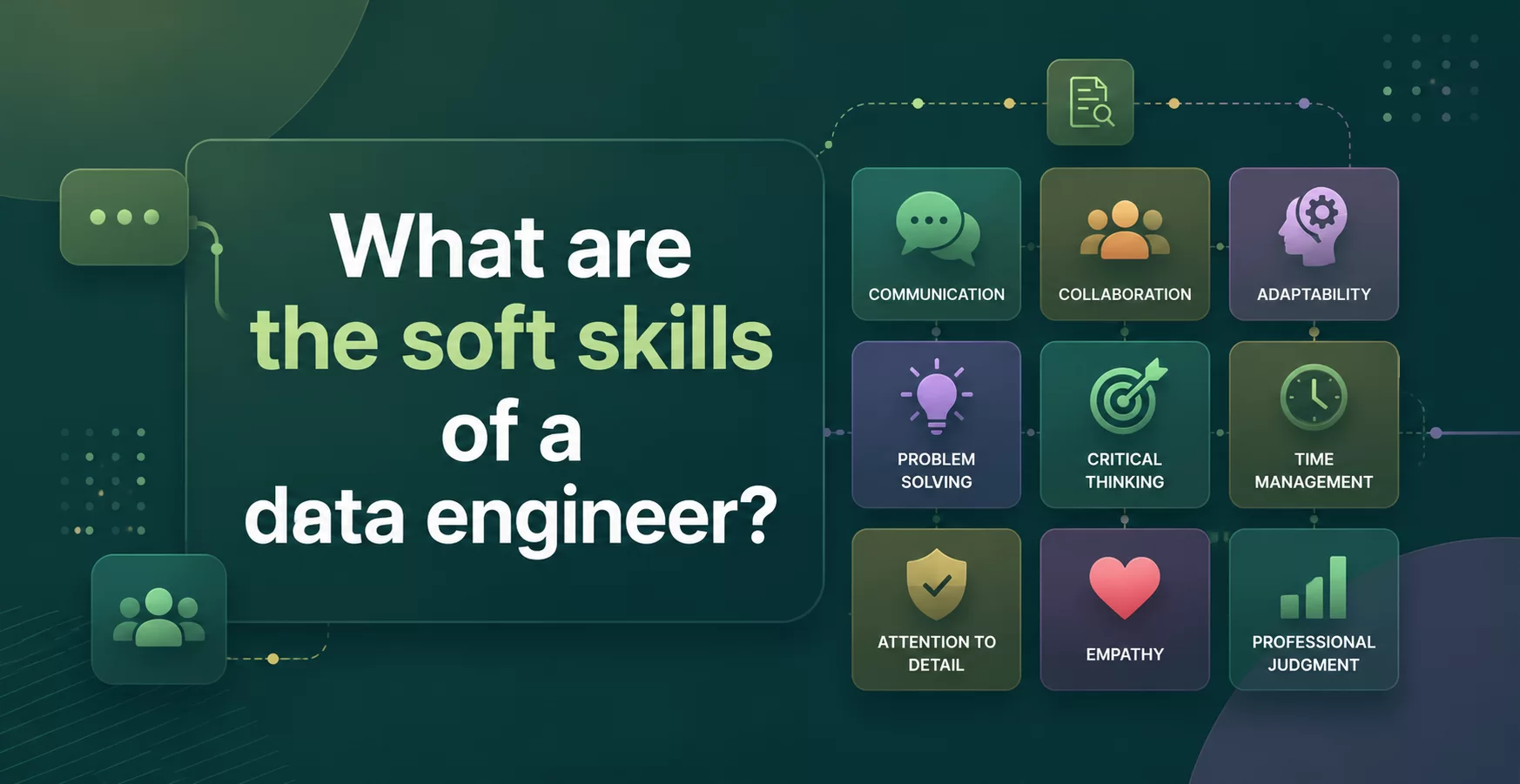
The Soft Skills for Data Engineer
1. Clear Written Communication
Data engineering produces a lot of artifacts that other people have to use: documentation, READMEs, pull request descriptions, Slack messages explaining what a pipeline does, data dictionaries, incident postmortems.
If you cannot write clearly, your technical work creates confusion instead of clarity.
What this looks like in practice:
- Writing a README that explains what a pipeline does, why it exists, how to run it, and what to do when it breaks
- Documenting a dbt model so that an analyst who did not build it can understand the grain, the logic, and the known limitations
- Writing a pull request description that explains what changed, why it changed, and what the reviewer should focus on
- Explaining a data quality issue to a non-technical stakeholder without using jargon that obscures the actual problem
Why aspiring data engineers underestimate this:
Most early-career data projects are solo work. Nobody else reads your documentation because you are the only person working on it. The habit of writing for other people clearly, completely, without assuming shared context does not develop automatically. It has to be practiced.
How to develop it:
Write documentation for every portfolio project as if you are handing it to a colleague who has never seen the codebase. Then show it to someone who has not worked on the project and ask them if they can follow it. If they cannot, the documentation is not good enough yet.
2. Asking the Right Questions Before Building
One of the most expensive mistakes a data engineer can make is building the wrong thing correctly.
Data engineering work is often initiated by a request that sounds clear but contains hidden assumptions. “We need a daily pipeline for user engagement data” contains at least a dozen unanswered questions: Which users? What counts as engagement? What is the grain? How far back should the history go? Who consumes this data and in what format? What is the latency requirement? What happens if the source data is late?
Engineers who build without asking these questions ship pipelines that technically function but do not serve the actual business need.
What this looks like in practice:
- Before starting work, writing out a list of clarifying questions and sending them to the requester
- Identifying assumptions in a requirement and making them explicit before any code is written
- Asking “what decision will this data support?” before designing a schema
- Pushing back gently when a requirement is technically possible but architecturally problematic
Why this is harder than it sounds:
There is social pressure to just start building. Asking too many questions can feel like slowing things down or appearing uncertain. The skill is knowing which questions are necessary before starting and which can be answered by building a prototype.
How to develop it:
When you receive any data request in a job, in a practice project, or in a learning exercise write out five clarifying questions before you write a single line of code. Then decide which ones must be answered before you start and which ones you can answer yourself by making a documented assumption.
3. Translating Technical Concepts for Non-Technical Audiences
Data engineers regularly have to explain technical concepts to people who do not share their vocabulary. A stakeholder asking why their dashboard has not updated does not need a lecture on Airflow DAG dependencies. They need a clear, jargon-free explanation of what broke, when it will be fixed, and whether the data they currently have is reliable.
What this looks like in practice:
- Explaining a pipeline failure in plain language: “The process that pulls data from Salesforce ran into an error this morning and stopped before finishing. We are re-running it now and data should be current by 10 a.m.”
- Explaining data modeling decisions without expecting the audience to know what a grain or surrogate key is
- Describing a data quality issue in terms of business impact, not technical mechanics
- Presenting a proposed architecture to a non-technical manager in a way that surfaces the tradeoffs they actually care about: cost, reliability, maintenance burden
Why this matters for career transitioners:
If you are coming from an analytics or BI background, you are probably already used to translating data into business language. That skill transfers. The new challenge is translating system behavior, pipeline failures, schema changes, latency issues into terms stakeholders can act on.
4. Stakeholder Management
Data engineers serve multiple stakeholders. They often balance competing priorities. Analysts want data faster. Data scientists want raw access. Product managers want new sources ingested. Business leaders want dashboards that never break. Security and compliance teams want access tightly controlled.
Managing these relationships, setting expectations, communicating progress, saying no gracefully when a request is not feasible is a significant part of the job.
What this looks like in practice:
- Setting realistic timelines and communicating proactively when something will take longer than expected
- Explaining technical constraints in business terms: “Ingesting that source in real time would require infrastructure changes that would take four weeks and cost significantly more to run. A daily batch pipeline can be ready in one week. Can we start there?”
- Declining a request clearly and offering an alternative rather than just saying no
- Following up when a stakeholder’s need has been addressed
The beginner mistake:
Over-promising. Early-career engineers often say yes to requests they do not fully understand, then deliver late or deliver the wrong thing. The better pattern is to ask clarifying questions, give a realistic estimate with explicit assumptions, and communicate early when something changes.
5. Documentation as a Professional Standard
Documentation deserves its own entry, separate from written communication, because the attitude toward documentation is what separates engineers who are easy to work with from engineers who create dependencies.
An undocumented pipeline is a liability. When the engineer who built it leaves or moves to another team, the pipeline becomes a black box. Nobody knows what it does, why it does it that way, or what to do when it breaks.
What good documentation looks like for a data engineer:
- Pipeline documentation: What does this pipeline do? What are the inputs and outputs? What are the known edge cases? What do you do when it fails?
- Data model documentation: What is the grain of this table? What does each field mean? What transformations were applied? What are the known limitations?
- Architecture documentation: Why was this approach chosen? What alternatives were considered and rejected? What would need to change if the data volume doubled?
- Runbook documentation: Step-by-step instructions for common operational tasks, how to trigger a backfill, how to add a new source, how to rotate credentials
Why aspiring data engineers avoid it:
Documentation feels like overhead when you are trying to build. It is also invisible that you do not get credit for documentation the way you get credit for shipping a new pipeline. But documentation is what allows your work to survive contact with the rest of the organization.
How to build the habit:
Treat documentation as part of the definition of done. A pipeline is not complete when it runs. It is complete when it runs and is documented well enough that someone else could maintain it.
6. Curiosity and Independent Problem-Solving
Data pipelines break in unexpected ways. Data sources change schemas without warning. Queries that ran in two seconds last week now run in forty. A dashboard that was correct yesterday shows numbers that do not match another dashboard.
Engineers who wait for someone to hand them a solution do not last long in data roles. The job requires genuine curiosity the habit of asking “why is this happening?” and following that thread until you find out.
What this looks like in practice:
- When a pipeline fails, reading the error logs carefully before asking for help
- When data looks wrong, tracing it upstream table by table until you find where it went wrong
- When performance degrades, checking execution plans, partition sizes, and query patterns rather than just re-running and hoping
- When a stakeholder reports a discrepancy, treating it as a real investigation rather than assuming it is a reporting error
Why this matters for career transitioners:
If you are coming from analytics, you are already used to investigative thinking, following a number until you understand where it came from. That mindset transfers directly into data engineering debugging. The difference is that instead of tracing a metric through a dashboard, you are tracing data through a pipeline.
7. Giving and Receiving Feedback
Data engineering is increasingly a team sport. Pull requests are reviewed. Architecture decisions are discussed. Pipeline designs are critiqued. If you cannot give useful feedback or receive critical feedback without becoming defensive, you will be difficult to work with and your code will reflect it.
What good feedback looks like in a data engineering context:
- Reviewing a pull request and explaining why a change would be better, not just marking it as wrong
- Pointing out a potential data quality issue in someone else’s model without making it personal
- Receiving feedback on your data model and asking questions to understand the concern before defending your approach
- Disagreeing with a technical decision respectfully and with a clear alternative
The specific challenge for career transitioners:
Many career transitioners come from environments where they worked alone solo analyst, one-person BI team, individual contributor. Collaborative code review is a new experience. The habit of treating feedback as information rather than criticism takes deliberate practice.
How to develop it:
Seek out code review even when it is not required. Share your portfolio project work in data engineering communities and ask for technical feedback. Practice the discipline of reading feedback before responding to it.
8. Prioritization Under Pressure
Data engineers are almost always working on more than one thing. There is the pipeline that needs to be built, the incident that needs to be resolved, the technical debt that needs to be addressed, and the three stakeholder requests that all came in this week.
The ability to triage, communicate priorities clearly, and protect focus time is a practical skill that affects the quality of your technical output.
What this looks like in practice:
- When three requests come in at once, communicating to each requester when you expect to get to their item, not just silently triaging
- Recognizing when an incident is severe enough to drop everything versus when it can be addressed in the normal queue
- Pushing back when scope creep threatens to expand a defined project without a corresponding conversation about timeline
- Protecting time for unglamorous but necessary work: documentation, testing, technical debt reduction
Why this is harder than it looks:
Every stakeholder believes their request is urgent. Prioritization requires judgment about business impact that develops with experience but aspiring engineers can start building it now by being explicit about tradeoffs rather than just absorbing all requests silently.
9. Ownership Mentality
The difference between an engineer who is pleasant to manage and one who is genuinely valuable often comes down to ownership. An engineer with an ownership mentality does not just complete tickets. They notice when something is wrong and fix it. Instead of moving on immediately, they follow up to ensure the issue was truly resolved. Most importantly, they care whether the pipeline is producing correct data, not just whether it runs without errors.
What this looks like in practice:
- Noticing that a data quality check failed and investigating it, even when it was not explicitly in your assigned work
- Following up with a stakeholder after delivering a pipeline to make sure it is meeting their actual need
- Taking responsibility when a pipeline you built causes a downstream problem, even if the immediate cause was an upstream schema change you could not have anticipated
- Adding monitoring and alerting to your pipelines so that you are the first to know when something breaks, not the last
What this is not:
Ownership is not martyrdom. It is not working 80-hour weeks or being the single point of failure for a system. It is caring about the outcome, not just the output.
10. Knowing When to Ask for Help
This soft skill is listed last, but it is one of the most practical for early-career engineers: knowing the difference between a problem that requires more time and a problem that requires another person’s knowledge.
Spending three hours stuck on something that an experienced colleague could have clarified in five minutes is not a sign of independence. It is a sign of poor judgment about how to use time.
What good help-seeking looks like:
- Spending a reasonable amount of time (30–60 minutes) genuinely attempting to solve a problem before asking
- When asking, providing context: what you were trying to do, what you tried, what the error or unexpected behavior was, and what you think might be causing it
- Not asking the same question twice without noting what you learned from the first answer
Why this matters for career transitioners:
Career transitioners sometimes feel pressure to prove themselves by working independently. That instinct is understandable but counterproductive when it means staying stuck rather than moving forward. The goal is to learn fast, and learning fast often requires asking good questions of people who know more.
How Soft Skills Show Up in the Hiring Process
Most data engineering interviews test technical skills directly, SQL problems, Python exercises, system design questions. Soft skills are evaluated more indirectly, but they are evaluated.
Behavioral questions (“Tell me about a time you had to explain a technical problem to a non-technical stakeholder”) are explicitly testing communication, stakeholder management, and ownership.
Take-home projects are often evaluated not just on whether the code works but on how it is documented, structured, and explained in the accompanying writeup.
Portfolio repositories signal documentation habits, code organization standards, and professional engineering judgment, all before a conversation happens.
The debrief conversation at the end of a technical interview “Do you have any questions for us?” is an opportunity to demonstrate curiosity, preparation, and strategic thinking about the role.
Reference to the candidate’s past work often focuses on how they collaborated, communicated, and handled ambiguity, not just what they built.
The Misconception Worth Addressing
“Soft skills are nice to have. Technical skills are what get you hired.”
This is partially true and mostly misleading.
Technical skills are the threshold. If you cannot write a SQL transformation, design a basic pipeline, or explain what a DAG is, no amount of communication skill will get you into a data engineering role.
But past that threshold, soft skills are often the deciding factor between candidates who are technically similar. And once you are in a role, soft skills are what determine whether your technical work creates lasting value or accumulates as unmaintained, misunderstood infrastructure.
The data engineers who advance fastest are not always the strongest coders. They are the ones who build systems other people can trust, communicate in ways that build confidence, and make the people around them better at their jobs.
Frequently Asked Questions
Do data engineers need soft skills if they work mostly independently?
Yes, possibly more so. Engineers who work independently are often the only person who understands a system. That makes documentation, clear communication about what they built, and proactive alerting even more important. When something breaks in a system that only one person understands and that person has not documented it, the organization has a serious problem.
What is the most important soft skill for an aspiring data engineer?
Clear written communication. Almost every other soft skill is downstream of it, stakeholder management, documentation, feedback, and even curiosity depend on the ability to express ideas clearly and completely in writing.
How do I demonstrate soft skills in a portfolio project?
Through documentation. A portfolio project with a clear README, an architecture diagram, documented assumptions, and a written explanation of tradeoffs demonstrates exactly the soft skills hiring teams look for. The code is the technical signal. The documentation is the professional signal.
Can soft skills be learned, or are they personality-based?
They can be learned. Written communication improves with deliberate practice. Asking the right questions is a learnable habit. Documentation standards can be built incrementally. None of these are fixed personality traits. They are professional disciplines that develop with intention and feedback.
Do data engineering interviews actually test soft skills?
Yes, though not always explicitly. Behavioral interview questions, the quality of a take-home project writeup, how a candidate responds to technical feedback during a live coding exercise, and how they explain their portfolio work, all of these evaluate soft skills in practice.
Final Thoughts
The technical skills of a data engineer are well documented, but the soft skills for data engineer success are often what separate average engineers from exceptional ones. There are roadmaps, courses, certifications, and bootcamps. The soft skills receive less attention because they are harder to teach in a structured curriculum and harder to evaluate in a portfolio.
But they are not optional. They are the difference between an engineer who ships pipelines and an engineer who builds systems that the organization can actually use, trust, and maintain over time.
If you are preparing to transition into data engineering, do not wait until you are in a role to develop these habits. Document your portfolio projects as if other engineers will maintain them. Practice explaining your technical decisions in plain language. Seek feedback on your work before it is perfect. Learn to ask good questions before you start building.
The technical skills get you to the interview. The combination of technical and soft skills gets you the role and builds the career.
P.S. If you are transitioning into data engineering and want a concrete next step: take your most recent portfolio project and write documentation for it as if you are handing it to a colleague you have never met. If that colleague could not run, maintain, and understand the pipeline from your documentation alone, you have identified your next area of growth.