
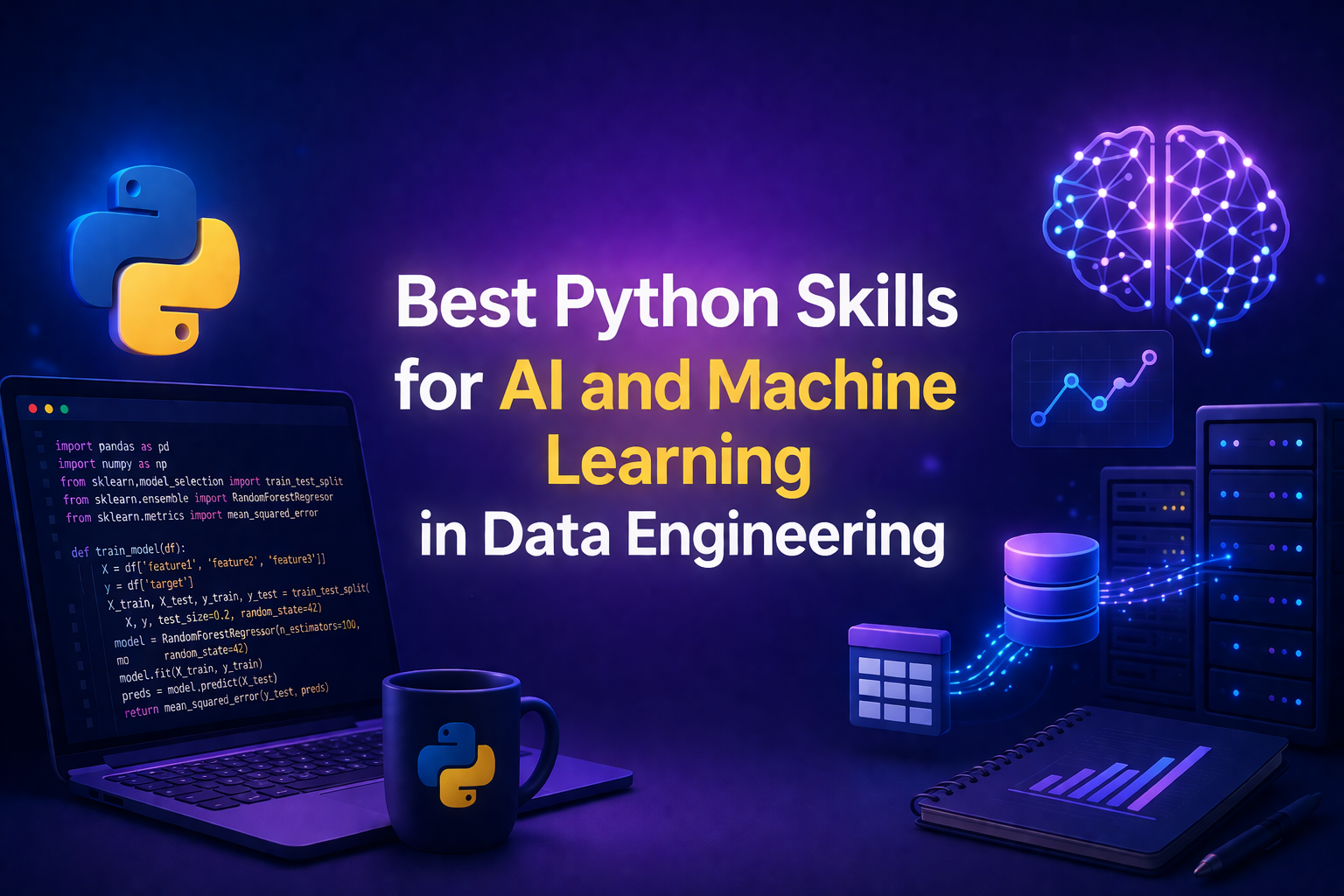
Best Python Skills for AI and Machine Learning
The most valuable Python skills for AI and machine learning are data handling, SQL with Python, clean coding, workflow automation, API work, testing, and production-ready ML pipeline support. Data engineers don’t spend most of their time tuning models, they build the systems that collect, clean, move, and prepare data so models can work.
That matters because raw data is messy, late, and often broken. The job-ready path is practical, not academic, so the focus here is on the Python skills you’ll use in real pipelines, real teams, and real hiring interviews.
Try first:
Quick summary: The best Python skills for AI data engineering help you turn raw data into trusted, model-ready data, then move it through repeatable workflows. The strongest candidates pair Python with SQL, testing, and automation.
Key takeaway: Learn Python for data movement and reliability first. Model support comes after that.
Quick promise: By the end, you’ll know which Python skills to learn first, which ones can wait, and how to prove them with projects that look like real work.
Start with the Python skills that make data usable for AI
The first Python skills to learn are the ones that turn raw data into clean, structured, model-ready data. This is the base of AI and machine learning in data engineering because bad input creates bad output.
Work comfortably with Pandas, NumPy, and file formats you will see every day
Pandas is where many AI data pipelines begin. You need to read files, clean columns, filter rows, join tables, group data, and reshape it without getting lost. NumPy matters too, especially when you work with arrays, numeric operations, and data that later feeds ML tools.
In daily work, you’ll often touch CSV, JSON, and Parquet. CSV is easy to inspect, JSON shows up in APIs, and Parquet is common in analytics and larger data systems. Each format behaves a little differently, so you need to know how to load and save them safely.
What trips beginners up is rarely syntax. It’s column types, missing values, bad timestamps, duplicate rows, and memory use. A script that works on 5,000 rows can fail on 5 million. Therefore, strong Python data handling means writing code that stays clear when the data gets ugly.
Use Python with SQL to move between databases and data pipelines
Strong data engineers use Python and SQL together, not one instead of the other. SQL pulls and shapes data in the database, while Python handles pipeline logic, validation, file movement, and custom transforms.
In practice, you’ll query a database, load the results into Python, clean or enrich them, then write them back to a table, file, or warehouse. That pattern shows up in ETL, ELT, analytics engineering, and ML data prep.
You should get comfortable with database connectors, parameterized queries, and basic read-write flows. Also learn when not to move huge datasets into Python. If SQL can handle a filter or aggregation first, let it. Good engineers reduce waste before code gets fancy.
Start Free Trial, Python + SQL for Data Engineering
Learn to write Python code that stays clean when pipelines get bigger
Good Python for AI data engineering is not about making code run once. It’s about making it readable, reusable, and easy to fix when a job breaks at 2 a.m.
Build reusable scripts with functions, classes, and clear project structure
Functions are enough for many pipeline tasks. If you need to load data, clean columns, and save output, small functions often beat large scripts. Classes help when you manage shared settings, repeated behaviors, or several related steps across a project.
Clean structure matters more than clever tricks. Split work into modules. Keep config outside the main script. Use clear names. Set up a virtual environment so dependencies don’t collide. Even a simple package layout can make your project easier to test and deploy.
Hiring managers notice this fast. A tidy project says you can work on team code, not only personal notebooks.
Catch problems early with logging, testing, and error handling
AI and ML pipelines break when data changes, APIs fail, or schemas drift. If your code only works on perfect input, it won’t last in production.
Start simple. Use try/except where failures are expected, but don’t hide errors. Add logging so you know what ran, what failed, and where. Write small tests for the most fragile parts, such as column checks, row counts, null handling, and output shape.
A pipeline that finishes is not always a pipeline you can trust. Silent bad data is worse than a loud failure.
These habits improve debugging speed and build trust in your output. That trust matters because ML teams, analysts, and business users often depend on your data without seeing the pipeline behind it.
Master the Python tools that connect data engineering to machine learning systems
The most important bridge skills are workflow automation, API work, and ML pipeline basics. Data engineers support models by feeding them trusted, timely data and helping move data flows into production.
Automate recurring work with schedulers, workflows, and Python scripts
A one-off script is helpful. A repeatable job is where real value starts.
You should understand how scheduled runs, dependencies, retries, and backfills work. Python often powers the task logic inside workflow tools like Airflow and similar orchestrators. Even if you don’t manage the platform, you should know how jobs connect and how failure in one step affects the next step.
Batch pipelines still matter a lot in AI work. For example, a nightly feature build or daily prediction input job can support a model without real-time complexity. Therefore, strong automation skills make you more useful fast.
Use APIs and cloud services to collect, send, and serve data
APIs are a common door into outside data. Python helps you pull product records, event data, usage logs, and feature inputs from other systems.
You don’t need deep backend skills to be effective here. Start with REST basics, authentication, request handling, JSON payloads, and error responses. Then learn how to land that data in cloud storage, a database, or a warehouse.
This is where many AI projects either move or stall. If you can fetch outside data reliably and store it cleanly, you become the person who connects systems instead of waiting on them.
Understand ML pipeline basics without needing to become a data scientist
You don’t need to become a model researcher to work well with ML teams. You do need to understand what clean model input looks like and how batch inference flows work.
That means knowing how features are prepared, how row-level consistency matters, and why training and serving data should match. It also helps to understand scikit-learn style workflows, mainly so you can hand off datasets in the right shape and support repeatable runs.
Think of it like building the road, not driving the race car. If the road is stable, the model team moves faster.
Focus on the Python skills that make you more hireable in AI data engineering roles
The best skill mix is practical, project-based, and tied to business problems. Employers want proof that you can build reliable data flows, not only talk about tools.
Which Python skills should beginners learn first, and what can wait
A simple learning path works better than trying to learn every tool at once:
- First: Core Python, Pandas, basic NumPy, file handling, and SQL integration.
- Next: Reusable scripting, config management, logging, and simple tests.
- Then: APIs, workflow orchestration concepts, and cloud data basics.
- After that: ML pipeline support, feature prep, and batch inference flows.
This order works because each layer supports the next one. Skip the base, and later tools feel like memorized commands instead of useful skills.
Show your skills with portfolio projects that look like real data engineering work
A strong portfolio looks like work a company might pay for. Build one or two projects that solve a clear data problem end to end.
Good project ideas include:
- A small ETL pipeline that pulls API data, cleans it in Python, and loads it into a database
- A messy dataset cleanup flow for model-ready features
- A scheduled reporting or batch processing job with logs and validation checks
- A Python plus SQL workflow that writes clean output tables for analytics or ML teams
What makes a project stand out in 2026 is reliability. Show structure, tests, clear README notes, and business context. A simple project done well beats a flashy one that breaks on first run.
FAQ about Python skills for AI and machine learning in data engineering
Is Python enough for AI data engineering?
Python is essential, but it’s not enough by itself. You also need SQL, data modeling basics, and workflow thinking because most jobs involve moving and shaping data across systems.
Should data engineers learn machine learning?
Yes, but only to the level needed to support production data flows. You don’t need deep research skills to be valuable in AI data engineering.
Is Pandas still worth learning in 2026?
Yes. Pandas remains one of the most useful tools for cleaning, joining, and validating data, especially in local workflows and pipeline prototyping.
Do I need NumPy if I already know Pandas?
Yes. You won’t use it as often as Pandas in every pipeline, but NumPy helps with arrays, numeric logic, and understanding how many data tools work under the hood.
How important is SQL compared with Python?
They matter together. SQL handles set-based work well, while Python manages pipeline logic, integration, validation, and automation.
Do beginners need Airflow right away?
No. Learn scripting and repeatable jobs first. Then orchestration tools make more sense because you already understand task flow and dependencies.
What kind of Python projects help with interviews?
Projects that pull, clean, validate, and store data help most. Interviewers want to see structure, reliability, and business thinking, not only notebooks.
Is testing necessary for entry-level data engineers?
Yes. Even basic tests help a lot because broken data is common. Testing shows that you care about output quality and can maintain production-minded code.
The best Python skills are the ones that help you move, clean, test, automate, and prepare data for AI systems at scale. Job-ready success comes from combining Python, SQL, reliability habits, and workflow thinking.
Pick one core area, then build one project that proves it. If you want a smart next step, start with Python plus SQL, then add testing and automation once that base feels solid.