
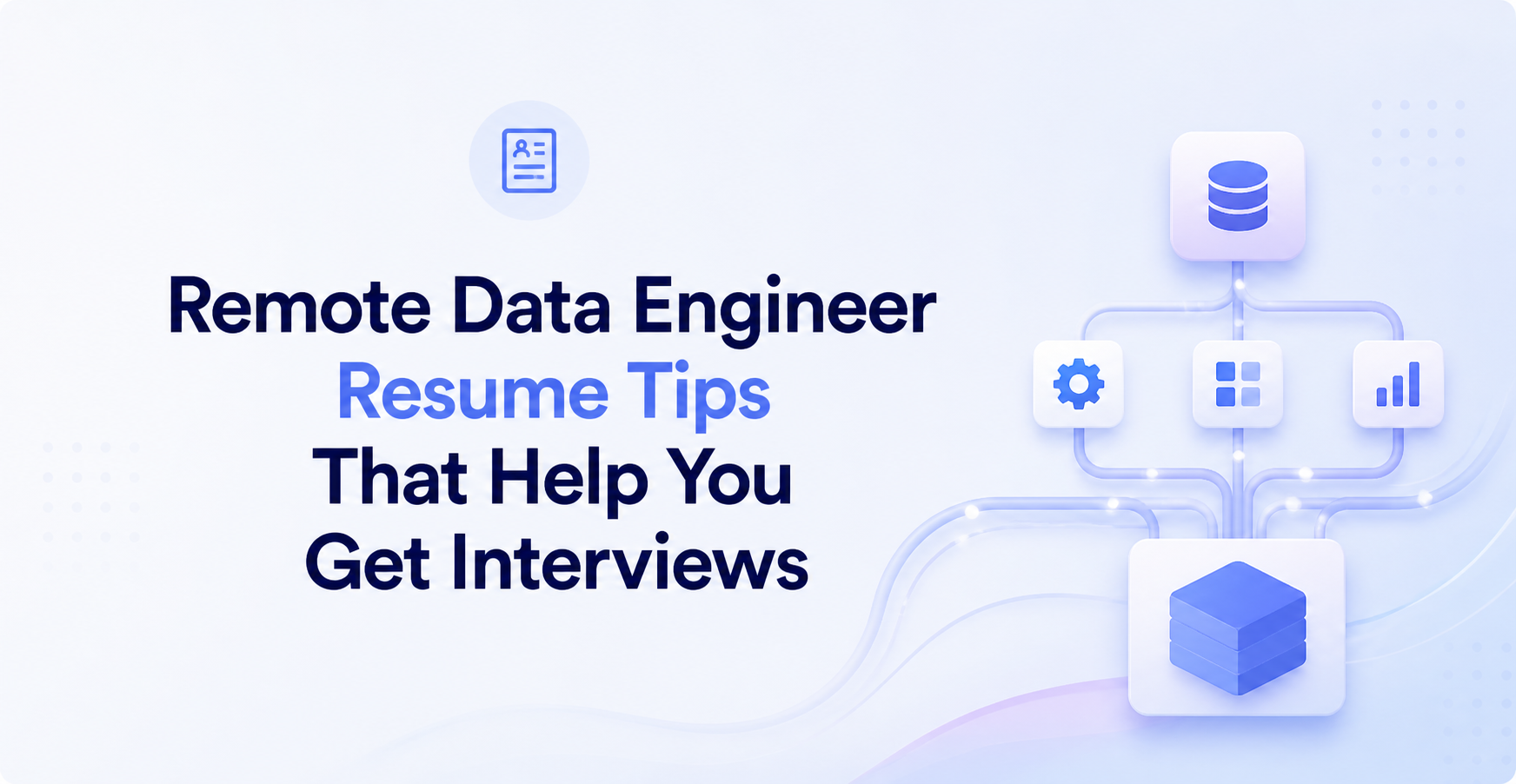
Remote Data Engineer Resume Tips That Get Interviews
A strong remote data engineer resume shows impact, remote-ready habits, and the stack you use. It can’t read like a job description. It has to make a hiring manager think, “This person can build, communicate, and own work without hand-holding.”
Remote roles also attract more applicants. Titles vary by company, but the BLS projects 9% growth for database administrators and architects from 2023 to 2033. That means demand is there, but so is competition. The fixes below help your resume stand out fast.
Quick summary: A strong remote resume makes three things obvious fast: you ship useful data work, you know the modern stack, and you can work well without someone checking on you every hour.
Key takeaway: The biggest upgrade is simple. Replace generic responsibility bullets with action, tool, and result bullets that show ownership, reliability, and business value.
Quick promise: By the end, you’ll know what to cut, what to rewrite, and how to make your remote fit easy for both ATS tools and human reviewers to spot.
What remote hiring managers look for on a data engineer resume
Hiring managers want proof fast. They look for results, cloud and data stack experience, communication skills, and signs that you can manage work well without close supervision.
Show business impact instead of only listing tasks
Task lists are weak because they tell people what your job was, not how well you did it. A better bullet shows what changed because of your work.
Here is the difference:
| Weak bullet | Stronger bullet |
| Managed ETL pipelines | Built Python and Airflow pipelines that cut nightly load times and improved delivery reliability |
| Worked with stakeholders | Wrote source-to-target docs and handled async requests across US and EU teams |
| Maintained data warehouse | Improved Snowflake models and reduced failed downstream reports |
The pattern is simple. Show the work, name the tool, then show the outcome. Faster jobs, fewer incidents, better freshness, lower cost, cleaner data, those are the details people remember.
Highlight remote-friendly skills employers can verify quickly
Remote work skills should not live only in a soft skills list. Put them in bullets people can trust.
Good signals include writing documentation, owning tickets, working across time zones, posting clear updates, and driving projects forward without constant follow-up. A short summary can help too: “Remote data engineer with experience building AWS data pipelines, writing documentation, and collaborating async across distributed teams.”
Build a resume that is easy for ATS and people to read
The best format is clean, keyword-aware, and easy to scan. Your goal is to pass the ATS, then make a recruiter stop and keep reading.
Use the right sections in the right order
For most remote data engineer jobs, this order works well: summary, skills, experience, projects, education, certifications.
Why this order? Because recruiters want your fit near the top. They need to see your stack, then your proof. If you hide Python, SQL, Airflow, or Snowflake at the bottom, you make the scan harder than it needs to be.
Keep formatting plain. Use standard headings. Skip graphics, columns, rating bars, and fancy templates that break parsing.
Add keywords naturally without sounding robotic
Job posts often mention tools like Python, SQL, Airflow, dbt, Snowflake, AWS, Azure, Spark, Kafka, and data pipelines. Use those terms where they belong, inside real bullets.
Bad keyword use looks stuffed. Good keyword use sounds like this: “Built ELT workflows with dbt and Snowflake on AWS, improving data freshness for finance dashboards.” Human first, ATS second.
Make your experience section prove you can own pipelines from start to finish
Your experience section should show ownership, scale, and reliability. A strong bullet explains what you built, how it performed, and what changed because of your work.
Write stronger bullets with a simple structure
Use this formula: action + tool + result.
That gives you clean, believable bullets like these:
- Built Airflow jobs in Python to orchestrate daily ingestion from SaaS APIs, cutting manual reporting work.
- Modeled warehouse tables in dbt and Snowflake, improving downstream reporting consistency.
- Added data quality checks with Great Expectations, reducing broken loads in production.
- Migrated legacy ETL jobs to Spark, improving processing speed for large batch workloads.
Each bullet does a job. It shows motion, tools, and payoff.
Use metrics that make your work believable
The best metrics for data engineering are practical ones: runtime, freshness, success rate, incident count, delivery speed, and cost. If you know the exact number, use it. If you don’t, use an honest range or plain language like “reduced repeated pipeline failures” or “improved same-day data availability.”
Never invent numbers. If you can’t defend a metric in an interview, don’t put it on the page.
Use projects and certifications to fill gaps and show proof of skill
Projects help when your work history is short or your remote experience is thin. Certifications help when they support the exact role you’re targeting.
Choose projects that look like real data engineering work
Toy projects don’t move the needle much. End-to-end projects do.
A better project includes ingestion, storage, orchestration, transformation, and some downstream use. Think cloud storage, Airflow or Prefect, dbt or SQL transforms, and a dashboard or analytics output that solves a business problem. That feels like real work, because it is close to real work.
List certifications only when they support the job you want
Cloud and platform certifications can help, especially for AWS, Azure, GCP, Snowflake, or Databricks roles. Still, they support experience. They don’t replace it.
If a cert is old, unrelated, or entry-level compared with your current role, leave it out.
Avoid the resume mistakes that sink interview chances
The most common blockers are vague bullets, walls of text, missing tools, weak summaries, unrelated detail, and no proof that you can work well remotely.
Trim clutter so your best work stands out
Cut old roles that don’t help your story. Trim long job descriptions. Remove filler like “responsible for” and “worked on.” Keep what proves fit.
For many candidates, one page is enough. For experienced engineers, two pages is fine. The better rule is this: if a line doesn’t help you get the interview, it shouldn’t stay.
Tailor the resume for each remote role
You don’t need a total rewrite every time. Adjust the summary, skills, and top few bullets to match the role.
If one job leans on Spark and AWS, move that work higher. If another stresses dbt, analytics engineering, and async collaboration, bring those details forward. Small edits can change how relevant you look.
FAQ: Remote data engineer resume questions answered
These are the questions people search for most, and the answers are usually more simple than people expect.
How long should a remote data engineer resume be?
One page works for early-career candidates. Two pages works for experienced candidates with strong, relevant work. The real rule is readability. If page two adds proof, keep it. If it adds clutter, cut it.
Do projects matter if I already have experience?
Yes, if the projects fill a gap or support your target role. A strong cloud or orchestration project can help you pivot, especially if your current job uses older tools or less end-to-end ownership.
How do I show remote experience on a resume?
Name it directly in your summary or job bullets. Mention async updates, documentation, cross-time-zone work, ticket ownership, and independent delivery. Show the behavior through examples, not empty claims.
Do I need a resume summary?
Usually, yes. A short summary helps recruiters see your level, tools, and remote fit in seconds. Keep it to two or three lines. Make it concrete, not fluffy.
How many tools should I list?
List the tools you can discuss with confidence. Ten solid tools beat a giant shopping list. Group them by category if needed, like languages, orchestration, cloud, warehouses, and data quality.
How should I handle an employment gap?
Be honest and brief. You can use projects, freelance work, coursework, or certifications to show momentum. What matters most is that your recent work still proves current skill.
What if I don’t have cloud experience yet?
Don’t hide from it. Build one or two cloud-based projects and put them on the resume. If the job asks for AWS or Azure, show that you’ve used the basics in a realistic workflow.
How do I stand out in a crowded remote job market?
Stand out by being easier to trust. Show outcomes, ownership, remote habits, and a clear stack. A focused resume beats a crowded one almost every time.
Next steps that turn a better resume into more interviews
The highest-impact changes are simple. Show results, put the right tools near the top, prove remote readiness, and make every section easier to scan.
Glossary
ATS
Software that scans resumes for structure and keywords.
Async communication
Work updates shared without needing everyone online at the same time.
ELT
A workflow where data is loaded first and transformed later in the warehouse.
dbt
A tool used to transform, test, and document analytics data models.
Data freshness
How current the available data is for reporting or downstream use.
Orchestration
Scheduling and managing pipeline tasks across systems.
Conclusion
A remote resume doesn’t win because it looks busy. It wins because it makes trust easy. Hiring managers want to see impact, ownership, clear tools, and proof that you can work well without close supervision.
If your resume still reads like a task list, that’s the first fix to make.