
RAG for Data Engineers: Skills, Tools, and Career Opportunities
RAG is a strong career path for data engineers because it combines data pipelines, search, cloud systems, and generative AI. RAG for data engineers does not require a move into AI research. It requires dependable data work that makes AI answers accurate, current, secure, and traceable.
The work is practical: connect documents, prepare them for search, retrieve the right facts, and measure whether the system performs. Those are familiar problems for data engineers.
Key Points
- RAG systems retrieve trusted company data before a language model writes an answer.
- SQL, Python, data modeling, and cloud skills remain central to RAG work.
- A credible portfolio proves data quality, retrieval quality, security, and monitoring.
- Job titles vary, so search postings by responsibilities as well as title.
- Employers value engineers who can explain tradeoffs, failures, and operating costs.
Quick summary: RAG moves data engineers closer to AI products without discarding their existing strengths. The strongest candidates can build reliable ingestion, search, evaluation, and security controls around a language model, then explain how each choice affects users.
Key takeaway: The language model is only one component of a production RAG system. Clean source data, well-designed metadata, access rules, and retrieval evaluation usually determine whether employees can trust the final answer.
Quick promise: By the end, you can choose a focused learning stack, outline an end-to-end portfolio project, and describe RAG work in a way that hiring managers can connect to real data engineering responsibilities.
RAG for Data Engineers: Skills, Tools, and Career Opportunities
Retrieval-augmented generation, or RAG, gives a language model relevant source material at question time. Instead of relying only on its training data, the model receives selected passages from company policies, product documents, tickets, or knowledge bases.
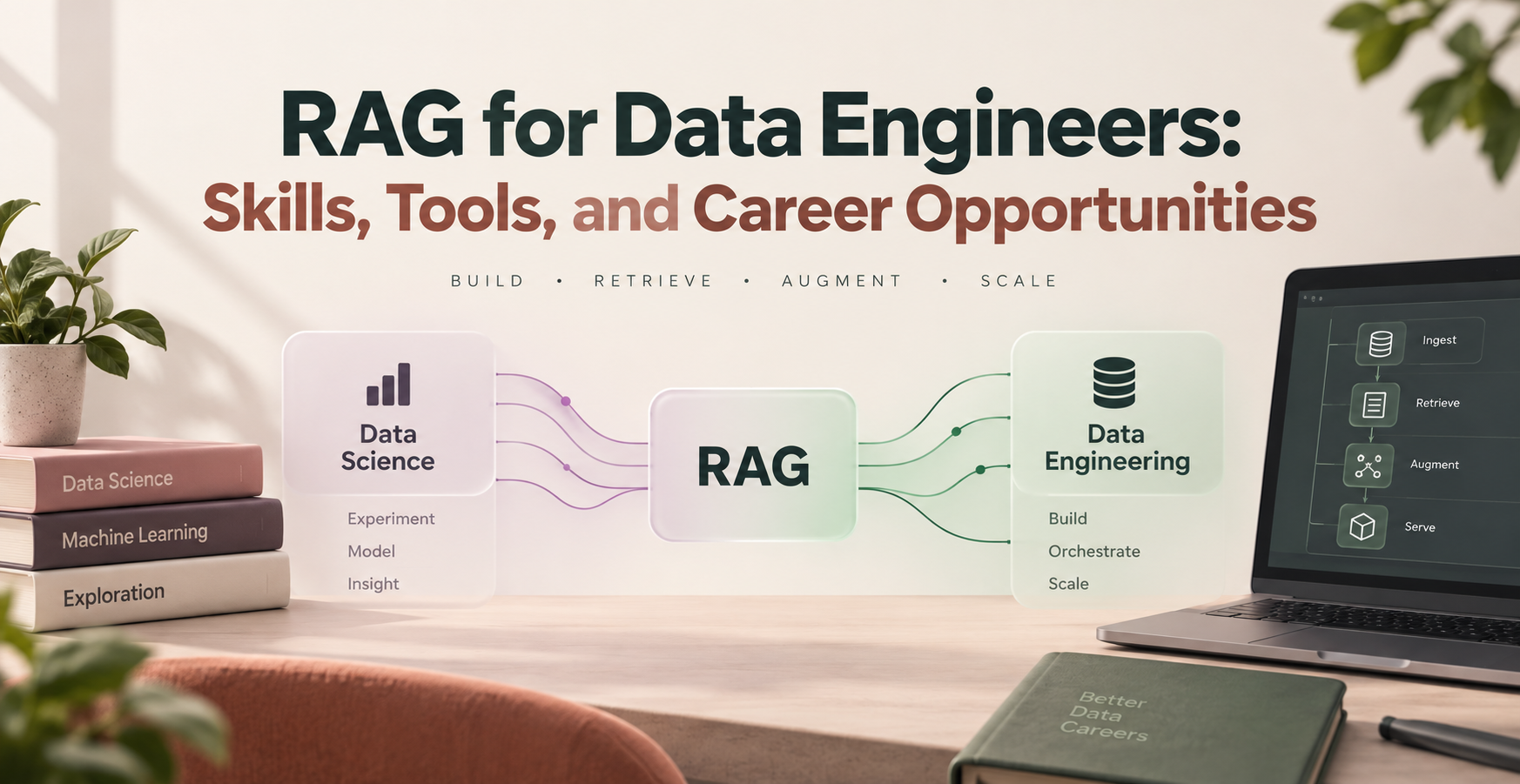
A typical RAG flow looks like this:
- Ingest files, database records, or API data.
- Parse, clean, and split documents into chunks.
- Create embeddings, which turn text into searchable numeric vectors.
- Store vectors, metadata, and source references.
- Retrieve relevant chunks for each question.
- Send the context to a model and return an answer with citations.
- Monitor quality, freshness, latency, and cost.
What a data engineer owns in a RAG pipeline
Data engineers make the knowledge layer dependable. That includes source connectors, batch or streaming ingestion, parsing, chunking, metadata, embedding jobs, vector indexing, freshness checks, and access controls.
Application developers may build the chat interface. Meanwhile, the data engineer makes sure an employee cannot retrieve another team’s restricted documents. They also track failed jobs, duplicate records, stale indexes, and expensive model calls.
How RAG differs from fine-tuning and analytics pipelines
RAG is usually the better choice when facts change often or users need evidence for an answer. Fine-tuning changes a model’s behavior or style. It does not create a live, traceable knowledge source.
| Approach | Main purpose | Updates | Best fit |
| RAG | Retrieve current facts for answers | Re-index source data | Policies, documentation, support |
| Fine-tuning | Change model behavior | Train model again | Format, tone, narrow tasks |
| Analytics pipeline | Produce data for reporting | Run ETL or ELT jobs | BI, metrics, dashboards |
Core RAG Skills for Production Systems
Strong fundamentals still carry the most weight. SQL helps you inspect source quality, join ownership data, and validate counts. Python supports parsers, API clients, embedding jobs, and test suites.
Data engineering foundations that still matter
Use JSON when APIs return nested records, and Parquet when you need efficient columnar storage. Relational databases fit structured metadata, while NoSQL stores can help with flexible document records.
Git, Docker, Linux, REST APIs, and basic system design matter because RAG projects must run outside a notebook. A repeatable ingestion job beats a one-time script every time.
RAG and AI skills worth learning next
Learn embeddings, chunking, metadata filters, hybrid search, reranking, prompt construction, context windows, and grounding. You do not need advanced mathematics to explain why a chunk size affects recall or why filters prevent cross-team retrieval.
Track precision, recall, relevance, hallucinations, response latency, and cost. A retrieval result can be technically similar yet useless to a user, so evaluation needs real questions and expected source passages.
Cloud, security, and reliability skills for production work
AWS, Azure, and Google Cloud all support common RAG patterns: object storage for source files, managed compute for jobs, secret managers, logging, and role-based access. The product choices differ, but the engineering concerns stay familiar.
A local demo becomes a business system only after it handles encryption, PII, retries, data lineage, tenant isolation, disaster recovery, and audit logs.
RAG Tools and Architecture Choices for a Practical Portfolio Project
Choose tools based on document volume, team skills, hosting rules, operational capacity, and budget. Popularity alone is a weak reason to select a database or framework.
Build an internal policy assistant or technical documentation search tool. Both projects make the system’s limits clear and give you useful interview material.
A simple architecture from raw files to grounded answers
Collect approved PDFs or documentation from object storage, SharePoint, Git repositories, or an API. Extract text, remove boilerplate, split content, create embeddings, and write records with document IDs, owners, dates, and permissions.
Airflow, Dagster, or Prefect can schedule ingestion. Then add data quality checks for empty files, duplicate chunks, missing metadata, and failed embeddings. Event-driven updates fit urgent changes, while nightly batch jobs work for stable sources.
Choosing vector databases and search platforms
| Option | Strength | Tradeoff | Good project fit |
| PostgreSQL with pgvector | Familiar SQL and metadata joins | Less specialized at large scale | Small to medium internal tool |
| Pinecone, Weaviate, or Milvus | Vector-focused search features | New service and operating cost | Dedicated retrieval workload |
| OpenSearch or Elasticsearch | Keyword search and filters | More search operations work | Hybrid search and exact terms |
Hybrid search combines keyword and vector retrieval. It helps with error codes, product names, legal clauses, account IDs, and other terms where exact matching matters.
LangChain and LlamaIndex can speed up experiments, but they do not replace data modeling. OpenAI, Anthropic, and open-source models each involve different hosting, cost, and privacy decisions. Use evaluation tools such as Ragas or a custom labeled dataset before calling a system ready.
What makes a portfolio project credible
Document the source data, architecture diagram, chunk schema, ingestion code, tests, evaluation set, citations, access model, monitoring plan, and deployment notes. Include a short discussion of latency and cost.
A polished chat screen cannot prove retrieval quality. A small evaluation dataset with expected sources shows that you tested the system instead of trusting fluent answers.
RAG Career Opportunities and a Job-Ready Roadmap
RAG work appears under many titles: data engineer, analytics engineer, AI engineer, machine learning engineer, platform engineer, search engineer, and data platform engineer. Search postings for “vector search,” “LLM pipelines,” “document processing,” “knowledge systems,” and “AI platform.”
Which RAG-related roles match your background?
Warehouse and SQL experience fit an AI data engineer path. Python and API experience fit AI engineering work. Distributed systems and cloud experience fit machine learning platform or AI platform roles.
Search relevance knowledge can lead toward search engineering. Pay and hiring demand depend on location, seniority, company size, and the actual work, so focus on responsibilities rather than inflated title claims.
A focused six-month learning plan
First, strengthen SQL and Python through repeatable ingestion tasks. Next, build one pipeline that loads documents, stores metadata, and handles failures.
Then learn embeddings and retrieval. Deploy a small RAG application, add tests and monitoring, and practice explaining its system design. Measure retrieval quality, response time, source freshness, and test coverage.
Explaining RAG experience in interviews
Use this resume pattern: action, system, constraint, and result. For example: “Built a Python ingestion pipeline for versioned technical documents, added metadata filters and citations, and created retrieval tests for common support questions.”
Be ready to discuss chunk size, embedding choice, permissions, stale data, prompt failures, fallback behavior, and cost controls. GitHub code, an architecture diagram, and a short demo make those claims easier to verify.
RAG Mistakes to Avoid and Standards Employers Expect
Poor source data creates poor answers, even when the model sounds confident. Oversized chunks waste context space. Arbitrary chunks can split a procedure halfway through. Missing metadata makes filtering and citations unreliable.
Review every project across six areas:
- Source data quality and document freshness.
- Retrieval quality against a labeled evaluation set.
- Answer quality, including citations and unsupported claims.
- Security controls for permissions, secrets, and PII.
- Reliability through retries, alerts, logging, and recovery plans.
- User feedback that identifies failed searches and missing content.
A compact glossary of RAG and data engineering terms
| Term | Plain-English definition |
| RAG | A system that retrieves source content before an AI model answers. |
| Embedding | A numeric representation of text used for similarity search. |
| Vector database | A system that stores and searches embeddings. |
| Chunking | Splitting documents into smaller retrievable passages. |
| Metadata | Context such as author, date, product, or access level. |
| Hybrid search | A mix of keyword and vector search. |
| Reranker | A model that reorders retrieved results by relevance. |
| Context window | The amount of text a model can process in one request. |
| Grounding | Tying an answer to supplied, verifiable sources. |
| Hallucination | A confident claim that lacks support or is false. |
| Data lineage | A record of where data came from and how it changed. |
| Evaluation set | Questions and expected evidence used to test quality. |
Build AI Experience on Data Engineering Strengths
RAG gives data engineers a practical route into AI because it rewards reliable pipelines, search knowledge, cloud skills, and production discipline. The strongest project is not the flashiest chatbot. It is the one that retrieves the right information safely and proves it with evidence.
Use this one-minute action list:
- Learn how embeddings, chunking, and metadata affect retrieval.
- Pick one stack that fits your current skills.
- Build one end-to-end project with real source documents.
- Add citations, tests, and a small evaluation dataset.
- Record latency, freshness, and cost tradeoffs.
- Prepare a clear architecture explanation for interviews.
Data Engineer Academy offers guided projects, mentorship, resume reviews, mock interviews, and career coaching for candidates who want to turn those skills into stronger job applications.
Frequently Asked Questions
Is RAG worth learning for data engineers?
Yes. RAG uses many existing data engineering skills, including ingestion, data quality, storage, orchestration, access control, and observability. You should also learn basic retrieval and evaluation concepts. That combination fits teams building internal AI search tools, support assistants, and knowledge systems.
Can a beginner data engineer learn RAG?
Yes, but start with SQL, Python, APIs, and data pipelines. A beginner can build a small document search project after learning those basics. Avoid starting with complex multi-agent frameworks. Reliable ingestion and clear metadata teach more useful engineering habits.
Do data engineers need machine learning degrees for RAG work?
No. Most RAG engineering roles do not require machine learning research skills or a graduate degree. You need to understand embeddings, retrieval, prompts, and evaluation well enough to build and operate a system. Strong data engineering fundamentals remain the foundation.
What tools should I learn for a RAG portfolio?
Start with Python, PostgreSQL with pgvector, a model API, and a simple orchestration tool. Add Docker and cloud storage when the local version works. Later, compare a managed vector database or OpenSearch to show that you can evaluate architecture tradeoffs.
Is pgvector good enough for a RAG project?
Yes, pgvector is a strong choice for many portfolio projects and smaller production workloads. It keeps vectors and relational metadata in PostgreSQL, which simplifies filtering and joins. A dedicated vector database may fit higher-scale retrieval needs or specialized search features.
How do I measure RAG quality?
Measure retrieval quality and answer quality separately. Use a labeled set of realistic questions with expected documents or passages. Check whether retrieval returns the right evidence, whether the answer cites it correctly, and whether response latency and costs stay within your target.
What is the biggest mistake in a RAG project?
The biggest mistake is treating a fluent answer as proof that the system works. A model can sound persuasive while retrieving outdated or irrelevant content. Test source freshness, permissions, citations, and retrieval relevance before you focus on interface design.
What RAG jobs should data engineers search for?
Search for data engineer, AI data engineer, AI platform engineer, machine learning platform engineer, search engineer, and AI engineer roles. Also search job descriptions for vector search, LLM pipelines, document processing, knowledge retrieval, semantic search, and AI platform responsibilities.