

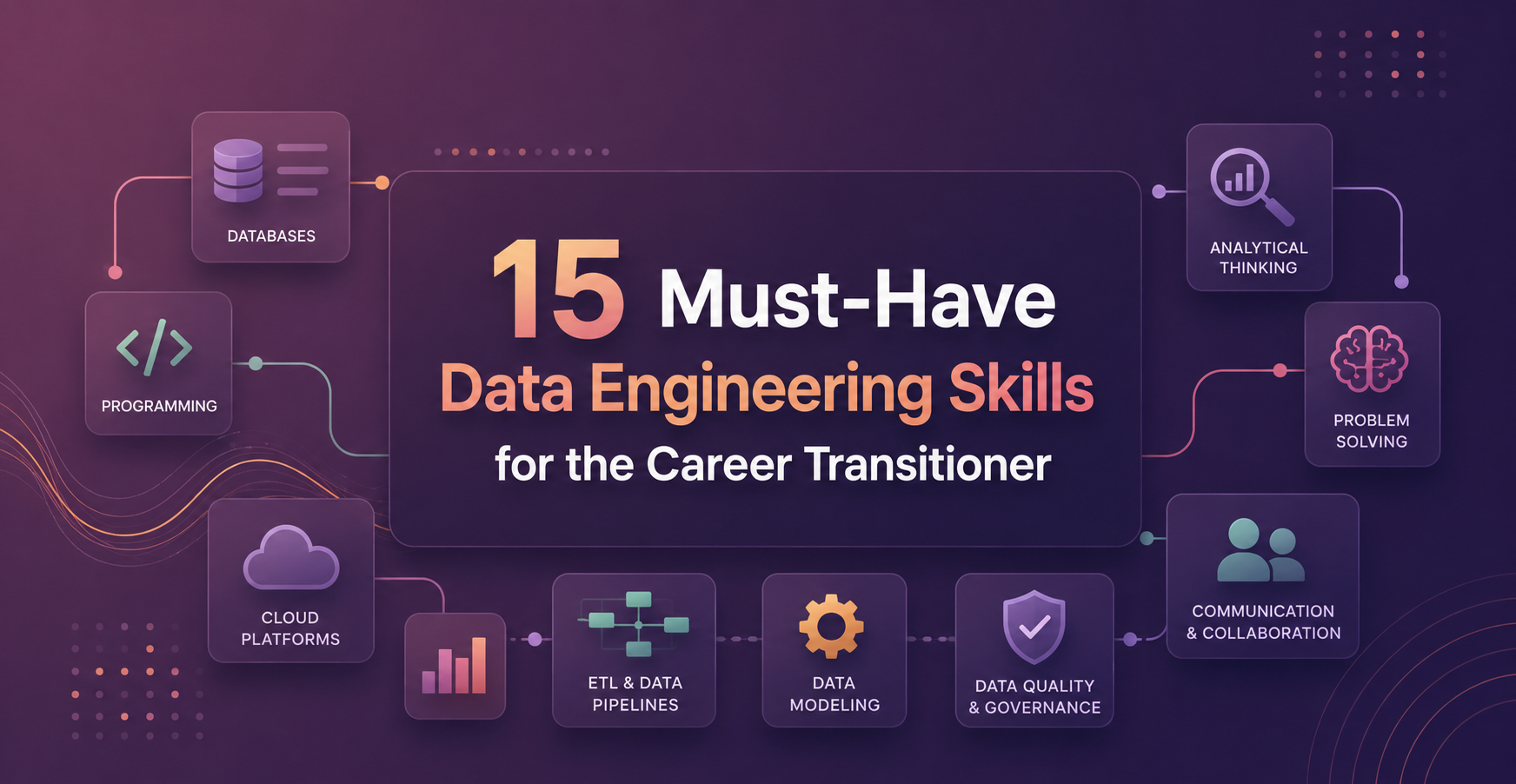
15 Must-Have Data Engineering Skills for the Career Transitioner
Introduction
If you are already working with data as an analyst, a BI developer, a QA engineer, or a SQL-fluent IT professional you have probably noticed something: data engineering jobs pay well, the demand is strong, and a meaningful portion of the role overlaps with work you already do.
But there is a gap between working with data and building data systems. Closing that gap requires specific skills that most analytics curricula do not cover.
This guide breaks down the 15 most important data engineering skills for career transitioners. Not abstract buzzwords. Not a list of tools to memorize. Specific, learnable skills explained in terms of what you already know and what you need to build next.
If you already know SQL and some Python, you are closer than you think. But closer is not the same as ready. Here is what readiness actually looks like.
What Makes Data Engineering Different From Data Analytics
Before diving into skills, it is worth drawing a clear line.
Analytics asks: What happened?
Data engineering asks: How do we collect, transform, validate, store, and refresh this data reliably every day, at scale, without manual intervention?
An analyst builds a report. A data engineer builds the system that makes reliable reporting possible.
That distinction shapes every skill on this list.
The 15 Must-Have Data Engineering Skills for Career Transitioners
Skill 1: SQL for Data Engineering (Not Just Reporting)
If you already know SQL for dashboards and ad-hoc analysis, you have a foundation. But data engineering SQL is different.
What changes:
- You are not writing one-time queries. You are writing transformations that run on a schedule.
- You need to handle deduplication, incremental loading, and idempotent updates.
- You need to think about how a query will perform against 100 million rows, not 10,000.
What to add to your SQL skills:
- Window functions (ROW_NUMBER, LAG, LEAD, RANK)
- CTEs for readable, modular transformation logic
- Slowly changing dimension (SCD) patterns
- Deduplication strategies
- Incremental load logic
- Data validation queries (NULL checks, uniqueness checks, referential integrity)
- Query performance and partitioning concepts
Common mistake: Assuming that because SQL runs correctly once, it is pipeline-ready. A pipeline-ready SQL transformation handles edge cases, runs without duplicating data, and fails loudly when something unexpected happens.
What good looks like: You can write a SQL model that transforms raw event data into a clean, deduplicated daily metrics table one that can run every morning without corruption.
Skill 2: Python for Data Movement
Python is the backbone of most modern data pipelines. But the Python used in data engineering is not the same Python used for machine learning or web development.
What data engineering Python looks like:
- Extracting data from REST APIs
- Parsing and flattening JSON responses
- Handling pagination and rate limits
- Writing data to CSV, Parquet, or databases
- Connecting to databases with SQLAlchemy or similar connectors
- Add logging for better visibility.
- Use error handling to manage failures.
- Writing modular, reusable functions
- Running scripts reliably in production environments
What to focus on:
- Functions and modules
- Error handling with try/except
- Working with the requests library for APIs
- Working with pandas for local data manipulation
- Writing scripts that can be parameterized and scheduled
Common mistake: Stopping once the script works one time. The real question is: Will this still work tomorrow? For example, how would your pipeline respond if the API returns an unexpected schema? Additionally, you should consider what happens when the database becomes unavailable.
What good looks like: You can write a Python script that pulls data from an API, handles pagination and errors, logs its progress, and loads records into a database without creating duplicates on reruns.
Skill 3: Understanding Databases and Data Warehouses
Most career transitioners already know relational databases at a surface level. Data engineering requires going deeper, and understanding the difference between operational databases and analytical warehouses.
Key distinction:
| Operational Database | Analytical Warehouse |
| Supports applications | Supports reporting and analytics |
| Optimized for writes | Optimized for reads |
| Rows updated frequently | Data appended or slowly changed |
| Examples: PostgreSQL, MySQL | Examples: BigQuery, Snowflake, Redshift |
What to learn:
- How to design schemas for analytics (not just applications)
- Primary keys, foreign keys, and referential integrity
- Normalization vs. denormalization and when each is appropriate
- Partitioning and clustering for query performance
- Cost-aware querying in cloud warehouses
- Views vs. materialized views
What good looks like: You can design a schema that supports fast analytical queries, explain why you chose your grain and structure, and load data into it efficiently.
Skill 4: Data Pipeline Design
This is where most career transitioners have the largest gap. Knowing SQL and Python does not mean you know how to design a pipeline.
What a data pipeline actually is:
A repeatable, automated system that moves data from a source to a destination while handling failures, scheduling, data quality, and dependencies.
A script is not a pipeline. A pipeline runs on a schedule, fails loudly when something breaks, logs what it did, handles retries, and can be rerun without creating a mess.
Core pipeline concepts to understand:
- Extraction, transformation, and loading (ETL vs. ELT)
- Batch vs. streaming pipelines
- Idempotency – the ability to rerun a pipeline without side effects
- Incremental loading vs. full refreshes
- Backfills
- Dependency management between tasks
- Failure handling and alerting
What good looks like: You can describe the architecture of a batch pipeline from source to warehouse what happens at each stage, how failures are handled, and how the pipeline ensures data quality.
Skill 5: Data Modeling
Data modeling is where many aspiring data engineers are weakest, even if they have SQL experience.
The most important concept in data modeling: grain.
Grain means what one row in a table represents. If you do not understand the grain, you cannot safely join, aggregate, or trust that table.
What to learn:
- Fact tables (measurable events; orders, clicks, transactions)
- Dimension tables (descriptive attributes; customers, products, dates)
- Star schema design
- One-to-many and many-to-many relationships
- Slowly changing dimensions (Type 1, Type 2)
- Surrogate keys vs. natural keys
- Normalized vs. denormalized tradeoffs
Common mistake: Writing SQL joins without understanding the grain of each table involved. This silently creates fan-out inflated metrics that look correct but are not.
What good looks like: You can design a star schema for a real business domain, explain the grain of each table, and write joins that do not accidentally multiply rows.
Skill 6: dbt (Data Build Tool)
dbt has become one of the most important tools in the modern data stack, especially for teams that do transformation inside the warehouse.
If you come from analytics or BI, dbt is likely the fastest skill to add because it builds directly on SQL.
What dbt does:
dbt helps teams apply software engineering practices version control, testing, documentation, modular design to SQL-based transformations.
What to learn:
- Models (SQL files that define transformations)
- Sources (references to raw data)
- Staging, intermediate, and mart layer conventions
- Tests (not_null, unique, accepted_values, relationships)
- Documentation and lineage
- Incremental models
- Jinja templating basics
- Running dbt in CI/CD
Common mistake: Treating dbt as “just a way to run SQL.” The real value is the testing, documentation, and lineage it provides the engineering discipline it imposes on transformation work.
What good looks like: You can build a dbt project with staging models, mart-level transformations, documented sources, and tests that prevent null keys and duplicate rows from reaching downstream consumers.
Skill 7: Orchestration
Once you have pipelines, you need something to coordinate them. That is orchestration.
What orchestration means:
Orchestration controls the order, timing, and dependencies of pipeline tasks. It handles scheduling, retries, alerting when tasks fail, and backfills when historical data needs to be reprocessed.
Common tools:
- Apache Airflow
- Dagster
- Prefect
- AWS Step Functions
- Azure Data Factory
Core concepts to understand:
- DAGs (Directed Acyclic Graphs) a map of tasks and their dependencies
- Tasks and operators
- Scheduling (cron-based and event-based)
- Retries and retry delays
- Sensors (tasks that wait for a condition before proceeding)
- Backfills
Important clarification: Airflow is not where you write your business logic. It is where you coordinate the execution of that logic. Your Python scripts and SQL transformations live elsewhere. Airflow decides when they run, in what order, and what happens when they fail.
What good looks like: You can build an Airflow DAG that orchestrates an end-to-end pipeline extraction, transformation, loading with appropriate retries, task dependencies, and failure alerting.
Skill 8: Cloud Platform Fundamentals
Modern data engineering happens in the cloud. You do not need to memorize every service, but you do need to understand the architecture pattern.
The pattern:
- Data lands in object storage (S3, GCS, Azure Blob)
- Compute processes or transforms it
- Results land in a warehouse or serving layer
- Access is controlled through IAM
- Costs and failures are monitored
Minimum cloud literacy for each major platform:
AWS: S3, Glue, Redshift, IAM, CloudWatch, Lambda basics
GCP: Cloud Storage, BigQuery, Cloud Composer, Dataflow basics, IAM
Azure: Azure Data Lake Storage, Azure Data Factory, Synapse Analytics, Azure SQL
Cross-platform concepts to prioritize:
- Object storage (what it is, how data lands there, how pipelines read from it)
- IAM and secrets management (how access is granted and secured)
- Managed compute vs. serverless
- Cost awareness (how to avoid expensive mistakes in cloud warehouses)
- Monitoring and logging in cloud environments
Common mistake: Thinking you need to learn every AWS service before applying for jobs. You do not. You need to understand how cloud services fit together in a data architecture.
Skill 9: Data Quality and Testing
A pipeline that moves bad data faster is not a good pipeline.
Data quality is not something you verify manually before a stakeholder meeting. In production systems, quality checks are built into the pipeline and run automatically.
What data quality testing looks like:
- Null checks (critical fields must not be null)
- Uniqueness checks (primary keys must be unique)
- Referential integrity (foreign keys must match)
- Accepted value checks (a status field should only contain known values)
- Freshness checks (data should have arrived by a certain time)
- Volume checks (row counts should be within expected ranges)
- Duplicate detection
Tools:
- dbt tests (built-in and custom)
- Great Expectations
- Soda
- Custom Python validation functions
What good looks like: You can add data quality checks to a pipeline that fail loudly and block downstream processing when data does not meet expectations.
Skill 10: APIs and Data Ingestion
Understanding how data enters the system is fundamental. Most pipelines start with data extraction from external systems, and that usually means working with APIs.
What to learn:
- How REST APIs work (GET and POST requests, headers, authentication)
- API keys and OAuth basics
- Pagination strategies (offset, cursor-based, page tokens)
- Rate limit handling and retry logic
- Parsing and flattening nested JSON
- Handling schema changes in API responses
- Incremental ingestion vs. full pulls
Tools:
- Python requests library for custom extractors
- Fivetran, Airbyte, or Stitch for managed connectors
Key insight: Pulling one API response is easy. Building an ingestion process that handles pagination, respects rate limits, detects schema changes, retries gracefully, and stores raw data before transformation that is data engineering.
What good looks like: You can build a Python-based API extractor that handles multi-page responses, stores raw JSON for reprocessing, and loads cleaned records incrementally into a table.
Skill 11: Git and Software Engineering Practices
Most career transitioners do their data work in notebooks or spreadsheets. Data engineering requires version-controlled, documented, maintainable code.
What to learn:
- Git basics: init, add, commit, push, pull
- Branching: feature branches, main vs. development
- Pull requests and code review basics
- .gitignore and environment variable management
- Project structure for data pipelines
- README documentation
- Dependency management (requirements.txt, virtual environments)
- Basic CI/CD concepts (automated testing on push)
Why this matters for career transitioners:
Hiring teams look at GitHub repositories. A well-structured repository with a clear README, meaningful commits, and organized code signals engineering discipline even on a beginner project.
Common mistake: Putting everything in one notebook with no documentation. A hiring manager cannot evaluate your engineering judgment from a Jupyter notebook that runs top-to-bottom once.
What good looks like: Your portfolio project lives in a GitHub repository with a README that explains the architecture, a clear folder structure, environment variable handling, and commit history that shows iterative development.
Skill 12: Linux, CLI, and Developer Environment
You do not need to become a Linux systems administrator. But you do need to be comfortable in the terminal.
Practical CLI skills to build:
- Navigating directories (cd, ls, pwd)
- Reading files (cat, head, tail, less)
- Searching text (grep)
- File permissions (chmod)
- Environment variables (export, .env files)
- Running Python scripts from the command line
- Installing packages
- Reading log files
- SSH basics
- Basic cron scheduling
Why this matters:
Data pipelines run in server environments, containers, and cloud compute. If you can only work in a GUI, you will be blocked the first time you need to debug a pipeline running on a remote server.
What good looks like: You can SSH into a server, navigate to a pipeline directory, run a script, check the logs, and diagnose a basic failure all from the terminal.
Skill 13: Distributed Processing Fundamentals
This skill matters most at scale. It is not required for every entry-level data engineering role, but understanding when and why distributed processing is used separates informed engineers from tool followers.
The core problem:
Pandas is excellent when data fits on one machine. When data grows to hundreds of gigabytes or terabytes, single-machine processing becomes a bottleneck.
What distributed processing adds:
Spark and similar frameworks distribute data across many machines, processing partitions in parallel. The tradeoff is complexity shuffles, memory management, cluster configuration, and execution plan optimization all matter.
What to learn at the beginner level:
- What a Spark DataFrame is and how it differs from a Pandas DataFrame
- Lazy evaluation (nothing runs until you trigger an action)
- Partitions and why they matter for performance
- Parquet as a columnar storage format
- When Spark is appropriate and when it is overkill
- Basic PySpark syntax for reading, transforming, and writing data
Common mistake: Learning Spark as “Pandas with different syntax.” Spark is a distributed execution engine. Its performance characteristics shuffles, skew, executor memory, are fundamentally different from single-machine processing.
Skill 14: Monitoring, Logging, and Observability
A pipeline that runs silently and fails silently is a liability. Production data pipelines require visibility.
What this skill looks like in practice:
- Adding structured logging to Python scripts (using Python’s logging module, not print statements)
- Understanding what to log: start time, rows processed, errors encountered, completion status
- Setting up pipeline alerts that notify when a run fails or takes too long
- Understanding data freshness monitoring (how do you know if yesterday’s data did not arrive?)
- Tracking pipeline run history and failure rates
Tools:
- Python logging module
- Cloud-native monitoring (CloudWatch, Stackdriver, Azure Monitor)
- Orchestration-level alerting (Airflow, Dagster, Prefect all have built-in alert mechanisms)
- Data observability tools (Monte Carlo, Bigeye, Soda Cloud) at more advanced levels
Why this matters for career transitioners:
Hiring teams want to see that you think about what happens after a pipeline is deployed. Anyone can make a pipeline work once. Engineers build pipelines that surface problems before stakeholders discover them.
What good looks like: Your pipeline logs its progress at each stage, surfaces errors with enough detail to diagnose the cause, and sends an alert when a run fails.
Skill 15: Production Thinking
This is not a tool. It is a mindset and it is the skill that most separates analysts who understand data from engineers who build data systems.
What production thinking means:
Every time you write a script, model, or pipeline, ask:
- Will this still work tomorrow?
- What happens if the source data is late?
- What happens if the schema changes?
- What happens if this runs twice?
- What happens if the API returns an error?
- Can someone else understand and maintain this code?
- How do I know when this breaks?
What production thinking produces:
- Idempotent pipelines (safe to rerun)
- Error handling and retry logic
- Logging and alerting
- Data quality tests
- Documentation
- Modular, readable code
- Environment variable management (no hardcoded credentials)
Common mistake: Stopping once the pipeline works end-to-end in a local environment. Production readiness begins after the first successful run, not before it.
What good looks like: Your portfolio project is not just functional; it is documented, testable, repeatable, and observable. It looks like something a team could maintain.
How These Skills Build on Each Other
The skills above are not independent. They form a progression.
| Stage | Focus | What You Build |
| Stage 1 | SQL for data engineering | Clean transformations and validation queries |
| Stage 2 | Python for data movement | API-to-database ingestion script |
| Stage 3 | Databases and warehouses | Analytical schema with fact and dimension tables |
| Stage 4 | Pipeline design | End-to-end batch pipeline |
| Stage 5 | dbt | Tested, documented SQL transformations |
| Stage 6 | Orchestration | Scheduled, observable pipeline with retries |
| Stage 7 | Cloud fundamentals | Cloud-hosted pipeline |
| Stage 8 | Production readiness | Portfolio project with tests, logs, and documentation |
Most career transitioners do not need to complete all eight stages before applying for roles. A solid foundation in Stages 1 through 6 demonstrated through a real portfolio project is competitive for many entry-level and junior data engineering positions.
What Hiring Teams Actually Look For
Based on how data engineering job descriptions are written and what teams evaluate in technical interviews, here is what matters:
SQL: Can you write transformations, not just queries? Can you explain deduplication, incremental loading, and window functions?
Python: Can you write maintainable scripts that handle errors, log progress, and work in production, not just in a notebook?
Pipeline design: Can you explain how a batch pipeline works end to end? Can you describe what idempotency means and why it matters?
Data modeling: Can you explain grain? Can you design a fact and dimension schema for a real business scenario?
Cloud: Can you describe a cloud data architecture? Do you understand object storage, compute, and access control?
Portfolio: Is your GitHub repository structured, documented, and functional? Does it show engineering judgment or just a working script?
Problem-solving: When something breaks, can you diagnose it? Do you understand enough about the system to know where to look?
The Biggest Misconception Career Transitioners Have
“I know SQL. I know some Python. I’m almost there.”
SQL and Python are necessary. They are not sufficient.
The transition into data engineering requires understanding how those skills fit inside systems pipelines that run reliably, fail loudly, and can be maintained by a team.
The gap is not about learning more syntax. The gap is about learning to think like a systems builder, not just a data user.
Frequently Asked Questions
Do I need a computer science degree to become a data engineer?
No. Many working data engineers do not have CS degrees. What matters is demonstrable skill: SQL, Python, pipeline design, data modeling, and a portfolio that shows you can build production-style systems. A degree helps in some hiring contexts, but it is not a requirement at most organizations.
How long does it take to transition into data engineering?
It depends heavily on your starting point. Someone with strong SQL experience and basic Python knowledge might build a competitive portfolio in six to twelve months of focused learning and project work. This assumes consistent effort, not passive watching of tutorial videos, but active building.
Do I need to know all 15 skills before applying?
No. A solid foundation in SQL, Python, data modeling, pipeline design, dbt, and orchestration demonstrated through a real portfolio project is competitive for many roles. Distributed processing and advanced cloud skills can be developed on the job.
What is the most important skill to start with?
SQL for data engineering. If you already know SQL for analytics, the next step is understanding how SQL fits inside a reliable transformation layer. From there, Python for data movement, then data modeling, then pipeline design.
What should a beginner portfolio project look like?
A strong beginner project pulls data from a real API, stores the raw data, transforms it using SQL or dbt, loads it into a warehouse, tests the output for data quality, orchestrates the workflow with Airflow or Prefect, and documents the architecture in a clear README. It does not need to be complex. It needs to show engineering judgment.
Final Thoughts on Data Engineering Skills for Career Transitioners
The path from data analyst or BI developer to data engineer is real, and more people are walking it than the industry often acknowledges.
The skills on this list are not gatekeeping requirements. They are the practical building blocks of production data systems things you will use in your first data engineering role and continue developing throughout your career.
Start with what you know. Build on it deliberately. Ship a real project. Document your work.
The goal is not to check every box on this list before you apply. The goal is to build enough of a foundation that you can grow into the role, and to show hiring teams that you understand how data systems actually work.
That combination demonstrated skill plus engineering judgment is what gets you in the door.
P.S. If you are making the transition from analytics or technical support into data engineering, the single highest-leverage thing you can do is build one real pipeline not finish ten tutorials. Pick a data source, design an architecture, and build something that runs, fails loudly, and can be explained to another engineer. That project will teach you more than any course.