

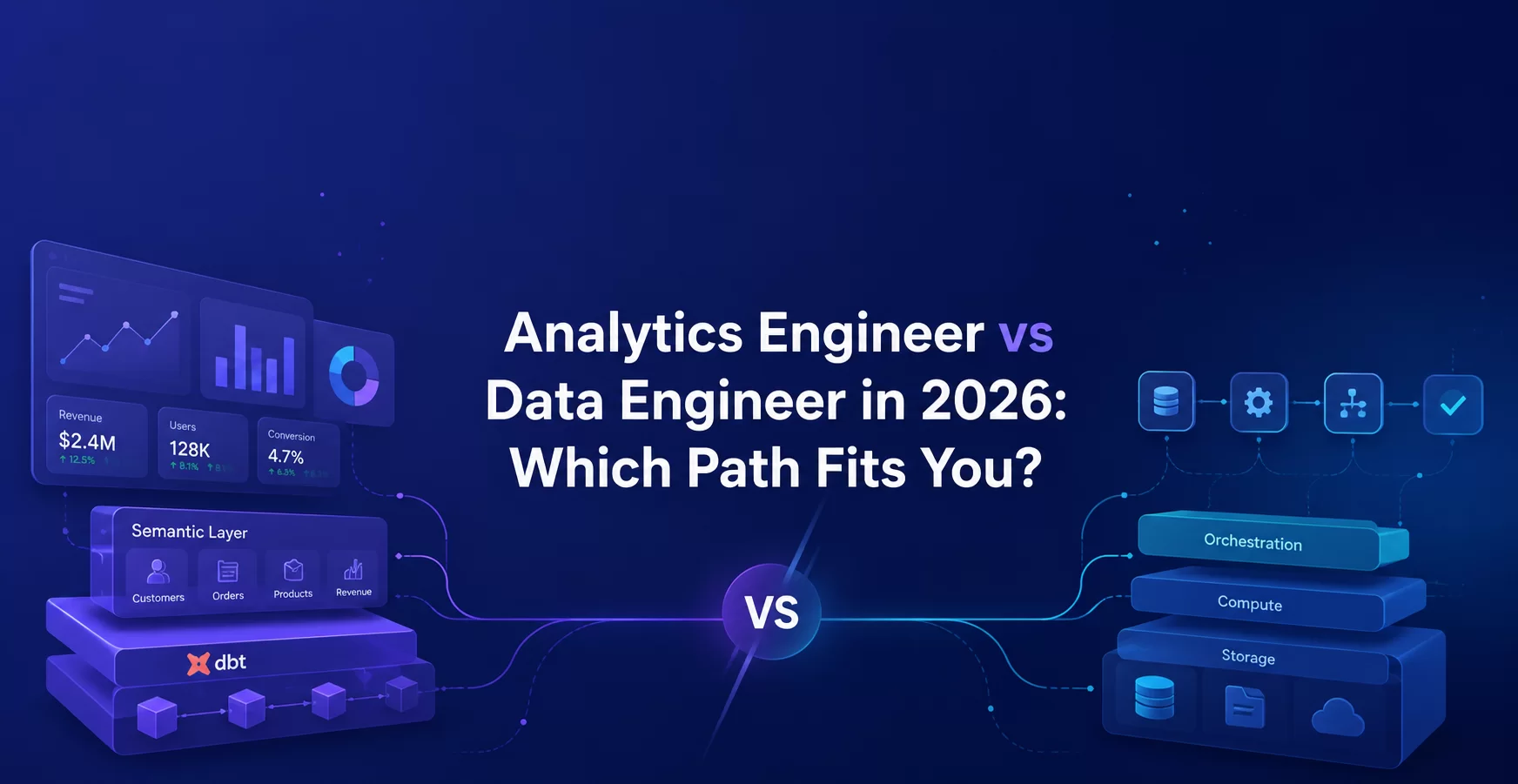
Analytics Engineer vs Data Engineer in 2026: Which Path Fits You?
If you’re choosing between analytics engineer vs data engineer, neither role is better for everyone. The right path depends on how you like to solve problems. If you enjoy metrics, dashboards, and business logic, analytics engineering may fit better. If you prefer pipelines, systems, and scale, data engineering is usually the stronger match.
This choice affects your daily work more than the title does. The clearest way to decide is to compare the work, tools, pay, and career fit side by side.
Key Points
- Analytics engineers turn raw warehouse data into trusted models for reports and decisions.
- Data engineers move data between systems and keep pipelines reliable at scale.
- Both roles use SQL, testing, Git, and data modeling, but the depth is different.
- In 2026, companies still need both roles because AI doesn’t replace metric ownership or production reliability.
- Analysts often move into analytics engineering, while software-minded builders often prefer data engineering.
Quick summary: Analytics engineering is closer to reporting, metrics, and stakeholder questions. Data engineering is closer to ingestion, orchestration, cloud systems, and reliability.
Key takeaway: Choose the role that matches your problem-solving style, not the one that sounds more technical.
Quick promise: By the end, you’ll know which path fits your background and what to learn first.
What each role actually does on a modern data team
Both jobs work with data, but they sit on different parts of the stack. Analytics engineers shape data for business use inside the warehouse. Data engineers get that data into the warehouse and keep the flow stable.
What an analytics engineer spends most of the day doing
An analytics engineer writes SQL, builds dbt models, defines metrics, adds tests, and documents logic. The goal is simple: make data clean, trusted, and easy to use.
That work often includes semantic layers, metric definitions, and naming rules that stop dashboard fights before they start. Because of that, analytics engineers work closely with analysts, product teams, and business leads. This path attracts people who like SQL, business rules, and clean dashboards.
What a data engineer spends most of the day doing
A data engineer builds and maintains pipelines. That includes ingestion from APIs, files, apps, and databases, then orchestration, storage, and quality checks.
The focus is less on dashboard logic and more on safe data movement. You might work with Airflow or Dagster, cloud services, streaming tools, and warehouse loading jobs. Much of the day goes to reliability, debugging failures, improving performance, and making systems scale without breaking.
The biggest differences that matter when you choose a path
The easiest way to compare these jobs is to look at the work you own each day.
| Area | Analytics Engineer | Data Engineer |
| Main focus | Trusted models and metrics | Pipelines and system reliability |
| Coding depth | Heavy SQL, some Python | SQL plus more Python and automation |
| Business contact | High | Medium |
| Common tools | dbt, BI tools, semantic layers | Airflow, APIs, cloud services |
| System ownership | Warehouse and reporting layer | Ingestion and data platform layer |
| Pay in 2026 | Strong, often close to DE in mature teams | Often higher in infra-heavy teams |
The takeaway is clear: both roles code, but they own different problems.
Skills, tools, and technical depth
There is overlap. Both roles use SQL, Git, tests, version control, and data warehousing. Both need to understand schemas, joins, and data quality.
The split shows up in technical depth. Analytics engineers usually go deeper into dbt, dimensional modeling, semantic layers, and metric logic. Data engineers usually go deeper into Python, orchestration, APIs, cloud platforms like AWS, Azure, or GCP, and warehouse operations in Snowflake, BigQuery, Redshift, or Databricks.
Where each role fits in the data stack
Analytics engineers usually work closer to the warehouse and business layer. Data engineers work closer to source systems and data movement.
On a healthy team, these roles are partners, not rivals. A data engineer brings raw data in and keeps it fresh. Then the analytics engineer turns that raw data into models that analysts and leaders can trust. When the handoff is clean, the whole team moves faster.
How the job market looks in 2026
Data roles in 2026 are more specialized than they were a few years ago. AI can help write boilerplate SQL or pipeline code, but companies still need people who understand business rules, data quality, and production ownership.
Why analytics engineering keeps growing
Many companies have plenty of dashboards and too little agreement. They need cleaner metrics, faster reporting, and fewer arguments over definitions.
That is why analytics engineering keeps growing. dbt-style workflows, governed metrics, and semantic layers have made this role easier to define and hire for. It’s a strong path for SQL-heavy professionals, especially analysts making a dbt analyst to engineer move.
Why data engineering is still in high demand
More systems create more pipeline work. Cloud migration, SaaS sprawl, streaming events, governance, and AI data workloads all add complexity.
Because of that, data engineers remain essential. Automation can speed up setup, but it doesn’t own outages, schema drift, access control, or warehouse cost control. Teams still need engineers who can build stable data platforms and fix problems under pressure.
Which path fits your background and personality
Titles matter less than habits. The better question is which kind of problem keeps your interest for hours.
Choose analytics engineering if you like SQL, metrics, and business questions
This path fits people who enjoy asking what a metric really means. You may like tracing why two dashboards disagree, cleaning business logic, or shaping data so others can answer questions faster.
People coming from analyst, BI, product analytics, or data science support roles often transition well here. If you already like SQL and stakeholder work, analytics engineering is one of the most natural career moves in data.
Choose data engineering if you like systems, automation, and scale
This path fits people who enjoy building behind the scenes. You may like APIs, job orchestration, warehouse design, cloud services, and fixing failures that others never see.
It also suits people with software, backend, or platform instincts. If you care more about how data moves than how a KPI is defined, data engineering will probably feel more rewarding over time.
How to switch into the role you want without wasting time
Career changers lose time when they study everything at once. Pick a target role early, then build a portfolio that looks like the job.
A simple transition plan for analytics engineering
Start with strong SQL. Then learn dbt, testing, documentation, and data modeling for reporting use cases.
Build one small project that shows clean marts, clear metric definitions, and useful business logic. A good portfolio project might model product usage, marketing funnels, or subscription churn. Hiring managers want to see trusted outputs, not only pretty charts.
A simple transition plan for data engineering
Start with SQL, Python, and cloud basics. Then learn orchestration, pipeline design, warehouse loading patterns, and data modeling.
Build one end-to-end project with API ingestion, scheduled jobs, quality checks, and a warehouse target. Even a small batch pipeline is enough if it’s well documented. The goal is to show that you can move data reliably, not that you can collect the most tools.
Glossary
- Analytics engineer: A data role focused on modeling, testing, and trusted metrics in the warehouse.
- Data engineer: A data role focused on ingestion, pipelines, storage, and reliability.
- dbt: A tool for transforming warehouse data with SQL, tests, and documentation.
- Semantic layer: A shared logic layer for metrics and business definitions.
- Orchestration: Scheduling and managing data jobs across systems.
- Data warehouse: A central system for analytics, reporting, and modeled data.
- Pipeline: The path data follows from source to storage and use.
- Data quality: Checks that keep data accurate, complete, and usable.
FAQ
Is analytics engineering easier than data engineering?
Analytics engineering is usually easier to enter if you already know SQL and reporting. The systems work is lighter, and the path from analyst to engineer is clearer. Data engineering often has a steeper learning curve because it adds Python, orchestration, cloud services, and production reliability.
Can a beginner become an analytics engineer before becoming a data engineer?
Yes, many people do. Analytics engineering is a common first engineering-style role for analysts and BI professionals. If you can write strong SQL, model data clearly, and use dbt with tests and docs, you can become job-ready without first working as a data engineer.
Does data engineering pay more in 2026?
Often, yes, especially on platform-heavy teams. Data engineers usually own more infrastructure and reliability work, and that can lift pay. Still, analytics engineers can earn similar pay at mature companies with strong warehouse practices, governed metrics, and large analytics teams.
Is analytics engineering still worth it with AI tools writing SQL?
Yes, because the hard part isn’t only writing SQL. Teams still need someone to define metrics, test assumptions, document business logic, and keep dashboards consistent. AI can speed up drafts, but it doesn’t own trust. That makes analytics engineering a solid 2026 career path.
Conclusion
The better path is the one that matches how you think. Analytics engineering fits people who want to stay close to reporting, metrics, and business questions. Data engineering fits people who want to build systems, manage scale, and own reliability.
That choice will shape your day more than salary chatter or title prestige. If you want guided projects, interview prep, and coaching for either path, Data Engineer Academy’s courses are a practical next step.