
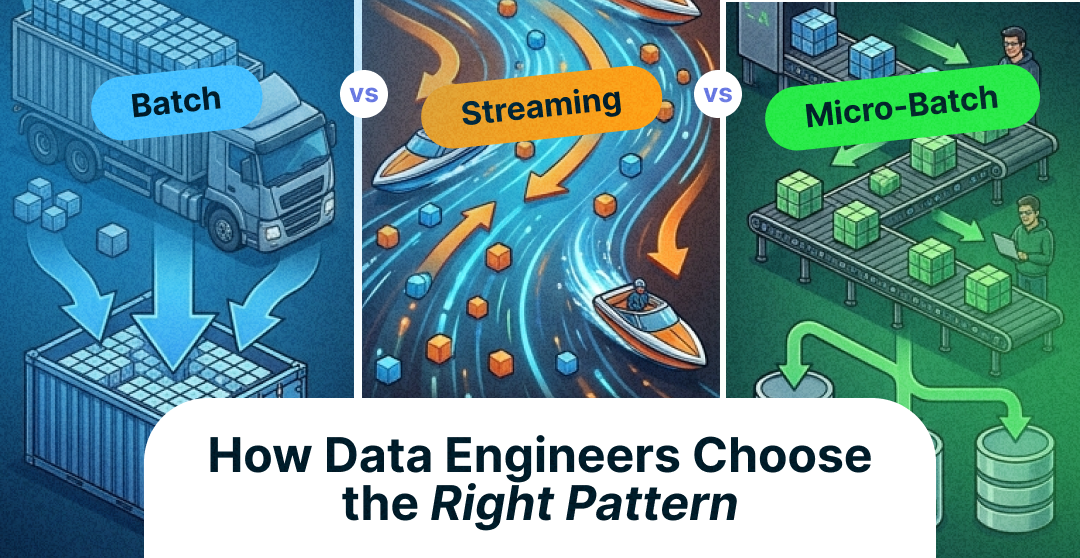
Batch vs Streaming vs Micro-Batch: How Data Engineers Choose the Right Pattern
Data engineers choose batch, streaming, or micro-batch by matching the pipeline to business timing. The batch vs streaming data pipeline decision depends on latency, cost, data volume, and what the team can support. Batch runs on schedules, streaming handles events as they arrive, and micro-batch groups small bursts every few seconds or minutes. The best pattern is the one that meets the need with the least operational pain.
That sounds simple, but teams still get this choice wrong. A daily finance report does not need a live event pipeline, and a fraud alert cannot wait for tomorrow’s job.
Key Points
- Batch processing is usually the simplest and cheapest option.
- Streaming is best when every event matters right away.
- Micro-batch fits teams that need fresher data without full streaming complexity.
- Latency matters, but correctness and support load matter too.
- Tool choice usually follows the pattern, not the other way around.
Quick summary: Batch is best for scheduled work, streaming is best for instant reactions, and micro-batch covers the wide middle where minutes matter but seconds do not.
Key takeaway: The right pattern is not the fastest one. It is the one that meets the SLA, keeps data correct, and stays manageable after the first launch.
Quick promise: If you use these rules first, you can avoid overbuilding your next pipeline and pick a pattern your team can keep running six months later.
What each pattern really does
The core difference is when data moves and how often compute runs.
Batch processing: move data in scheduled chunks
Batch collects records over time, then processes them on a schedule or trigger. That schedule might be hourly, nightly, or once a day.
This pattern fits daily reporting, ETL jobs, large backfills, and historical rebuilds. It trades freshness for simpler operations. In many teams, that also means lower cost and fewer failure points.
Streaming: process events as they happen
Streaming handles events continuously, or close to it. The system reacts as data arrives, often within milliseconds or seconds.
That makes it useful for fraud alerts, live dashboards, clickstream tracking, system monitoring, and user-facing features. You get fresh data fast, but you also take on more moving parts, more state, and more work around ordering and recovery.
Micro-batch: the middle ground many teams choose
Micro-batch groups small sets of events and processes them every few seconds or minutes. It is not fully continuous, but it feels near-real-time to many business users.
Teams often pick it when batch is too slow and full streaming feels heavy. In practice, it balances latency, cost, and simplicity better than many people expect.
How data engineers compare the tradeoffs
Picking a pattern is usually a tradeoff discussion, not a purity test.
This table gives the fast comparison:
| Pattern | Latency | Cost | Complexity | Reliability focus | Common use cases |
| Batch | Minutes to hours | Lower | Lower | Re-runs, idempotent jobs | Reporting, ETL, backfills |
| Micro-batch | Seconds to minutes | Medium | Medium | Small-window retries, duplicate control | Near-real-time analytics |
| Streaming | Milliseconds to seconds | Higher | Higher | State, ordering, late events | Alerts, live products, monitoring |
The short version is clear: faster data usually costs more to build and run.
Latency: how fresh does the data need to be?
Start with the business question. If a fraud model must block a payment now, seconds matter. If a sales dashboard refreshes every 10 minutes, micro-batch is often enough. If finance closes books every morning, daily batch is fine.
Freshness only matters when it changes an outcome. Many “real-time” requests are really “same hour” requests.
Cost and complexity: what can the team support?
Streaming usually needs more engineering time. You need stronger monitoring, better on-call habits, and more care around scaling and failures.
Batch is easier to reason about because work happens in clear runs. Micro-batch trims some complexity because engineers still work with bounded chunks, not a constant event flow.
Data quality, retries, and failure handling
Speed means little if the numbers are wrong. Batch is often easiest to retry because you can re-run a known time slice. Streaming is harder because events can arrive late, out of order, or more than once.
That is why engineers care about correctness as much as latency. Exactly-once delivery sounds great, but many real systems settle for at-least-once processing plus good deduplication and idempotent writes.
A simple way to choose the right pattern
A few rules of thumb handle most projects.
Use batch when speed is less important than simplicity
Batch is the safe default for reports, analytics models, large transforms, and backfills. It works well when users can wait for the next scheduled run.
If the business will not act on data within minutes, batch is often the smart choice. It is also easier for smaller teams and career switchers to build well.
Use streaming when the business needs instant action
Choose streaming when each event needs a fast response. Good examples include fraud detection, live recommendations, IoT alerts, gaming events, and ops monitoring.
Still, validate the need. A dashboard that updates every 30 seconds may not need full streaming if a 5-minute delay changes nothing important.
Use micro-batch when you need faster data without full streaming
Micro-batch works well for near-real-time dashboards, incremental pipelines, and teams moving toward event-driven work one step at a time. It is also common when warehouse refreshes every few minutes are good enough.
This pattern can be a strong long-term fit. However, it becomes a limit when each single event needs its own immediate action.
Common tools and architecture choices behind each pattern
Tools matter, but the pattern should drive the stack.
Where batch jobs usually run
Batch jobs often run in Airflow, dbt, Spark, or warehouse-native schedulers. Snowflake tasks, BigQuery scheduled queries, and Databricks jobs all fit this model.
What streaming architecture usually needs
Streaming usually adds an event broker, such as Kafka or Kinesis, plus a stream processor like Flink or Spark Structured Streaming. Teams also need state handling, windowing logic, and strong monitoring.
How micro-batch often fits modern data stacks
Micro-batch often lives inside frequent Spark jobs, incremental ETL, or warehouse pipelines that run every few minutes. That is why it fits many lakehouse and warehouse-first stacks.
One-minute summary
- Start with the business deadline, not the tool.
- Pick batch if hourly or daily freshness is enough.
- Pick streaming if delay changes the decision or user experience.
- Pick micro-batch if you need fresher data with less overhead.
- Plan for retries, duplicates, and late data before launch.
- Choose a pattern your team can monitor and support.
Conclusion
Choose batch for simplicity, streaming for instant action, and micro-batch for the practical middle path. Most teams do not need the fastest option, they need the most reliable one that still meets the business deadline.
If you want hands-on practice with these tradeoffs, Data Engineer Academy’s courses walk through real pipelines, system design, and project work that mirrors the job.
Glossary
Latency: Time between an event and usable output.
Batch processing: Scheduled processing of accumulated data.
Streaming: Continuous processing of incoming events.
Micro-batch: Small scheduled groups of recent events.
Idempotent write: A repeatable write that does not duplicate results.
Late data: Events that arrive after their expected time window.
State: Stored context a pipeline needs across events.
Windowing: Grouping streaming events by time or count.
FAQ
What is the main difference between batch and streaming?
Batch processes stored data on a schedule. Streaming processes events as they arrive. The real difference is timing: batch favors simplicity and lower cost, while streaming favors low latency and faster reactions.
Is micro-batch the same as streaming?
No. Micro-batch processes small chunks at short intervals, such as every 30 seconds or 5 minutes. Streaming handles events continuously. Micro-batch feels near-real-time, but it still works in bounded groups.
When is batch processing the best choice?
Batch is best when users can wait for updates. Common cases include daily reports, backfills, warehouse transformations, billing, and historical analytics. It is also a strong default when the team wants simpler operations.
When does streaming justify the extra cost?
Streaming earns its cost when delay changes the outcome. Fraud checks, operational alerts, IoT monitoring, and live product features are strong examples. If the business can wait a few minutes, streaming may be more than you need.
Can a data warehouse handle micro-batch pipelines?
Yes, often. Many teams run micro-batch with warehouse tasks, incremental models, or frequent scheduled jobs. This works well when data freshness targets are in minutes, not milliseconds.
Which tools are common for each pattern?
Batch often uses Airflow, dbt, Spark, and warehouse schedulers. Streaming often uses Kafka, Kinesis, Flink, or Spark Structured Streaming. Micro-batch can use Spark, Databricks jobs, or warehouse-native scheduled pipelines.
How do late events affect streaming pipelines?
Late events can break counts, windows, and downstream logic if you ignore them. Teams handle this with watermarks, allowed lateness, reprocessing rules, and deduplication. Correctness planning matters as much as low latency.
Should beginners learn batch or streaming first?
Start with batch. It teaches orchestration, transformations, retries, data modeling, and warehouse thinking with less overhead. After that, streaming concepts make more sense because you already understand pipeline fundamentals.