
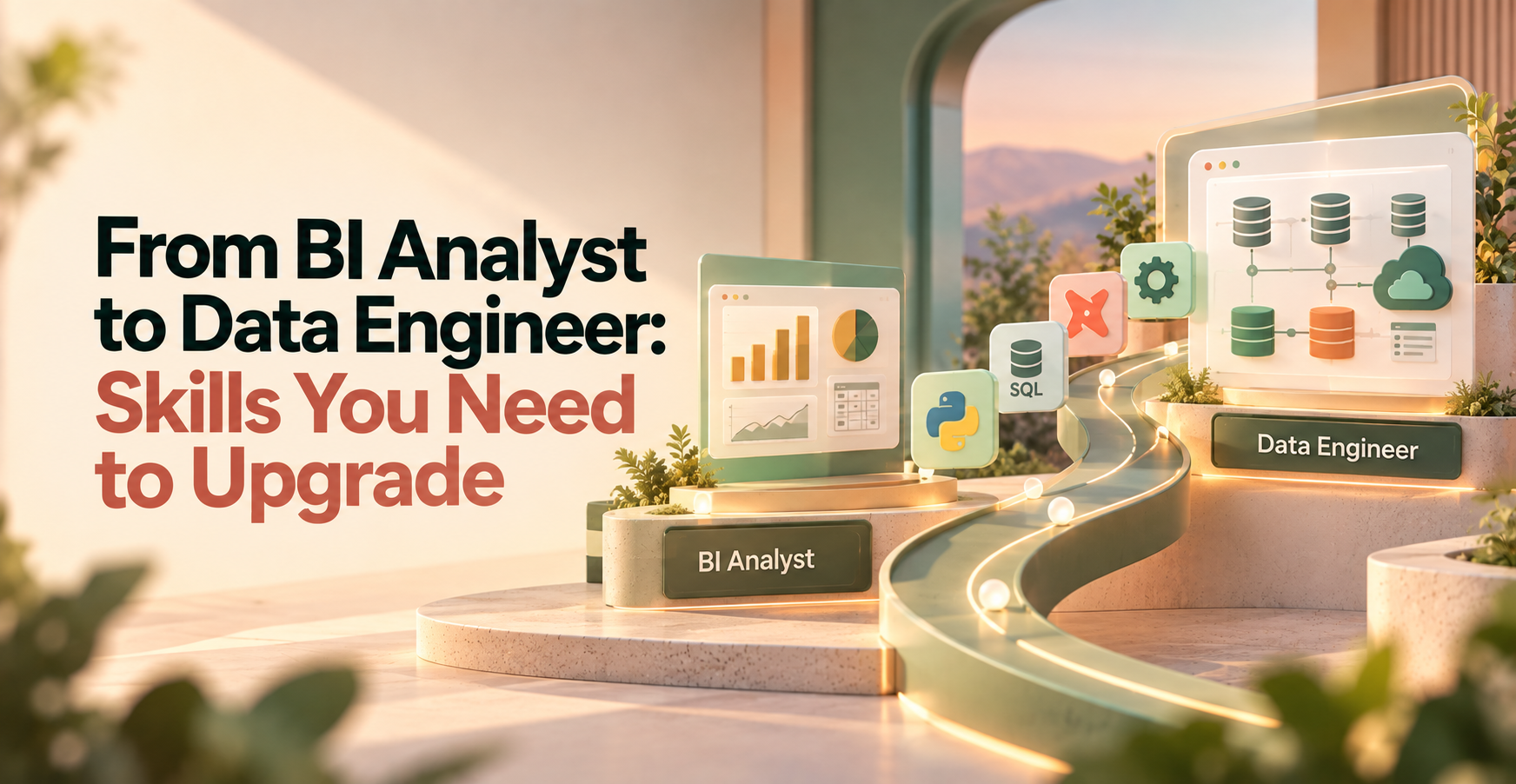
From BI Analyst to Data Engineer: Skills You Need to Upgrade
You can move from BI analyst to data engineer by building skills in Python, data pipelines, cloud platforms, testing, and software engineering practices. Your SQL, data modeling, and business knowledge provide a useful foundation.
The main upgrade is learning to build and maintain reliable systems that other teams can trust. Start by expanding the skills you already use.
Key Points
- Keep strengthening SQL while learning Python and Git.
- Build repeatable pipelines with tests and recovery steps.
- Practice with one cloud platform and one warehouse.
- Show hiring teams working projects and clear technical decisions.
Quick summary: BI experience transfers well, but engineering adds responsibility for ingestion, automation, and reliable updates.
Key takeaway: A successful pipeline must handle failures, not merely complete a successful run.
Quick promise: You’ll have a practical learning sequence and a focused plan for demonstrating engineering skills.
From BI Analyst to Data Engineer: Skills You Need to Upgrade
As a data engineer, you’ll build datasets that support multiple reports, applications, and teams. That requires thinking beyond individual dashboard requirements.
The responsibilities overlap, but the expected deliverables change.
| Work area | BI analyst emphasis | Data engineer emphasis |
| SQL | Answer business questions | Build reusable transformations |
| Modeling | Support reporting | Maintain shared datasets |
| Automation | Refresh reports | Coordinate pipeline dependencies |
| Troubleshooting | Investigate metric discrepancies | Recover failed data processing |
The biggest upgrades are Python, production data modeling, and software engineering habits.
Keep your SQL strength, then add Python and software basics
Joins, window functions, and query tuning remain valuable. However, engineers also need to explain query execution plans and prevent joins that multiply rows unexpectedly.
Learn Python functions and modules before building large scripts. Practice reading files, calling APIs, validating responses, and handling exceptions. Add Git, command-line tools, and basic automated tests.
You don’t need to become a general software developer. You need enough software knowledge to organize data-processing code, manage dependencies, and change it without breaking existing behavior.
Shift from reporting models to production-ready data models
Shared models need explicit grain, stable keys, and documented update rules. For example, Shopify order data can support a sales fact table with one row per order line.
Keep product and customer attributes in dimensions. Define how cancellations and refunds affect revenue before publishing the model.
Normalization reduces duplication, while denormalized tables can simplify warehouse queries. Choose based on update patterns and downstream needs. Also document incremental loading rules so another engineer can maintain the model without guessing.
Learn to Build Data Pipelines That Run Reliably
A data pipeline moves information through repeatable steps. A typical batch pipeline reads an API, stores raw responses, loads a warehouse, and transforms records into reporting tables.
Practice ingestion, orchestration, and incremental processing
Start with batch processing, which handles data at scheduled intervals. Streaming processes events continuously and introduces additional operational complexity.
Apache Airflow coordinates tasks through schedules and dependencies. Managed options include Amazon MWAA and Google Cloud Composer. Whichever tool you choose, learn retries, backfills, and failure handling.
Incremental loading processes new or changed records instead of reloading everything. It reduces unnecessary work, but you must handle late arrivals and updates to existing records.
Design reruns to avoid duplicates. For example, a warehouse merge can update existing records by a stable key while inserting new ones.
Make pipelines safer with tests, data quality, and monitoring
Check for missing keys, duplicates, unexpected schema changes, stale data, and broken relationships. dbt offers not_null, unique, and relationships tests. Source freshness checks address whether expected data has arrived.
Record task status, row counts, and useful error details in logs. Send alerts when failures require attention rather than hiding problems behind unlimited retries.
When a job fails, inspect the earliest failed step. Check source availability, credentials, and recent changes before rerunning affected tasks.
A successful rerun should repair the missing data without duplicating records that already loaded.
Keep recovery instructions beside the project code.
Add Cloud, Warehouse, and Data Platform Skills Employers Expect
Your warehouse experience is a bridge into platform work. Choose one cloud and one warehouse first, such as AWS with Redshift or GCP with BigQuery.
Snowflake is another warehouse option. You don’t need every vendor to understand the underlying concepts.
Understand storage, permissions, and the cost of cloud data
Object storage holds files independently of warehouse tables. Amazon S3, Azure Data Lake Storage, and Google Cloud Storage commonly hold raw extracts and intermediate datasets.
For a pipeline task, first save the source response to storage. Then grant the loading process permission to read the required location.
Learn roles, access policies, and secret management. Keep API tokens outside code, and grant only the permissions each task needs.
Cloud costs require attention too. Storage, query processing, and idle compute can all create charges. Configure budget alerts, inspect usage, and shut down resources you no longer need.
Use engineering habits that keep shared data trustworthy
Keep code and configuration in version control. Review changes before merging, and test them outside production.
Separate development and production resources so experiments don’t overwrite shared tables. Document setup steps, ownership, dependencies, and recovery procedures.
Governance and privacy also belong in engineering work. Avoid copying sensitive customer data into public repositories. Apply least-privilege access, and use synthetic or approved public data for demonstrations.
Analysts already practice rigor. The difference is the operating context: shared pipelines need repeatable controls because their failures can affect many downstream users.
Build a Focused Learning Plan and Prove Your Skills With Projects
A small, coherent portfolio gives hiring teams evidence they can inspect. Each project should demonstrate a different level of responsibility.
Follow a project sequence from SQL transformations to a full pipeline
First, strengthen Python and Git through small file-processing tasks. Next, build SQL transformations with explicit keys, documented grain, and automated checks.
Then build an end-to-end pipeline using NYC Open Data’s 311 service-request data. Extract a manageable subset through its API, preserve raw files in cloud storage, and load a warehouse.
Add orchestration, incremental updates, tests, and failure alerts. Publish reporting tables for request counts by date and borough.
Include setup instructions and architecture notes. Explain choices such as batch frequency and update handling. Finally, demonstrate a failed run and recovery, not only the finished tables.
Use BI experience to stand out in applications and interviews
Describe the technical work behind your dashboards: reusable SQL, dimensional models, metric definitions, and conversations that resolved conflicting business requirements.
Use measured results only when you have evidence. State your own contribution clearly, especially when engineering teams owned ingestion or infrastructure.
For interviews, practice pipeline design, debugging, data modeling, and tradeoff questions. Explain why you selected a loading method and what happens when the source changes.
Data Engineer Academy offers end-to-end projects, mentorship, mock interviews, and resume support. Those services can provide structure when you need feedback beyond independent practice.
Data Engineering Glossary
Grain: What one row in a table represents.
Orchestration: Scheduling tasks and managing their dependencies.
Incremental load: Processing new or changed records rather than the entire dataset.
Backfill: Loading or reprocessing data for an earlier period.
Idempotency: Repeating an operation without changing the intended result or creating unintended duplicates.
Schema: The structure of data, including columns and data types.
Data freshness: How recently a dataset received an expected update.
Least privilege: Giving a user or process only the access needed for its task.
Conclusion: Build One Pipeline You Can Explain
Your BI background gives you a strong starting point. The next step is proving you can keep shared data dependable.
- Strengthen Python alongside your existing SQL skills.
- Define grain and update rules before loading data.
- Make pipeline reruns safe.
- Add tests, logs, and recovery instructions.
- Practice permissions and cloud cost controls.
- Present decisions and results honestly in interviews.
Start with one small pipeline and document how it handles failure. That creates engineering evidence you can discuss with a hiring team.
If you want guided practice and feedback, consider Data Engineer Academy’s projects and mentorship. For your next read, choose a beginner guide to building an end-to-end data pipeline.
FAQ: Preparing for the Career Transition
Can a BI analyst become a data engineer without a computer science degree?
Yes, a BI analyst can become a data engineer without a computer science degree. Hiring requirements vary, but SQL, Python, data modeling, and demonstrated pipeline work provide relevant evidence. Study software fundamentals and be ready to explain testing, dependencies, error handling, and your project architecture.
How much Python do you need for data engineering?
You need practical Python skills for reliable data processing. Focus on functions, modules, collections, file handling, API requests, exceptions, and testing. pandas helps with smaller tabular workloads, but you should also understand memory limits and when database processing is a better fit.
Should beginners learn Spark immediately?
Beginners don’t need Spark immediately. Start with SQL, Python, and batch pipelines so you understand ingestion, transformations, and recovery. Learn Spark when your target roles require distributed processing. Apache Spark becomes more useful once you can explain partitioning, execution costs, and workload size.
What is the difference between ETL and ELT?
ETL transforms data before loading it into the target system. ELT loads data first and performs transformations in the destination, commonly a warehouse. The right choice depends on source formats, privacy requirements, available compute, and where your team wants to maintain transformation logic.
FAQ: Portfolio Projects and Job Applications
How long does it take to move from BI analyst to data engineer?
There isn’t a fixed timeline for the transition. Existing SQL skills, programming experience, and available study time change the preparation needed. Judge readiness by milestones: building a pipeline, testing it, recovering failures, documenting decisions, and explaining the architecture without relying on a tutorial.
Are cloud certifications enough to get a data engineering job?
Cloud certifications alone don’t demonstrate that you can operate a data pipeline. They can support platform knowledge, but hiring teams also need evidence of coding, modeling, and debugging skills. Pair certification study with a project that includes permissions, deployment instructions, and cost controls.
What should a beginner data engineering portfolio include?
A beginner portfolio should include reproducible code, setup instructions, an architecture diagram, tests, and documented tradeoffs. Use approved public data and remove credentials before publishing. Show how the pipeline handles changed records and failed runs, plus the warehouse tables that downstream users can query.
Should BI analysts apply for analytics engineering roles too?
Yes, analytics engineering roles can be a useful bridge when they emphasize SQL transformations, dbt, testing, and shared models. Read job descriptions carefully because responsibilities vary. Apply where your existing strengths match the work, while continuing to develop Python, ingestion, and platform skills.