
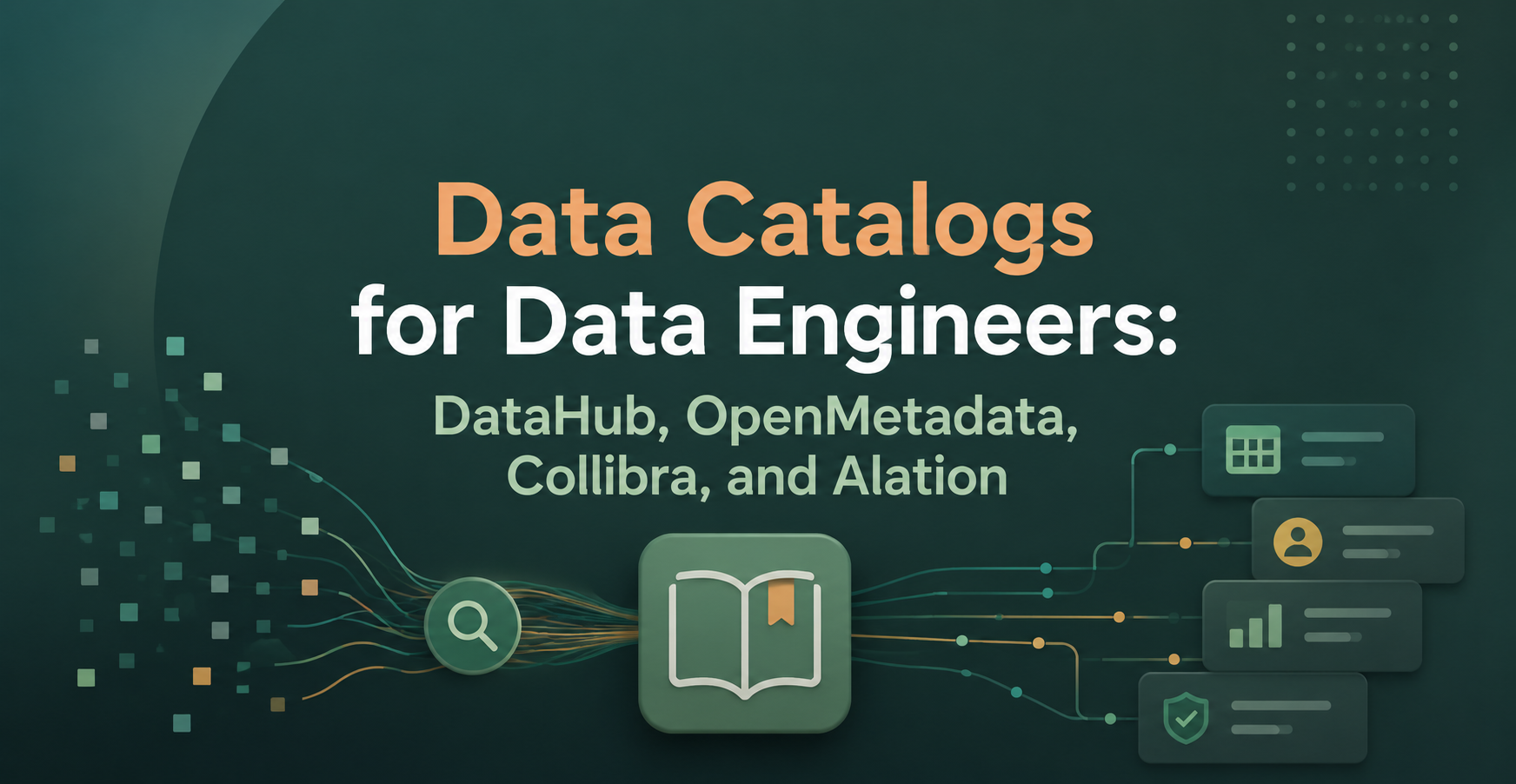
Data Catalogs for Data Engineers: DataHub, OpenMetadata, Collibra, and Alation
Data catalogs help data engineers find trusted data faster, understand where it came from, and keep pipelines easier to debug. For dxata engineering teams, the right catalog turns scattered metadata into searchable context, so you spend less time chasing table owners and more time fixing real issues. DataHub, OpenMetadata, Collibra, and Alation all solve that problem, but they solve it for different kinds of teams. The best choice depends on team size, governance needs, budget, and how much engineering effort you can put into setup and upkeep.
Key Points
- A good data catalog cuts time spent hunting for tables and owners.
- DataHub and OpenMetadata fit engineering-first teams well.
- Collibra works best when governance and process matter most.
- Alation shines when broad business adoption matters as much as metadata depth.
- The right pick depends on your biggest pain point, not the longest feature list.
Quick summary: DataHub and OpenMetadata lean technical; Collibra and Alation lean governance and business use.
Key takeaway: Pick the catalog that removes your biggest daily blocker first.
Quick promise: A useful catalog makes data easier to find, trace, and trust.
What a data catalog actually does for a data engineering team
A data catalog is a shared map of your data estate. It tells you what a table is, who owns it, where it came from, how it changed, and whether people trust it. That sounds simple, but it changes daily work in a big way.
Without a catalog, engineers lose time in Slack, tickets, and tribal knowledge. Someone asks which customer table is current. Another person wants to know why a dashboard broke after a schema change. A third needs to trace a bad metric back to the pipeline that wrote it. A catalog pulls those answers into one place.
The problems it solves in real workflows
Most teams don’t struggle because they lack data. They struggle because nobody knows which data is safe to use. Duplicate datasets pile up. Business definitions drift. Ownership gets fuzzy. Lineage is missing until something breaks.
As a result, engineers waste hours proving basic facts. Analysts build on stale tables. Business users stop trusting dashboards. The catalog becomes the place where context lives, not just the place where assets are listed.
The features that matter most
Search matters first. If people can’t find assets fast, they won’t use the tool. After that, focus on lineage, ownership, schema history, glossary terms, tags, and usage context.
Integrations matter too. Your catalog should connect to warehouses like Snowflake and BigQuery, orchestration tools like Airflow, transformation layers like dbt, and BI tools like Looker or Tableau. If metadata stays fresh, the catalog stays useful.
DataHub vs OpenMetadata vs Collibra vs Alation: what each one is best at
These four tools overlap, but they don’t aim at the same buyer or operating model.
The table below shows the practical differences.
| Tool | Best for | Setup | Governance | Collaboration | Extensibility | Team size |
| DataHub | Engineering-led teams | Moderate | Medium | Good | High | Small to large |
| OpenMetadata | Unified metadata platform | Moderate | Medium to high | Good | High | Small to mid-sized |
| Collibra | Formal governance programs | Heavier | High | Strong stewardship | Medium | Mid-sized to large |
| Alation | Broad discovery and adoption | Moderate | High | Strong business use | Medium | Mid-sized to large |
The short version is clear. DataHub and OpenMetadata usually fit modern data teams that want flexibility. Collibra fits organizations with tighter control needs. Alation fits teams that want strong search and wider use outside engineering.
DataHub: strong for modern engineering teams
DataHub comes from an engineering-heavy mindset. Teams often like it because lineage is strong, the metadata model is flexible, and the platform works well with active developer workflows.
It’s a good match when your team wants to move fast, automate metadata collection, and shape the catalog around your stack. If engineers already own platform tooling, DataHub often feels natural.
OpenMetadata: a good fit when you want one platform for metadata
OpenMetadata also appeals to technical teams, but its pitch is a bit different. It focuses on centralizing metadata management and making discovery easy across systems.
Many teams compare DataHub vs OpenMetadata directly. The choice often comes down to workflow fit. DataHub can feel stronger for teams that want deeper customization. OpenMetadata can feel cleaner for teams that want one place to manage metadata with less platform sprawl.
Collibra: built for governance-heavy organizations
Collibra is usually the better fit when governance is not optional. If you need stewardship workflows, policy control, business glossary ownership, and formal review paths, Collibra is built for that style of work.
That makes it attractive in regulated industries and large organizations. Data engineers may not love every process step, but companies that need auditability and formal control often accept that tradeoff.
Alation: strong search and business-friendly adoption
Alation is known for data discovery, search, and collaboration that works well for non-technical users. It often lands well in organizations where adoption across analytics, finance, operations, and product matters as much as technical metadata depth.
For engineers, that means fewer repeated questions from business teams. For everyone else, it means the catalog feels usable, not like an internal admin tool.
How to choose the right data catalog for your team
The best catalog is the one your team will keep current. That’s why selection should start with the problem you need to fix first, not the broadest product demo.
Choose based on your biggest pain point
If your team needs flexible lineage, engineering integrations, and open workflows, start with DataHub or OpenMetadata. If governance reviews, policy control, and stewardship are the main issue, Collibra usually fits better. If search quality and business adoption matter most, Alation is a strong choice.
Budget also matters. Open-source options can lower licensing costs, but they still need owner time. Commercial tools may reduce platform work, yet they usually bring higher cost and more process.
Questions to ask before you buy or deploy
Ask a few blunt questions before you commit:
- Which systems must connect on day one?
- Who owns the catalog after launch?
- How will metadata stay fresh?
- Which users need it most, engineers, analysts, stewards, or business teams?
- Can your team support admin work, access control, and training?
If you can’t answer those, the tool won’t fix the underlying problem.
A simple rollout plan that keeps the catalog useful
A catalog fails when it becomes a side project with stale metadata. Rollout matters as much as product choice.
Start small, then expand
Start with one warehouse, one domain, or one high-value pipeline. Pick assets people already care about, such as revenue tables, customer dimensions, or executive dashboards.
That gives the catalog a real audience fast. It also keeps the first rollout small enough to manage.
Keep the metadata fresh
Fresh metadata builds trust. Automate ingestion where you can. Assign owners for key datasets. Review critical assets on a schedule. Add glossary terms for fields that create confusion.
If nobody updates the catalog, people stop believing it. Once trust drops, adoption drops with it.
Glossary
- Data catalog: A searchable system for data assets and their context.
- Metadata management: The practice of collecting and organizing data about data.
- Data lineage: A record of where data came from and how it moved.
- Ownership: The named person or team responsible for a dataset.
- Business glossary: Shared definitions for terms, metrics, and core concepts.
- Schema: The structure of a table, including fields and types.
- Tag: A label used to group, classify, or warn about data.
- Stewardship: Ongoing review and care for data quality and meaning.
Conclusion
DataHub and OpenMetadata usually make the most sense for engineering-first teams that want flexible metadata management and strong integrations. Collibra fits organizations that need tighter governance and formal ownership workflows. Alation stands out when search, discovery, and business adoption are top priorities.
The right data catalog should reduce confusion, not add another system to maintain. If it helps your team find, understand, and trust data faster, it’s doing its job.
FAQ
What’s the difference between a data catalog and data lineage?
A data catalog is the broader system. It includes search, ownership, glossary terms, tags, and documentation. Data lineage is one part of that system. Lineage shows how data moved and changed across sources, pipelines, and downstream assets.
Is DataHub or OpenMetadata better for small teams?
Both can work well for small teams. DataHub often appeals to teams that want more customization and engineering control. OpenMetadata often appeals to teams that want a cleaner, centralized metadata platform. Your stack and owner time usually decide the winner.
When does Collibra make more sense than an open-source catalog?
Collibra makes more sense when governance is a hard requirement. That usually means formal stewardship, approval flows, policy tracking, and strong business glossary ownership. Large or regulated organizations often need that structure more than they need maximum flexibility.
Is Alation only for business users?
No. Alation is useful for engineers too, especially when cross-team discovery is a problem. Its strength is making data easier to find and understand across technical and non-technical users, so engineers answer fewer repetitive questions.
What should you learn next after choosing a catalog?
Learn lineage, data modeling, and metadata automation next. Those skills make any catalog more useful. If you want guided practice, Data Engineer Academy’s courses pair catalog concepts with SQL, pipelines, and real projects.