
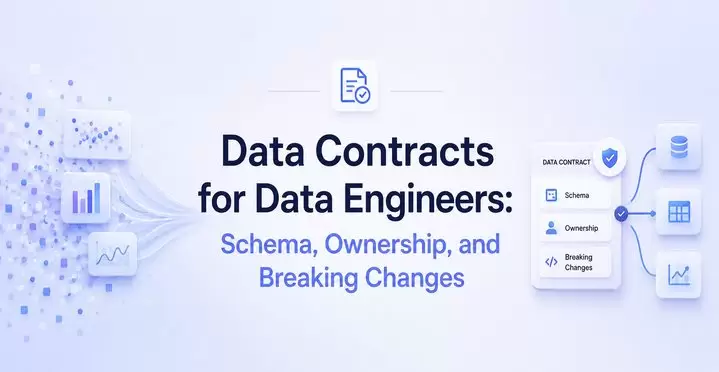
Data Contracts for Data Engineers: Schema, Ownership, and Breaking Changes
A data contract is an agreement between the team that publishes data and the teams that use it. In data contracts in data engineering, that agreement covers schema, ownership, and change rules, so downstream jobs don’t break without warning. Data engineers use contracts to catch issues early, protect dashboards and models, and stop “small” upstream changes from turning into production incidents.
When the contract is clear, trust goes up. When it isn’t, a renamed field or shifted meaning can break reports hours later, after bad data has already spread.
Key Points
- A data contract defines structure, meaning, timing, quality, and ownership.
- A schema is only one part of the contract, not the whole contract.
- Every critical dataset needs a named owner and a clear change process.
- Breaking changes should be defined before teams ship them.
- Contracts work best when checks run in CI, ingestion, or deployment workflows.
What a data contract actually is
A data contract is a shared promise. One team produces data, another team depends on it, and both agree on what “correct” looks like. That includes field names and types, but it also includes meaning, freshness, allowed values, and who responds when something goes wrong.
For a data engineer, this is practical, not academic. If the payments service emits an event with amount as a number today, consumers shouldn’t wake up tomorrow to find it changed to a string or missing on refunds.
How data contracts are different from schemas and SLAs
Teams mix up schemas, contracts, and SLAs because all three describe expectations. The difference is scope.
A schema tells you what the data looks like. A data contract tells you what the data means, who owns it, and how it can change.
A schema can validate shape. A contract also sets accountability.
A simple data contract example you can picture
Take an orders table used by finance, BI, and a fraud model. A basic contract might say order_id is required, created_at is UTC, status must be one of five values, and total_amount is stored in cents. It might also name the checkout team as owner, list a backup contact, and require 14 days’ notice before removing any column.
That is a real contract. It gives downstream users something they can build on.
The three parts every data contract should define
A good contract answers three questions: what the data looks like, who is responsible for it, and what happens when it changes. If one of those answers is missing, the contract is weak where failures usually happen.
Schema rules that keep downstream jobs stable
Start with the parts that break systems. Define required fields, data types, nullability, naming rules, and accepted values. Add time rules where needed, such as event timestamps in UTC or partition dates in YYYY-MM-DD.
These rules protect more than raw pipelines. They protect dbt models, BI dashboards, ML features, reverse ETL jobs, and alerts. Most importantly, checks should run before bad data lands in shared tables.
Ownership that makes one team accountable
Ownership needs a name, not a vague group label. Every important dataset should have a primary owner, a backup contact, and a review path for changes.
That matters because “the platform team owns it” often means nobody owns it. Clear pipeline ownership shortens incident response and removes the usual back-and-forth when consumers report a break.
Breaking changes and how to define them early
A breaking change is any change that can make a consumer fail or misread the data. Removing a column is breaking. Renaming a field is breaking. Changing user_id from integer to string is usually breaking. Changing the meaning of status without changing the name is also breaking.
By contrast, adding a nullable field is often safe. So is adding documentation or loosening an internal rule that consumers don’t rely on. Clear rules reduce arguments because everyone knows the line before release day.
How data contracts help data engineers prevent pipeline failures
Data contracts move failure detection earlier. Instead of learning about a problem from a broken dashboard at 9 a.m., you catch it during CI, at ingestion, or before a producer deploys.
That changes daily operations. Debugging gets faster because the expected shape and owner are already written down. Communication gets easier because consumers know when a change is safe and when they need to act.
What happens when contracts are missing
The pattern is common. A producer changes a field. No one tells downstream teams. A batch job fails later, a streaming consumer drops records, or a BI model starts returning nulls. Then alerts fire, ownership is fuzzy, and root cause takes too long to find.
The technical cost is rework. The bigger cost is lost trust in data.
Where contracts fit in the data pipeline lifecycle
The best place to check a contract is before production data spreads. For batch systems, that might be in CI or before a table change is merged. For streaming, it might be at schema registration or event publication. For transformation layers, contract checks can run with dbt tests or validation jobs.
Post-incident checks are still useful, but they are late. Prevention is the point.
How to design a contract that teams will actually follow
The best contracts are short, readable, versioned, and testable. If a contract feels like legal paperwork, engineers will avoid it. If it only lives in tribal knowledge, it will drift.
Choose only the rules that matter most
Don’t document every possible detail on day one. Start with fields that are business-critical, widely reused, or likely to break downstream systems. A payments feed deserves tighter rules than a temporary staging table.
Too many rules can slow adoption. Teams keep contracts current when the contract is small enough to maintain.
Make ownership and escalation paths visible
Include the owner team, the main contact, who approves changes, and who gets paged if validation fails. Also note the consumers when the dataset is shared widely.
That small section pays off during incidents. Engineers shouldn’t need detective work to find who can approve or fix a change.
Use examples and validation checks to remove guesswork
Sample records help humans. Automated checks help machines. Together, they close the gap between what the producer meant and what the consumer assumed.
A good schema contract often includes one or two example records, accepted enum values, and validation rules tied to CI or ingestion. That keeps the contract real, not decorative.
A practical way to handle breaking changes without chaos
Change management is where many contracts fail. The fix is simple: define safe changes, define breaking changes, version the contract, and give consumers time to move.
Versioning and deprecation windows that reduce risk
Use version numbers and short change notes. When a change is breaking, publish a new version, keep the old version alive for a set window, and notify consumers early. That gives teams time to update dashboards, pipelines, and model features without panic.
How to set up alerts and approvals for schema changes
A basic flow is enough. Validate the change, get peer review, notify affected consumers, and merge only when checks pass. For shared datasets, require explicit approval for breaking changes.
You don’t need a heavy process. You need a visible one.
Tools and patterns that support data contracts in modern stacks
Contracts become real when they’re tied to tools engineers already use. For event data, schema registries work well with formats like Avro or Protobuf. For tables and transforms, dbt tests, Great Expectations, Soda, and CI checks can enforce field rules and quality expectations.
Where schema registries and tests fit best
Schema registries are strongest in streaming systems such as Kafka. Tests fit better in warehouses, transformation layers, and batch pipelines. Many teams use both because contracts show up at multiple stages.
How catalogs and documentation support ownership
Catalog tools such as DataHub, OpenMetadata, and Amundsen make owners, definitions, and dependencies easier to find. That matters because a contract only helps if people can locate it, read it, and know who to contact.
FAQ
Are data contracts only for streaming data?
No. They work for streaming events, warehouse tables, APIs, and shared data products. Anywhere one team publishes data and another team depends on it, a contract can prevent surprise breaks.
Do data contracts replace data quality tests?
No. A contract sets expectations. Data quality tests check whether the data meets them. Most teams need both, because a written rule without validation won’t stop bad data.
Who should own a data contract?
The producing team should own it. That team controls the source and can approve changes. Shared datasets also need a backup contact and a clear incident path.
How strict should a data contract be?
It should be strict on fields and rules that can break downstream systems. Keep low-risk details flexible. Too much strictness slows teams down and makes contracts harder to maintain.
What counts as a breaking change?
Removing a field, renaming a field, changing a data type, or changing meaning without notice usually counts as breaking. Safe changes are often additive, such as adding a nullable column.
Can small teams use data contracts?
Yes. A small team can start with a short document or YAML file, a named owner, and a few automated checks. You don’t need a big platform team to get value.
How do data contracts work with dbt?
dbt can enforce parts of the contract through tests, schema definitions, and CI workflows. It is helpful for warehouse tables and transformations, though ownership and change policy still need to be written clearly.
What should I learn next after data contracts?
Learn schema evolution, data modeling, and data observability next. Those topics build on the same core idea: stable, trusted data depends on clear structure, clear ownership, and early detection.
Conclusion
Data contracts help data engineers protect schema, define ownership, and control breaking changes before they hit production. They turn unspoken assumptions into clear rules, which means fewer surprise failures and faster debugging.
Start with one critical dataset. Name an owner, write the few rules that matter most, and define what counts as a breaking change. If you want hands-on practice with these patterns in real pipelines, Data Engineer Academy’s DE Projects Course is a practical next step.