
Data Engineer Job Description: A Simple Breakdown for 2026
A data engineer builds and maintains the systems that move, clean, store, and prepare data. If a company wants reliable dashboards, reporting, or machine learning, this role helps make that happen.
Job posts can still feel confusing. One company says “pipeline development,” another says “data platform,” and another wants “ETL support.” The core job is usually the same, and that’s what you’re about to see.
Quick summary: Most data engineer roles focus on turning raw, messy data into clean, usable data. The job title may change, but the main work usually includes pipelines, storage, quality checks, and support for other teams.
Key takeaway: If a job post mentions SQL, Python, cloud tools, data warehouses, and pipeline reliability, you’re looking at the center of data engineering.
Quick promise: By the end, you’ll know what employers mean, which skills matter, what the day-to-day work looks like, and how to tell if this path fits you.
What a Data Engineer Job Description Usually Includes
A typical data engineer job description says this: you build and maintain systems that make data usable. Most postings focus on pipelines, data quality, storage, and support for analytics or machine learning.
Core responsibilities you will see in most postings
Think of the role like plumbing for data. The goal is simple, get the right data to the right place, in the right format, on time.
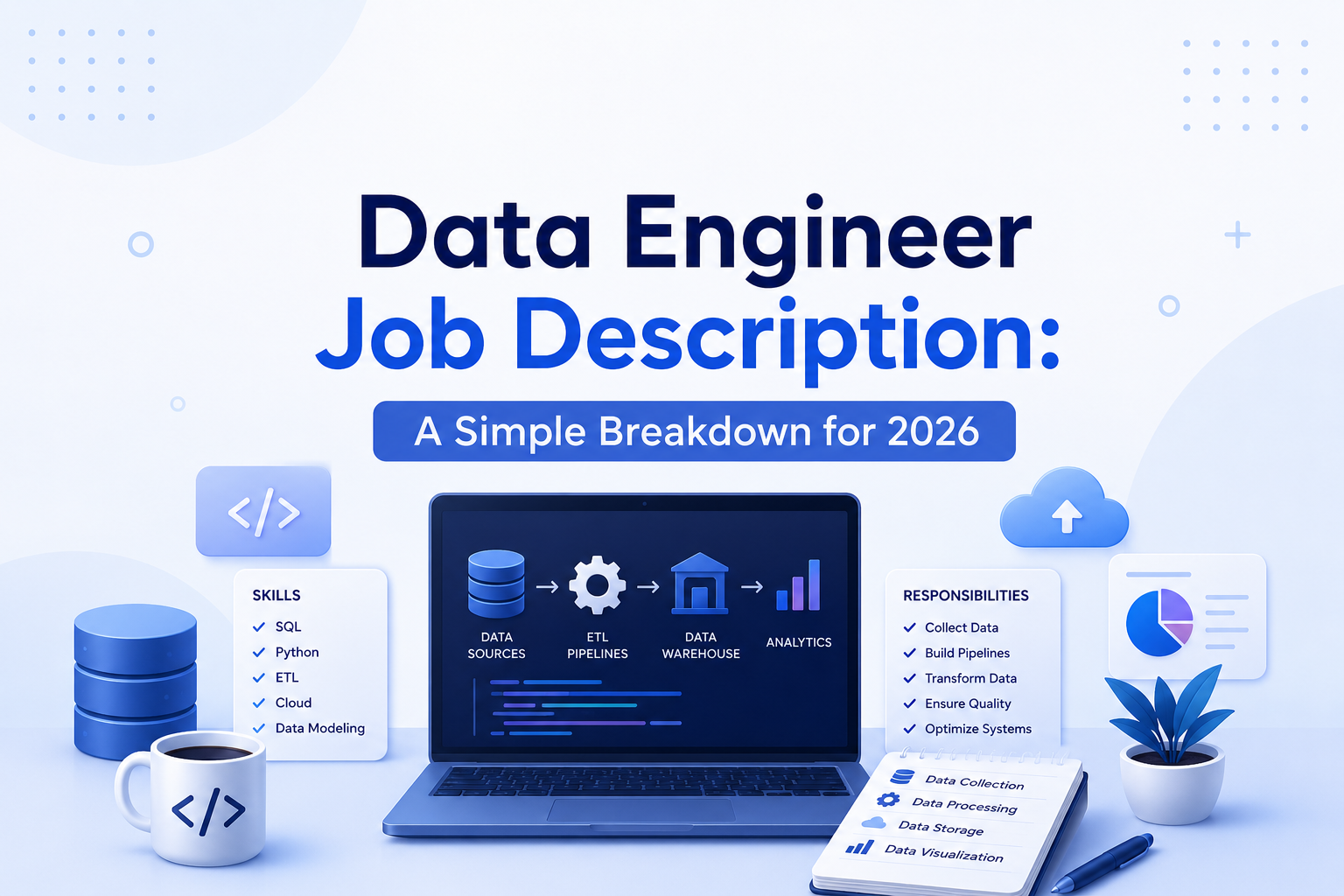
Common responsibilities include:
- Moving data from source systems into a warehouse or lake
- Cleaning messy records and standardizing formats
- Automating recurring workflows so data updates without manual work
- Monitoring jobs, fixing failures, and improving reliability
- Working with analysts, data scientists, and software teams
Some roles stay close to pipeline work. Others also include testing, cost control, documentation, and basic platform design.
Tools and technologies employers often list
SQL is usually the first thing employers ask for. Python is also common, especially for automation, APIs, and transformations.
Then you start seeing categories like cloud platforms, ETL or ELT tools, data warehouses, orchestration tools, and version control. One company may use AWS, Airflow, Snowflake, and Git. Another may use Azure, dbt, Databricks, and GitHub.
The stack changes by company. The pattern doesn’t.
The skills that matter most for the role
Data engineers need a mix of technical skill and problem-solving ability. Hiring managers want people who can write code, work with data systems, and catch issues before bad data spreads.
Technical skills employers expect first
SQL matters because you’ll query, join, filter, validate, and troubleshoot data all the time. Python matters because many teams use it for scripts, transformations, APIs, and workflow logic.
Data modeling is another big one. You need to understand how tables relate, how to structure data, and how to make reporting easier downstream.
You’ll also see employers ask for database knowledge, pipeline design, and cloud basics. Batch data means scheduled processing. Streaming data means data arrives closer to real time. Not every job needs both, but many postings want you to understand the difference.
Soft skills that help data engineers do well
This role isn’t only about code. You still need to explain problems, ask good questions, and work across teams.
Communication matters because analysts, product teams, and data scientists don’t all speak the same technical language. Attention to detail matters because one broken join or missing field can throw off a report. Collaboration matters because data issues often start in one system and show up somewhere else.
What a day in the life of a data engineer looks like
Most days are a mix of building, checking, and improving data systems. You’ll write code, test changes, fix broken jobs, review work, and talk with other teams.
Typical tasks during a normal workday
A normal day often includes:
- Checking alerts, failed jobs, or unusual data drops
- Writing SQL or Python for a new pipeline or update
- Testing transformations before they hit production
- Reviewing pull requests and commenting on logic or quality
- Meeting with analysts or product teams about new data needs
Some days are calm. Other days are all about fixing a broken dependency before business users notice.
Common problems data engineers solve
Here’s the thing, the job is not only “build pipeline, move on.” A lot of the work is making data trustworthy.
That means fixing missing data, duplicate records, slow jobs, broken schedules, schema changes, and poor data quality. Sometimes a source system changes without warning. Sometimes the data loads fine but the values are wrong. A good data engineer catches both problems.
Salary, seniority, and what changes the pay
Data engineering pay depends on location, company, and skills. Two jobs with the same title can pay very differently because the scope, tools, and expectations aren’t the same.
Why salary can vary so much from one job to another
Seniority is a major factor. So is the tech stack. A senior role that expects cloud architecture, platform ownership, and production support will usually pay more than a junior role focused on basic SQL and warehouse tasks.
Industry also matters. A finance company, a startup, and a healthcare org may all hire data engineers, but compensation can look very different. Company size, remote versus on-site expectations, and the cost of living in a given city also change the picture.
How to read a salary range in a job post
Don’t stop at base pay. Check for bonus, equity, benefits, remote flexibility, training support, and room to grow.
If exact pay is unclear, use verified sources like BLS, PayScale, Built In, Glassdoor, Levels.fyi, and Motion Recruitment. Then compare the role against your location and skill set. If you need a short version, here it is: Depends on location, company, and skills.
How to tell if this career is a good fit for you
Data engineering is a strong fit if you like solving technical problems and making data useful. If you enjoy systems, structure, and accuracy more than presentation work, you’ll probably like this role.
Signs you may enjoy data engineering
You may enjoy this path if:
- You like SQL and coding more than slide decks or dashboard polish
- You enjoy structured problem-solving and repeatable systems
- You care about accuracy and notice small inconsistencies
- You don’t mind reading logs, tracing bugs, or working with schemas
Do you like building the roads more than driving the car? That’s often the right instinct for this career.
When another data role may be a better match
If you want to answer business questions, build reports, and explain trends, data analyst may fit better. If you want to train models and run experiments, data scientist may fit better.
Conclusion
A data engineer job description usually sounds more complicated than the job itself. At its core, the role is about building systems that move, clean, store, and prepare data so teams can trust what they use.
When you compare job posts, focus on the real signals: pipelines, data quality, SQL, Python, cloud tools, and collaboration. That’s where the role lives, and that’s how you find the jobs that match your goals.
FAQs about the data engineer job description in 2026
Here are the short answers most people want first.
Is data engineering hard?
Yes, it can be hard, because the job mixes coding, systems thinking, and debugging. The good news is that you don’t need to learn everything at once. Start with SQL, Python, and one end-to-end project.
Can beginners get hired as data engineers?
Yes, but it is easier when you show proof of work. Entry-level candidates usually need a portfolio, internship, adjacent experience, or a strong project that looks like a real production workflow.
Which skills matter most first?
Start with SQL, Python, data modeling, and basic ETL or ELT concepts. If those are weak, fancy tools won’t save you. Strong fundamentals make every later tool easier to learn.
Is cloud experience required?
Not always for your first role, but it helps a lot. Many teams run pipelines in AWS, Azure, or GCP, so basic cloud storage, compute, and permissions knowledge makes you more competitive.
How long does it take to learn the role?
It depends on your background and practice time. Someone with coding experience can ramp faster. A beginner usually needs months of consistent work, not a weekend crash course.
How is a data engineer different from a data analyst?
A data analyst uses data to answer business questions. A data engineer builds the systems that move and prepare the data first. One uses the kitchen, the other helps build it.
How is a data engineer different from a software engineer?
They overlap, but the focus is different. Software engineers often build applications and services. Data engineers focus on pipelines, storage, modeling, and reliable data delivery.
What should salary expectations look like in 2026?
There isn’t one universal number. Use BLS, Glassdoor, Built In, PayScale, Levels.fyi, and Motion Recruitment, then compare by level, city, remote status, and total compensation.
What portfolio projects help the most?
Projects that show an end-to-end pipeline help most. Pull data from an API or database, load it into cloud storage or a warehouse, transform it, test it, and document the choices.
What’s the best way to start?
Pick one stack and build one solid project. For many beginners, that means SQL, Python, a cloud platform, dbt or Spark, and a simple pipeline you can explain without reading notes.