

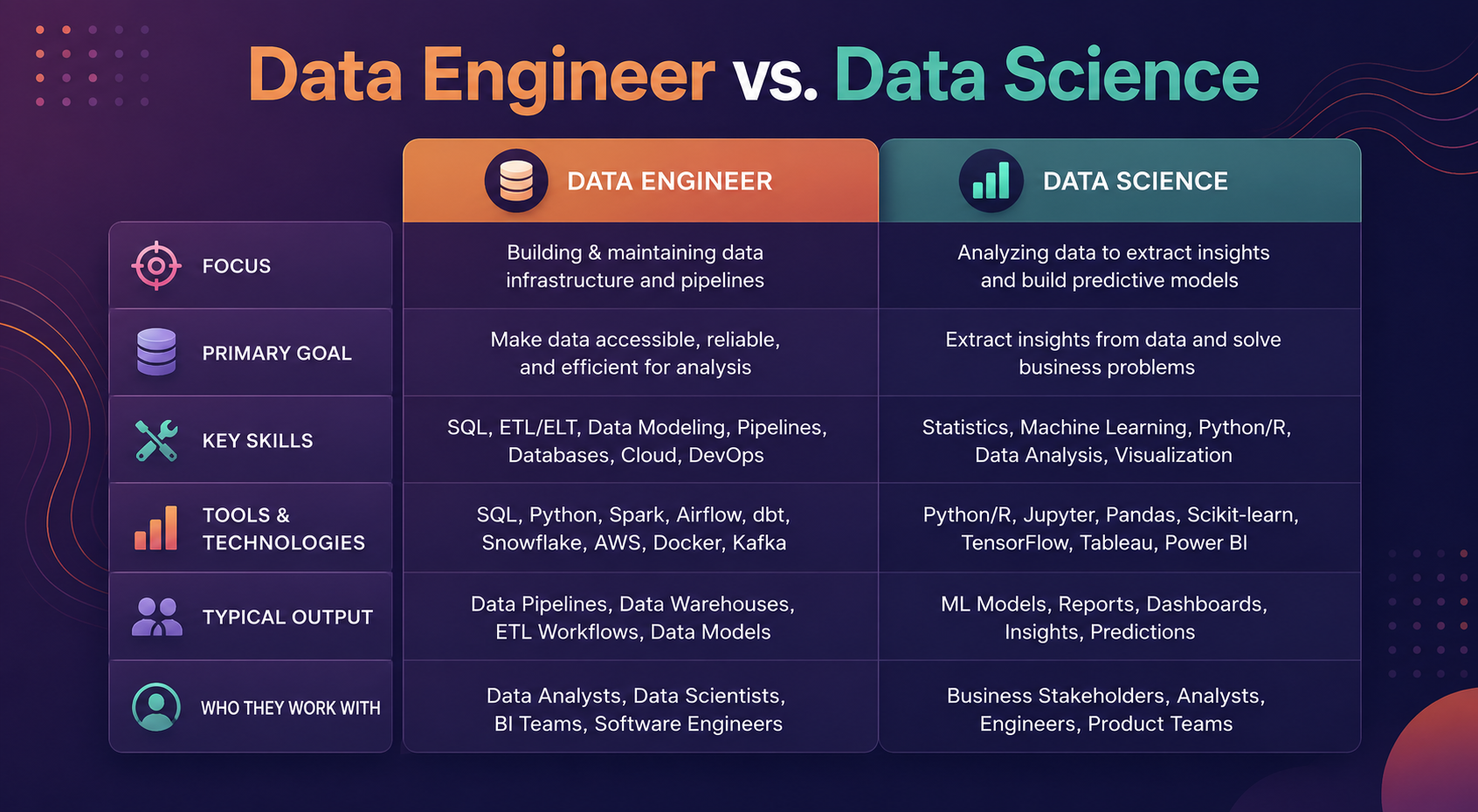
Data Engineer vs. Data Scientist: Key Differences Explained
If you’re trying to break into the data field, you’ve probably run into the same wall everyone else does; the terms “data engineer” and “data scientist” get used interchangeably in job posts, LinkedIn bios, and course marketing even though the jobs themselves are not the same. The confusion isn’t your fault. Both roles work with data. Both roles use Python and SQL. Both roles show up in the same org charts. But the day-to-day work, the required skill set, and the career trajectory are genuinely different.
This guide breaks down the real differences between a data engineer and a data scientist: what each role actually does, what skills each one requires, how much overlap really exists, and most importantly how to figure out which path fits you if you’re coming from analytics, BI, SQL, or a software-adjacent background.
What Does a Data Engineer Actually Do?
A data engineer builds and maintains the systems that move, store, and prepare data so that it can be trusted and used by everyone downstream; analysts, data scientists, dashboards, and machine learning models.
In practice, that means a data engineer spends most of their time on:
- Building pipelines that extract data from APIs, databases, and event streams
- Transforming raw data into clean, modeled tables (fact tables, dimension tables, marts)
- Loading data into warehouses like Snowflake, BigQuery, or Redshift
- Orchestrating pipelines with tools like Airflow, Dagster, or Prefect so jobs run on schedule and recover from failure
- Writing data quality tests so bad data doesn’t reach dashboards or models
- Optimizing storage and query performance as data volume grows
The core question a data engineer answers every day is not “what does this data tell us?” It’s “can this data be trusted, and will it still be here tomorrow, correctly, on schedule?”
What Does a Data Scientist Actually Do?
A data scientist uses data, usually data that a data engineer has already made accessible and reasonably clean to answer business questions, build predictive models, and generate insight.
A data scientist’s core responsibilities typically include:
- Exploratory data analysis to understand patterns, trends, and anomalies
- Statistical modeling and hypothesis testing
- Building and evaluating machine learning models
- Feature engineering for predictive models
- Communicating findings to stakeholders through visualizations and reports
- Running experiments (A/B tests) to validate business decisions
The core question a data scientist answers is closer to: “what does this data predict, explain, or recommend, and how confident are we in that answer?”
Data Engineer vs. Data Scientist: Side-by-Side Comparison
Here’s a direct comparison across the dimensions that actually matter when choosing between these two paths.
| Dimension | Data Engineer | Data Scientist |
| Primary goal | Build reliable systems that move and store data | Extract insight and predictions from data |
| Core tools | SQL, Python, Airflow, dbt, Spark, cloud warehouses | Python, R, Jupyter, scikit-learn, statistics libraries |
| Main skill focus | Pipelines, data modeling, orchestration, testing | Statistics, machine learning, experimentation |
| Typical output | Tables, pipelines, dashboards’ data source | Models, reports, experiment results |
| Failure mode to avoid | Broken, duplicated, or stale data | Misleading conclusions or unvalidated models |
| Background overlap | Software engineering, IT, DBAs | Statistics, math, research, analytics |
| Closer to | Software engineering | Applied statistics and research |
Where the Two Roles Overlap
It’s true that data engineers and data scientists share some foundational skills. This is exactly why the roles get confused.
- Both use SQL to query and understand data
- Both use Python, though for different purposes
- Both need to understand how data is structured (tables, keys, grain)
- Both work with cloud platforms and warehouses
- Both benefit from understanding the full data lifecycle
But the depth and purpose of those skills diverge quickly. A data engineer’s Python is about reliability: retries, logging, error handling, modular scripts that run unattended every day. A data scientist’s Python is about analysis: pandas for exploration, scikit-learn for modeling, statistical libraries for inference. Same language, different job.
Data Engineering SQL vs. Data Science SQL
This distinction deserves its own section because it’s one of the most common points of confusion for people transitioning from analytics.
Data science SQL usually asks: “what happened?” A data scientist queries a table, pulls the result into a notebook, and moves on to modeling or analysis.
Data engineering SQL asks: “how do we transform, validate, store, and refresh this data reliably every day?” A data engineer writes SQL that becomes part of a production transformation, code that must be idempotent, tested, and safe to rerun without duplicating rows or breaking downstream dashboards.
If you already know SQL from a BI or analyst role, that’s a real head start but it’s a head start on data engineering skills, not proof you already have them.
Skills You Need for Data Engineering
If the data engineer path sounds like the better fit, here’s what actually needs to go on your learning list:
Technical Skills
- SQL for transformation, not just reporting (CTEs, window functions, incremental logic)
- Python for data movement (APIs, JSON parsing, error handling, logging)
- Data modeling (fact tables, dimension tables, grain, star schema)
- Pipeline orchestration (Airflow, Dagster, or Prefect)
- Cloud fundamentals (object storage, IAM, managed warehouses)
- Data quality testing (dbt tests, Great Expectations, or Soda)
- Version control and basic software engineering practices
Common Mistake to Avoid
A common mistake among aspiring data engineers is treating a working script as a finished pipeline. A script that runs once is not the same as a pipeline that runs every morning, handles a failed API call gracefully, and doesn’t quietly duplicate rows. That distinction is the actual job.
Skills You Need for Data Science
If the data scientist path is the better fit, your learning priorities look different:
- Statistics (hypothesis testing, distributions, confidence intervals)
- Python for analysis (pandas, NumPy, matplotlib/seaborn)
- Machine learning fundamentals (regression, classification, model evaluation)
- Experiment design (A/B testing, causal inference basics)
- Communication (translating model output into business recommendations)
Notice how little orchestration, pipeline design, and cloud infrastructure appear on this list compared to the data engineering path. That’s the clearest signal of how different these careers really are, despite the shared “data” label.
How Much Data Science Should a Data Engineer Learn?
You don’t need to become a data scientist to be a strong data engineer, but a working understanding of how data scientists use data will make you better at your job. Specifically, it helps to understand:
- What feature engineering needs from a warehouse (clean, well-modeled, historized tables)
- Why data scientists care about data freshness and completeness, not just schema correctness
- Basic statistics vocabulary so you can collaborate without a translation layer
You do not need to learn model tuning, deep learning architectures, or experiment design to succeed as a data engineer. That time is much better spent on orchestration, data modeling, and testing the skills that are actually evaluated in data engineering interviews and code reviews.
Career Paths and Hiring Demand
Both roles are in demand, but they sit in different parts of the org chart and different parts of the hiring pipeline.
- Data engineers are hired earlier in a company’s data maturity someone has to build reliable pipelines before there’s clean data to analyze
- Data scientist roles often require more advanced statistics or a graduate-level background, though this varies by company and industry
- Data engineering roles frequently overlap with software engineering job postings and hiring bars
- Analysts, BI developers, and SQL-heavy professionals often find data engineering a more direct transition than data science
If you’re coming from a SQL heavy, BI, or IT background, data engineering is usually the shorter, more direct path not because it’s “easier,” but because your existing skills map more directly onto the job.
Which One Should You Choose?
Ask yourself these questions honestly:
- Do you enjoy building systems, debugging pipelines, and thinking about reliability? → Data engineering
- Do you enjoy statistics, experimentation, and answering “why” questions with models? → Data science
- Are you coming from SQL, BI, or IT support? → Data engineering is usually the more direct transition
- Are you coming from math, statistics, or research? → Data science may map more naturally to your background
Neither path is more valuable than the other. They solve different problems, and most mature data teams need both roles working together a data scientist’s model is only as good as the pipeline and warehouse feeding it.
Next Steps If You’re Choosing Data Engineering
If you’ve read this far and data engineering sounds like your path, don’t start by trying to learn everything at once. Start with one stage at a time:
- Stage 1: SQL foundations – joins, CTEs, window functions, data validation
- Stage 2: Python for data movement – APIs, JSON, error handling, logging
- Stage 3: Databases and warehousing – schemas, fact and dimension tables
- Stage 4: Orchestration – Airflow, Dagster, or Prefect
- Stage 5: Transformations – dbt models and tests
Each stage builds toward one thing: a single, real, production-style portfolio project that shows you can move data reliably from source to warehouse not ten scattered tutorials.
Key Takeaways
- Data engineers build and maintain the systems that move, store, and prepare data
- Data scientists use that data to build models, run experiments, and generate insight
- Both use SQL and Python, but for different purposes and at different depths
- SQL/BI/analyst backgrounds usually transition more directly into data engineering
- Math/statistics/research backgrounds usually transition more directly into data science
- Strong data engineers understand data science needs without needing to be data scientists themselves
P.S. If you already know SQL and you’re trying to decide between these two paths, the fastest way to find out is to build one small pipeline pull data from an API, clean it, load it into a database, and test it for duplicates. If you enjoy that process more than you enjoy analyzing the data once it lands, data engineering is probably your path.