
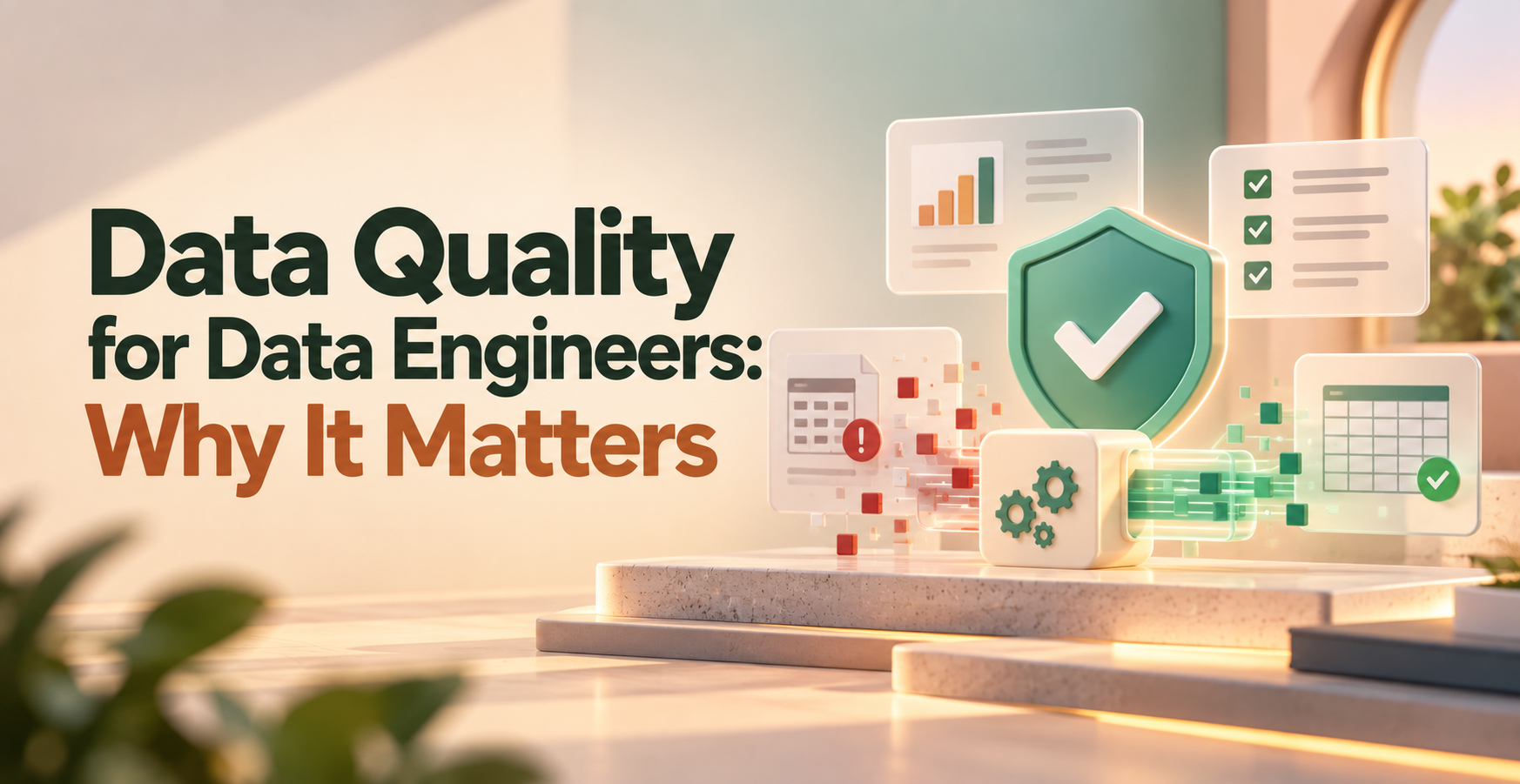
Data Quality for Data Engineers: Why It Matters
Data quality matters because every report, model, and decision depends on data that is accurate, complete, consistent, and timely. For data engineers, protecting that quality starts at the source and continues through ingestion, transformation, and reporting.
A pipeline can finish on schedule and still deliver the wrong answer. Well-placed checks help you catch problems before other teams build on them.
Key Points
- Define what trustworthy data means for each important dataset.
- Check records at ingestion, during transformation, and before reporting.
- Monitor freshness and volume alongside pipeline job status.
- Give every alert an owner and a clear response path.
Quick summary: Data quality is an ongoing engineering practice, not a final inspection. Teams need shared rules, tests at likely failure points, monitoring for unexpected changes, and a way to correct affected data when something goes wrong.
Key takeaway: A green pipeline status tells you the code completed. It doesn’t tell you that the data meets its business rules.
Quick promise: With an owner, a few agreed rules, and checks at the right stages, you can detect a bad batch early and identify which downstream outputs need attention.
Data Quality for Data Engineers: What It Means and Why It Matters
Data quality means a dataset is fit for its intended use. A sales dashboard and a fraud model may use the same order records, but they can have different freshness requirements. Neither requires perfect data. Both need known limits and reliable handling of errors.
For example, a duplicated order can inflate reported revenue if the reporting query sums every row. A late order may change yesterday’s total after the dashboard has refreshed. Engineers need to know which behavior users expect before choosing a check.
The six data quality dimensions engineers need to know
These dimensions turn a broad concern into rules you can test.
| Dimension | What it means | Practical example |
| Accuracy | Values match the real-world facts they describe. | An order total matches the completed transaction. |
| Completeness | Required data is present. | Every order has a customer ID. |
| Consistency | The same fact agrees across systems or tables. | An order status matches in the source and warehouse. |
| Validity | Values follow an allowed format or rule. | An order date is a valid calendar date. |
| Uniqueness | Records meant to appear once aren’t duplicated. | An order ID occurs once in the order table. |
| Timeliness | Data arrives when users need it. | Yesterday’s orders arrive before the morning report. |
Validity and accuracy aren’t interchangeable. A valid date can still be the wrong purchase date.
How poor data quality affects teams and business decisions
One source defect can reach several teams. If a system sends duplicate orders, a dashboard may overstate sales, an analyst may investigate the change, and a model may train on distorted purchase counts.
The costs extend beyond the initial error. Downstream jobs may fail, engineers spend time tracing records, and users start checking numbers by hand. Once people lose trust in a dataset, fixing the pipeline alone may not restore confidence; teams also need to explain which outputs changed.
Where Data Quality Breaks Down in a Data Pipeline
A data pipeline moves information through several stages, and each stage introduces different risks. Source applications can change fields. Ingestion can miss events. Transformations can multiply rows. Stored tables can become stale, while reports can apply the wrong business definition.
Common causes of unreliable data
Schema changes, inconsistent formats, nulls, and duplicate records can disrupt ingestion. Later, late-arriving events, timezone conversions, and incorrect joins can change results without making a job fail. Unclear definitions create another problem: teams may calculate “active customer” differently while using the same source table.
Consider a source system that starts sending an optional customer ID as null. The ingestion job may accept every record. A later join to the customer table then excludes those orders, lowering reported sales for customers even though the source recorded the transactions.
Why a successful pipeline run does not prove the data is sound
Operational health tells you whether a job ran, finished on time, and wrote an output. Data health tells you whether that output has the expected records and values. Both matter, but neither stands in for the other.
A scheduled job can finish after processing half its usual orders. Without volume and completeness checks, the reporting table may look normal until someone compares totals. Put checks near the point where an error first appears, then verify the outputs users depend on.
How Data Engineers Build Quality Into Data Workflows
Start with the datasets people depend on, then define what must be true at each stage. Data quality for data engineers works best when rules sit close to the records they protect and failures reach someone who can respond.
Set expectations with data contracts and quality rules
Agree with source teams on field names, data types, required values, accepted categories, and expected delivery times. Record who owns the source and who approves a change. These expectations form a data contract, even if the team keeps it in a shared document.
A contract helps catch a renamed field before it breaks downstream work. It also needs an update process: a planned source change shouldn’t leave engineers guessing which rule still applies.
Test data at ingestion and transformation points
Check incoming schemas and required fields before accepting a batch. In transformations, test business rules and relationships, such as whether each order references an existing customer. Before publishing a reporting table, check its key fields and expected grain.
Tools can automate parts of this work. dbt tests are common in SQL transformations; Great Expectations, Soda, and Amazon Deequ offer other approaches to data checks. Choose rules first, then select a tool that fits the pipeline.
Monitor freshness, volume, and unexpected changes
Tests catch known violations. Monitoring can flag new patterns, including delayed arrivals, unusual row counts, rising null rates, and shifts in value distributions. Set thresholds against agreed expectations and review noisy alerts rather than sending every fluctuation to an on-call engineer.
Each alert needs an owner, the affected dataset, and enough context to investigate. Data lineage helps trace a faulty source table to the dashboards and models that depend on it.
How to Make Data Quality Work Sustainable
A large test suite won’t help if nobody responds to failures. Sustainable data quality depends on choosing useful checks, assigning responsibility, and learning from incidents.
Prioritize checks by risk and downstream impact
Begin with data behind financial reporting, customer-facing features, important dashboards, or machine learning systems. For each dataset, weigh how likely an issue is, how much harm it could cause, and whether users would notice it quickly.
An order table may deserve uniqueness and freshness checks before a rarely used reference table does. After an incident, add a targeted rule if it would catch the same failure again. Avoid adding checks solely to raise a coverage score.
Assign ownership and measure improvement
Data producers own the meaning and delivery of source fields. Engineers own pipeline behavior and technical checks. Analysts and business owners help define acceptable outputs and report suspicious results.
Track failed checks, freshness against agreed targets, time to detect and fix incidents, and recurring problems. A high pass rate can hide weak tests, so review what failures reveal and whether users still find errors first.
For data quality for data engineers to last, teams need a clear response: identify affected outputs, fix the source or transformation, and rerun data when appropriate. Document the decision so the next incident takes less guesswork.
Key Takeaways
- Pick a high-impact dataset before expanding test coverage.
- Agree on required fields, business rules, freshness, and ownership.
- Validate inputs, transformations, and published outputs separately.
- Monitor changes that fixed tests may miss.
- Route alerts to owners with enough context to investigate.
- Use incidents to improve checks and repair affected data.
Data Quality Glossary
Data contract: An agreement on a dataset’s structure, rules, delivery, and ownership.
Schema: The fields, data types, and structure of a dataset.
Ingestion: The process of bringing source data into a data pipeline.
Transformation: A step that cleans, joins, or reshapes data for use.
Freshness: How recently a dataset received the data users expect.
Null rate: The share of records with missing values in a field.
Data lineage: A record of where data came from and which outputs depend on it.
Data grain: What one row represents, such as one order or one customer.
Conclusion: Start With One Dataset
Data quality for data engineers comes from shared expectations, checks throughout the pipeline, monitoring, and clear ownership. A completed job is only part of the evidence that users can trust its output.
Choose one important dataset, agree on its rules with the people who use it, and add a few high-value checks. If you want to practice that process, explore hands-on data engineering projects at Data Engineer Academy.
Frequently Asked Questions
What is data quality in data engineering?
Data quality means data is fit for its intended use. Engineers assess whether records are accurate, complete, consistent, valid, unique, and timely enough for the people and systems that depend on them. The standard depends on the dataset: a morning sales report may need a delivery deadline, while an order table also needs unique order IDs.
Who is responsible for data quality?
Responsibility is shared, with clear owners for each part. Source teams manage the fields and events they produce. Data engineers build checks and respond to pipeline failures. Analysts and business owners define what correct outputs mean. When a rule fails, the team should know who investigates and who decides whether affected data can be published.
What data quality checks should beginners start with?
Start with required fields, unique IDs, valid values, and freshness. These checks are easy to explain and catch common failures. For an order dataset, test that each order has an ID, IDs don’t repeat, dates parse correctly, and new records arrive before the report runs. Add business rules once users agree on them.
What is the difference between data validation and data monitoring?
Validation checks data against defined rules; monitoring watches for changes over time. A validation test might reject an order without an ID. Monitoring might flag an unexpected drop in daily orders. Both need thresholds and owners. Monitoring is useful when data passes its existing rules but its overall pattern has changed.
Can a data pipeline succeed while producing bad data?
Yes. A pipeline job can finish and write a table that contains missing, duplicated, or stale records. A successful run confirms that the process completed; it doesn’t confirm the business meaning of the output. Check record counts, required fields, relationships, and freshness alongside job status.
How do data contracts improve data quality?
Data contracts make source expectations explicit. They can define schemas, required fields, accepted values, delivery targets, and owners. Engineers can then detect a breaking change before it spreads through the pipeline. Contracts work only when source and downstream teams agree on a process for reviewing and updating them.
Which tools do data engineers use for data quality?
Common options include dbt tests, Great Expectations, Soda, and Amazon Deequ. They support different ways to define and run checks, but no tool decides which rules matter to a business. Start with the dataset’s requirements, the pipeline’s existing technology, and who will investigate failures.
How do you measure whether data quality is improving?
Measure whether teams detect and resolve meaningful issues faster. Track failed checks, recurring incidents, time to detect and fix problems, and whether datasets meet agreed freshness targets. Review cases where users found errors before monitoring did. A high test pass rate alone says little if the tests miss important defects.