
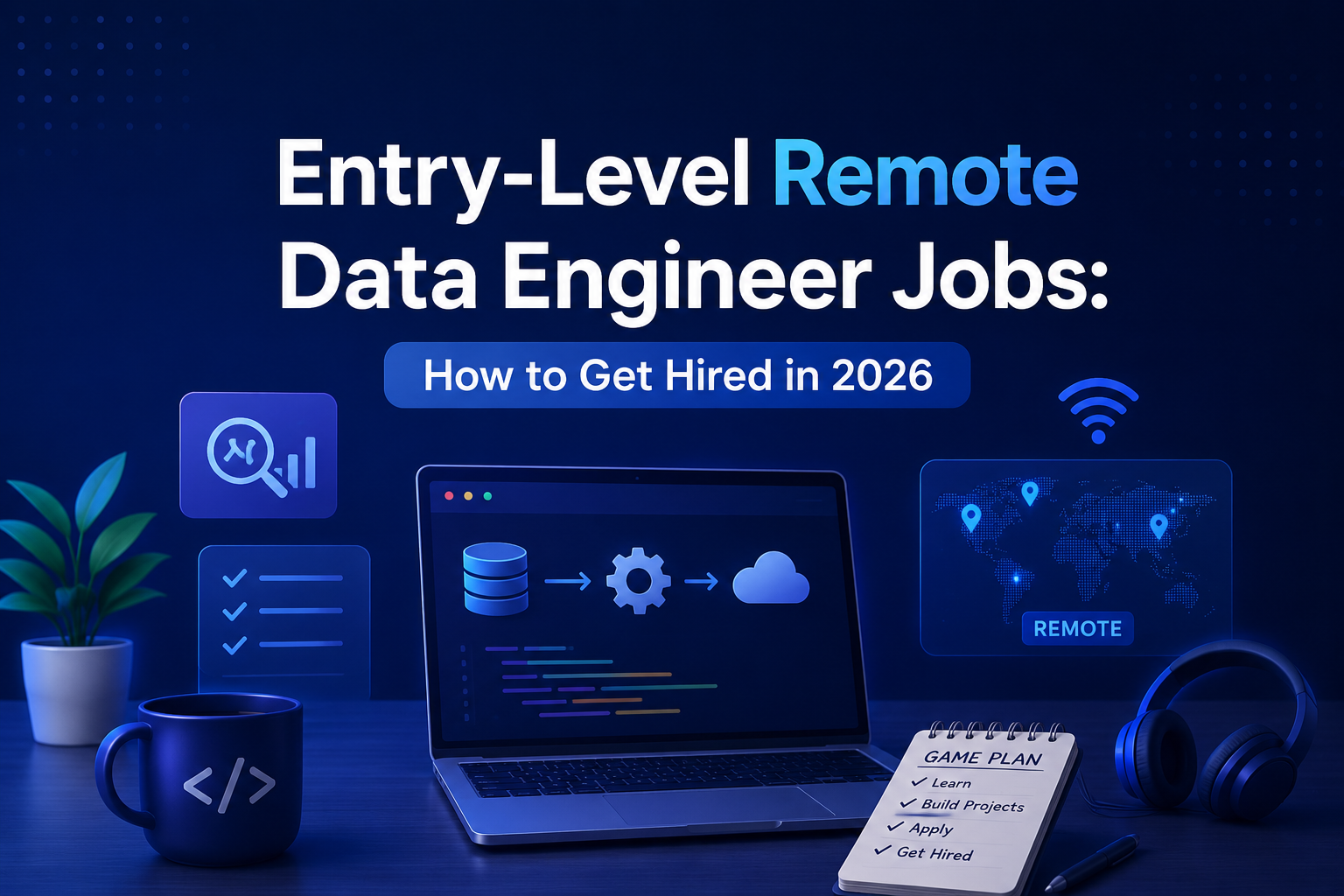
Entry-Level Remote Data Engineer Jobs: How to Get Hired in 2026
Yes, entry-level candidates can land remote data engineering jobs. The catch is simple: you need the right skills, proof that you can use them, and a smarter job search than “apply everywhere and hope.”
Remote data engineering is attractive in 2026 because it opens more roles, more flexibility, and often better career options across locations. It is also more competitive, because companies want juniors who can work with less hand-holding. Here’s the practical path.
Quick summary: Entry-level remote data engineering roles are real, but they usually go to candidates who can show SQL, Python, basic pipeline skills, and solid project work.
Key takeaway: For beginners, proof beats potential. A clean GitHub, a simple portfolio, and a few realistic projects matter more than vague claims.
Quick promise: If you follow the path below, you’ll know what to learn first, where to apply, and how to look job-ready to remote hiring teams.
What entry-level remote data engineering jobs usually ask for
Most junior remote data engineering roles ask for a small but useful technical base, plus signs that you can work independently. The exact bar depends on location, company, and skills, but remote teams usually expect more proof than an internship-level role.
The core skills hiring teams look for first
Start with SQL and Python. If you can’t query data, clean it, and move it from one place to another, you’re not ready yet.
Employers usually want to see that you can:
- write SQL joins, filters, aggregations, and basic window functions
- use Python for scripts, file handling, APIs, and simple data work
- explain what a data pipeline is and how ETL or ELT works
- show basic cloud knowledge, usually AWS, Azure, or GCP
- understand simple data modeling, like fact tables and dimension tables
You do not need to know everything. You do need enough to support real work. Think of it like being handed a wrench, not building the whole garage.
What makes remote roles harder for beginners
Here’s the thing. Remote teams hire for trust.
That means they want people who can write a clear update, ask a sharp question, and keep moving when nobody is sitting next to them. A beginner who communicates well often beats a stronger technical candidate who looks lost without constant direction.
This is why proof matters so much. A GitHub repo, a short portfolio, and project documentation tell employers, “I can do the work, and I can explain it.”
How to build a beginner-friendly data engineering skill set
The smallest useful stack is enough to get noticed: SQL, Python, Git, one cloud platform, and one project that moves data end to end. You don’t need ten certificates. You need a stack that makes sense.
Learn the tools that show up most in junior job posts
A good learning order saves time. Random tool collecting does not.
Go in this order:
- Learn SQL well enough to answer business questions from raw tables.
- Add Python for data cleaning, automation, and API pulls.
- Learn Git so you can version your work and collaborate.
- Pick one warehouse, such as Snowflake, and understand how data lands there.
- Add cloud basics, then tools like Airflow or dbt if job posts keep mentioning them.
Tool choice varies by company. The order matters more than the badge.
Build projects that prove you can do the work
Your projects should look like junior job tasks, not homework for the sake of homework.
Good examples include building a small pipeline that pulls data from an API, cleans messy fields, and loads it into a warehouse. Another strong project is a mini analytics workflow with raw data, transformed tables, and a final dashboard or summary query.
What makes a project strong? Not fancy code. Clear problem solving.
Show the setup, the logic, the output, and the repeatable steps. Add a short README that answers three questions: what the project does, how to run it, and what you learned.
Use a portfolio that is easy to scan
Hiring managers do not read portfolios like novels. They skim.
Keep yours simple. Include a short intro, a small skills section, two or three project summaries, GitHub links, and screenshots if they help. Each project should say what problem you solved, what tools you used, and what result the project produced.
If a recruiter lands on your page for 30 seconds, can they tell you’re aiming at data engineering? That’s the test.
Where to find remote data engineer jobs that fit beginners
The best beginner-friendly remote roles usually come from companies with clear junior hiring paths or teams willing to coach. You will save time if you search where those jobs show up instead of typing random titles into every job board.
Best places to search without wasting time
Start with LinkedIn, company career pages, remote-first companies, and staffing firms that post junior data roles. Search with titles like “junior data engineer,” “associate data engineer,” “entry-level data engineer,” “new grad data engineer,” and “early career data engineer.”
Filter for remote, then read the post carefully. Some jobs say “entry-level” but ask for three years of experience. Skip those unless your project work matches most of the stack.
A short target list works better than mass applying. Twenty strong applications beat 200 weak ones.
Which company types are most open to training beginners
Some company types are more realistic than others:
- Larger teams may have better onboarding and more structured support.
- Consulting firms sometimes hire juniors who can learn fast and communicate well.
- Mid-size companies can be a sweet spot if the team is growing and needs support.
- Startups can hire beginners, but they often want more independence on day one.
So which is best? It depends on your strengths. If you need coaching, aim for structured teams. If you learn fast and like ambiguity, a smaller company may still work.
How to make your resume and applications stand out
You can stand out without years of experience if your resume is clear, targeted, and full of proof. Remote hiring managers want evidence, not buzzwords.
Rewrite your resume around outcomes, not classwork
Do not write, “Completed bootcamp project using Python and SQL.”
Write bullets like:
- Built a Python pipeline that pulled API data, cleaned missing values, and loaded final tables into Snowflake.
- Wrote SQL models that reduced duplicate records and made reporting tables easier to query.
That shift matters. It tells the reader what you did, what tools you used, and what the work achieved.
Tailor each application to the job post
Sending the same resume everywhere is the fastest way to blend in. Mirror the language in the posting when it matches your actual experience.
Before applying, check four things:
- Do you match the main tools?
- Do you have one project close to the job’s workflow?
- Did you use the same title language as the post?
- Does your top third show remote-friendly traits, like documentation or collaboration?
A good application feels like a reply to one job, not a template blasted to fifty.
Use LinkedIn and GitHub to support your application
A clean LinkedIn profile helps recruiters trust what your resume claims. Use a simple headline, list the tools you actually know, and add your best projects.
GitHub matters too. Keep your repos organized. Name them clearly. Add READMEs. Pin the strongest ones. If your repo looks messy, remote teams may assume your work style is messy too.
What to expect from interviews for remote entry-level data roles
Most interviews test three things: basic technical skill, problem solving, and communication. They usually are not trying to prove you’re a senior engineer. They are trying to see if you can learn and contribute.
The questions you are most likely to face
Expect questions on SQL basics, Python basics, data pipeline thinking, debugging, and simple data modeling. You may be asked to explain how data moves from a source into a warehouse, or how you’d fix missing or duplicate data.
Behavioral questions matter too. Be ready for prompts about teamwork, feedback, learning fast, and handling unclear tasks. Some companies also use take-home tasks or short practical exercises.
How to show remote-ready communication in interviews
Talk through your thinking step by step. That matters almost as much as the answer.
A strong remote-style response sounds like this: “First, I’d check the source data. Then I’d validate the schema. After that, I’d test the transform logic and compare row counts.” Clear, calm, easy to follow.
Also ask good questions. Ask how the team documents pipelines, how juniors get support, and how code reviews work. Good questions show maturity.
FAQs about entry-level remote data engineer jobs
Yes, beginners can still get hired remotely in 2026, but proof matters more than potential alone.
Can beginners get remote data engineer jobs in 2026?
Yes. Companies still hire junior talent for remote roles, especially when candidates show strong projects, good communication, and a clear base in SQL and Python. The market is more competitive, so your portfolio has to do real work for you.
Which skills matter most first?
Start with SQL, Python, data modeling, ETL or ELT basics, and Git. After that, learn cloud storage and one warehouse tool. Those skills show up again and again in junior job descriptions.
Do certifications help?
They can help, but they rarely close the deal by themselves. A certification is more useful when it supports a portfolio project and gives context to the tools you used.
How long does it take to get hired?
Depends on location, company, and skills. Some people get interviews within weeks. Others need a few months of project work, resume cleanup, and consistent applications before things start moving.
How much do entry-level remote data engineers earn in 2026?
There is no single reliable number for every market. Pay depends on location, company, stack, and whether the role is truly entry-level. Check Glassdoor, Built In, PayScale, and Levels.fyi for your target region.
Do you need a degree?
No, not always. Many teams care more about proof of skill than a specific degree. A degree can help, but a solid portfolio, clear GitHub repos, and strong interview answers can carry a lot of weight.
Which tools show up most often?
SQL, Python, Git, cloud platforms, and warehouses show up the most. After that, common extras include Airflow, dbt, Spark, Snowflake, BigQuery, Redshift, and Databricks.
Can analytics engineer or ETL roles lead into data engineering?
Yes. They are often a smart entry point. If you’re building transformations, modeling tables, and owning data quality, you’re already doing part of the data engineering job.
Is data engineering still worth it in 2026?
Yes. BLS growth data across adjacent data and database roles still points in a healthy direction. Companies keep producing more data, and that means they still need people who can move, clean, and structure it well.
Conclusion
Entry-level remote data engineering jobs are possible. Not easy, not instant, but absolutely possible if you build the right proof of work.
If you’re wondering what to do next, keep it simple. Build one end-to-end project, clean up your resume, and apply consistently to remote-friendly junior roles. That is how beginners stop looking like beginners.