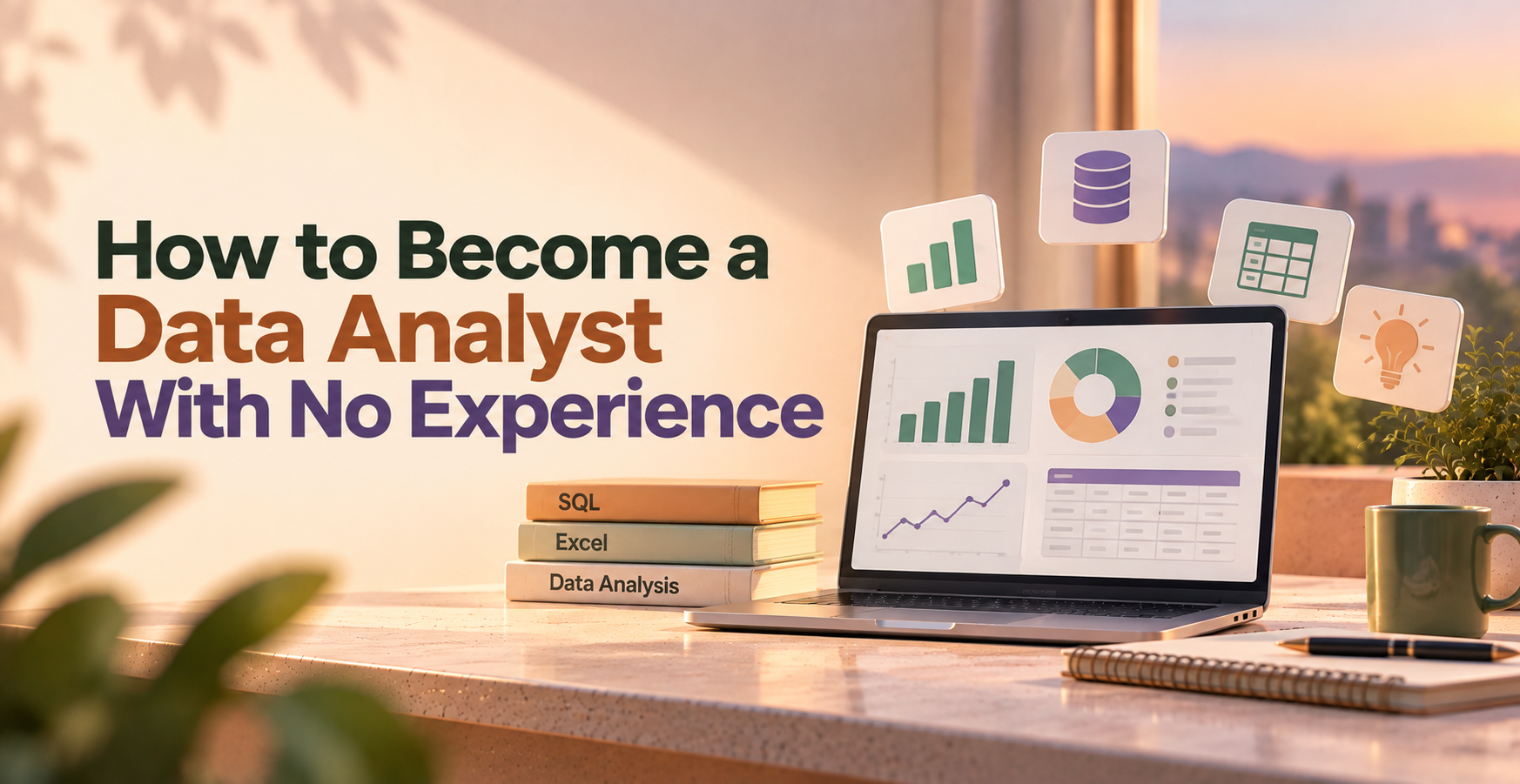
How to Become a Data Analyst With No Experience
You can move toward a data analyst role by learning core tools, completing practical projects, and showing clear evidence of your skills. If you’re figuring out how to become a data analyst with no experience, start with SQL, spreadsheets, and basic statistics.
Your goal is demonstrated ability, not a collection of course badges. No learning plan guarantees a job, but a focused plan gives you something concrete to show employers.
Key Takeaways
- Start with SQL, spreadsheets, and basic statistics before adding Python or trying to learn multiple dashboard tools.
- Build projects around clear business questions, and explain how your findings could support a decision.
- Publish honest case studies that include your data source, analysis steps, assumptions, and limitations.
- Translate your previous work into evidence of problem-solving, communication, and responsible data use.
- Practice explaining your work alongside SQL exercises, then target entry-level roles that match the skills you can demonstrate.
Quick summary: Build your foundation around questions you can answer with data. Learn the tool, apply it to a small dataset, and explain the result. Add complexity when you can describe why you need it.
Key takeaway: Your portfolio should make your reasoning visible. A reviewer needs to understand why you chose a metric, how you handled questionable records, and what your findings support. Attractive charts alone leave those questions unanswered.
Quick promise: Following these steps gives you a practical application package: relevant resume evidence, a project you can explain, and examples of your SQL reasoning. You’ll have clearer material for applications and interviews, without claiming experience you haven’t earned.
How to Become a Data Analyst With No Experience: Build a Practical Learning Plan
Start by identifying what you already bring. Have you tracked inventory, reconciled payments, reviewed customer complaints, or maintained reports? Those tasks involve useful analytical habits.
Degrees and certificates can support an application. Requirements vary by employer, but you still need to show what you can do.
Follow this sequence:
- Identify transferable skills and compare them with requirements in entry-level job listings.
- Learn spreadsheet analysis, SQL fundamentals, and practical statistics.
- Answer a small business question using a public dataset.
- Add Python and one dashboard tool when your projects need them.
Learn SQL, spreadsheets, and basic statistics first
Excel or Google Sheets gives you a place to practice sorting, filters, formulas, and pivot tables. Use them to summarize records and calculate averages or percentages.
SQL lets you retrieve and combine database records. Start with SELECT, WHERE, GROUP BY, and joins. Understand what one row means before combining tables.
Statistics helps you interpret the result. Study distributions, averages, medians, and outliers. A distribution shows how values are spread.
Correlation means two measures move together. It doesn’t establish causation. Higher sales during advertising campaigns, for example, don’t prove the campaigns caused every additional sale.
Add Python and a data visualization tool when you are ready
Python becomes useful when you need to repeat cleaning and analysis across files. The pandas library provides tools for working with tabular data.
For dashboards, choose Tableau or Power BI based on the roles you want. Don’t study every tool at once. Learn enough to complete a useful analysis, then improve the parts that slow you down.
Keep these data terms straight
SQL: A language for retrieving and working with data in relational databases.
Query: An instruction that asks a database for information.
Join: An operation that combines tables using related columns.
Pivot table: A spreadsheet summary grouped by categories.
Metric: A measurement used to track performance.
Distribution: The pattern of values across a dataset.
Correlation: A relationship between changes in two variables.
Dashboard: A visual display of related metrics and charts.
Build a Data Analyst Portfolio That Proves You Can Do the Work
A portfolio gives employers evidence beyond your resume. Each project should show your question, your reasoning, and a conclusion someone can understand.
Choose projects that answer real business questions
Pick a question with a clear decision behind it. Which transit routes have the longest delays? Which product categories drive sales changes? How many customers return after their first purchase?
Look for government datasets through Data.gov or city open-data portals. Kaggle also hosts datasets, but read their descriptions carefully. Label synthetic data as synthetic.
Start with the question. Clean the records, analyze the relevant measures, and explain what the result supports. A dataset without purchase dates, for example, can’t support a time-based retention analysis.
Choose a project that matches the skills you want to demonstrate.
| Project type | Skills shown | Possible data source |
| Transit delays | Date handling, grouping, comparisons | City transit open-data portal |
| Sales trends | SQL aggregation, spreadsheet summaries | Documented Kaggle sales dataset |
| Customer retention | Joins, cohorts, percentage calculations | Public transaction dataset with customer IDs |
The dataset needs the right fields for your question. A larger file doesn’t automatically make a stronger project.
Present your work with clear, honest case studies
Publish relevant SQL queries or Python code on GitHub. Pair them with a readable report or dashboard.
Explain what you changed during cleaning. Did you remove duplicates, exclude missing dates, or standardize category names? Describe why those choices made sense.
Label personal projects as personal projects. Don’t imply that a public-data exercise was paid client work.
Before publishing:
- Name the source and explain what each row represents.
- Document cleaning decisions, assumptions, and analysis steps.
- Include a useful finding and the limits of your conclusion.
Get Your First Data Analyst Interview Without Prior Experience
Search beyond the title “data analyst.” Junior analyst, reporting analyst, operations analyst, and business intelligence analyst can surface relevant openings. Read the responsibilities because similar titles can describe different jobs.
Tailor each application to the role’s tools and business needs. Relevant experience can also come through your current work or a volunteer reporting project with a defined scope.
Show transferable skills on your resume and in interviews
Operations, customer service, finance, and administration can all involve analytical work. Name the task, the tool, and the result.
If you reviewed complaints in Excel, explain how you categorized them and what the team did with the findings. Include a measured result only when you have evidence for it. Don’t invent percentages to strengthen a bullet.
Use STAR to organize an interview story: situation, task, action, result. For a personal project, explain the question, your responsibility, your analysis, and the finding.
Keep the story grounded in your contribution. Be ready to explain one difficult choice.
Practice common SQL and case-study interview tasks
Practice joining customer and order tables, grouping monthly totals, and identifying missing or duplicated records. Check whether a join changes the number of rows unexpectedly.
For case studies, clarify the business question before choosing a metric. Does “sales” mean gross revenue, net revenue, or units sold?
Talk through your assumptions. Explain a chart in plain language, including what you can’t conclude. Interview preparation helps you demonstrate your skills; it doesn’t guarantee an offer.
Keep your job search moving:
- Match resume evidence to the opening’s requirements.
- Ask relevant professionals for feedback or an informational conversation.
- Rehearse one project explanation and one SQL task aloud.
Turn One Question Into Evidence of Your Skills
Choose one tool and one real question. Complete a small project, then explain what it shows and where its conclusions stop.
A portfolio supports your application, but it doesn’t guarantee employment. Your next step is to build evidence you can discuss confidently.
Use this one-minute action summary:
- Choose SQL or a spreadsheet as your starting tool.
- Define one question with a clear decision behind it.
- Select a documented dataset with the fields you need.
- Clean the records and record your choices.
- Analyze the data and explain one useful finding.
- Publish an honest case study and practice presenting it.
Frequently Asked Questions
Can I become a data analyst if my math is rusty?
Yes, you can start while rebuilding your math skills. Begin with percentages, ratios, averages, and reading charts. Practice those concepts on datasets so you understand their purpose, then add probability and statistical inference as your target roles require them.
Do I need a powerful computer to learn data analysis?
No, you don’t need a high-end computer for small beginner projects. Spreadsheets, browser-based SQL practice, and modest datasets provide useful starting points. Larger files and some desktop tools require more resources, so keep your early projects small enough to run comfortably.
Should I learn data engineering before data analysis?
No, data engineering isn’t a prerequisite for learning data analysis. Analysts focus on answering questions with data, while data engineers build and maintain systems that collect and prepare it. Database fundamentals help both roles, but you don’t need to begin with cloud infrastructure.
Can I use AI tools while learning data analysis?
Yes, use AI to explain unfamiliar syntax, suggest practice questions, or help investigate an error. Run generated code and inspect its output before relying on it. You still need to explain each step, recognize incorrect results, and protect confidential information.
Can I publish workplace data in my portfolio?
Only publish workplace data when you have explicit permission and can meet applicable confidentiality requirements. Removing names doesn’t necessarily make records safe to share. When permission isn’t available, use public or synthetic data and describe your workplace skills without exposing private information.