
How to Explain Data Pipelines in an Interview
A strong interview answer traces data from its source to storage and consumption. It also explains the design choices behind reliability, scale, data quality, and business value. How to Explain Data Pipelines in an Interview comes down to telling a clear story, not reciting a list of tools.
Interviewers want to hear how you think when requirements are incomplete and failures are possible. Start with the business goal, then show how the pipeline meets it.
Key Points
- Start with the business question the pipeline must answer.
- Trace data through ingestion, transformation, storage, and consumption.
- Explain freshness, volume, failure handling, and ownership.
- Name tools only after explaining why they fit the requirements.
Quick summary: A clear pipeline answer follows the data, identifies its users, and explains the safeguards that keep results trustworthy when sources fail or requirements change.
Key takeaway: Tool names do not prove engineering judgment. Clear requirements, practical tradeoffs, and a recovery plan do.
Quick promise: You can use the framework below to turn a vague pipeline description into a structured answer that holds up under follow-up questions.
How to Explain Data Pipelines in an Interview
A data pipeline is a set of steps that collects, transforms, validates, and delivers data for a useful purpose. Sources might include an application database, a third-party API, CSV files, or event streams. The pipeline then moves the data into storage such as Amazon S3, Snowflake, BigQuery, or another data warehouse.
After that, analysts may use the data in Looker dashboards or finance reports. Product teams may track customer behavior, while machine learning systems can use prepared features for predictions.
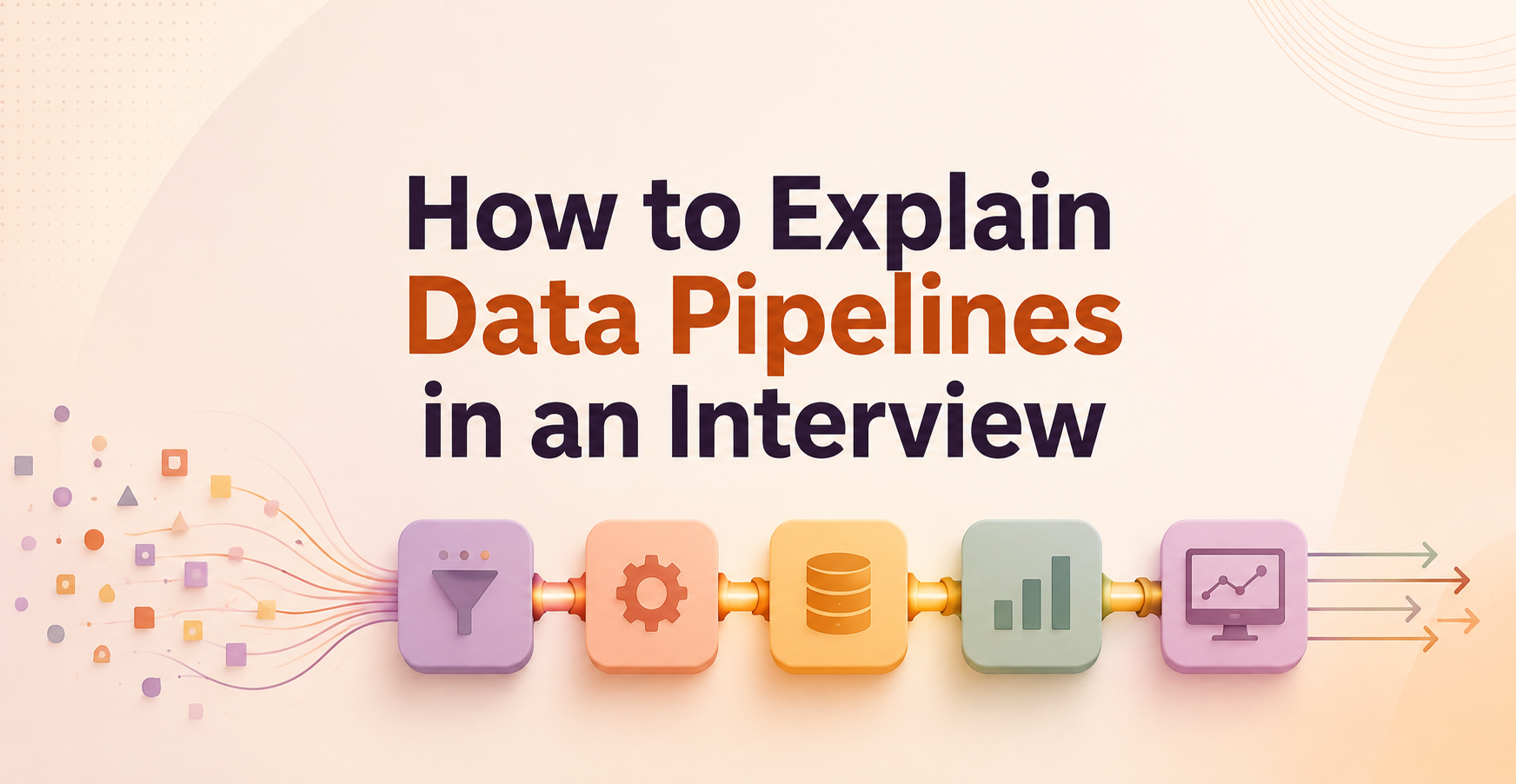
Application database -> ingestion job -> raw storage -> transformations -> warehouse tables -> dashboard
Interviewers care about the logic behind this flow. They want to know whether you consider malformed records, late data, duplicate events, changing schemas, and the needs of the people reading the final output.
Use one example throughout your answer. For an online store, a daily orders pipeline could pull order records from a PostgreSQL database with Python. Kafka may carry order events when the business needs near-real-time updates.
Next, SQL transformations clean currencies, remove duplicate order IDs, and join customer records. dbt can manage those transformations and tests. Snowflake stores the curated tables, while Airflow schedules tasks, tracks dependencies, and retries failed jobs. Finally, Looker gives finance and operations teams a shared revenue view.
Each tool has a job. Say what it does before naming it.
Connect the Pipeline to a Business Outcome
State why the company needs the pipeline before discussing architecture. Finance may need accurate daily revenue by 9:00 a.m. A product team may need customer activity within five minutes. A recommendation model may need fresh interaction events.
Use a Simple Framework for Your Data Pipeline Interview Answer
Under pressure, follow a consistent order:
- Clarify the business goal and success criteria.
- Identify source systems and downstream consumers.
- Describe ingestion, transformations, storage, and modeling.
- Cover orchestration, monitoring, and recovery.
- Compare the main tradeoffs.
For example: “I would build a customer orders pipeline that loads database changes into raw cloud storage, validates records, and transforms them into warehouse tables for finance reporting. Airflow would schedule daily loads and alert the team when freshness checks fail. Because finance needs a stable morning report, I would begin with batch processing rather than streaming.”
Adapt the depth to the role. A junior interview may focus on basic SQL, Python, and data flow. A senior interview may require detailed discussion of cost, service limits, ownership, and incident response.
Clarify Scale, Freshness, and Failure Requirements First
Ask how much data arrives, how often it arrives, and how quickly users need it. Also ask whether the workload is batch or streaming, plus what should happen after a source failure.
These questions prevent vague architecture. A daily internal dashboard has different needs than a customer-facing feature that processes events every second.
Describe Tradeoffs Instead of Claiming One Tool Is Best
Batch jobs cost less and remain easier to operate when data can arrive hourly or daily. Streaming reduces latency but adds operational work.
Similarly, a warehouse fits structured analytics, while a data lake can store cheaper raw files at larger volumes. Airflow works well for complex dependencies, but a cloud-native scheduler may be simpler for a small workload. Name your default choice, then explain when you would change it.
Show Technical Depth With Reliability, Quality, and Scale
A strong data engineering answer covers what happens when reality interrupts the happy path. Source systems change columns. APIs time out. Files arrive late. A rerun can duplicate revenue unless the pipeline handles it safely.
Use practical safeguards rather than vague claims about reliability.
| Pipeline risk | Practical safeguard |
| Duplicate records | Use idempotent upserts or merge logic |
| Missing file or API error | Retry, alert, and record the failure |
| Changed source schema | Validate contracts and version schemas |
| Late-arriving data | Reprocess a defined lookback window |
| Slow growing tables | Partition data and use incremental loads |
Track freshness, completeness, record volume, failure rate, and processing time. These metrics help teams find problems before a misleading dashboard reaches decision-makers.
Explain How You Detect and Recover From Pipeline Failures
Mention task-level logs, alerts, and data quality tests. If an API request fails, retry with limits and alert after the final failure. For bad events in a stream, a dead-letter queue preserves the records for later review.
Idempotency means a failed task can run again without creating duplicate output. For example, if an orders file is missing, the job should fail clearly, avoid publishing partial totals, and rerun safely after the file arrives.
Show How the Design Handles Growth and Change
Partition large datasets by a useful field such as event date. Process only new or changed records when possible, then reserve full backfills for corrected logic or historical repairs.
A small internal dashboard may need one daily job. A high-volume customer product may need parallel consumers, streaming ingestion, and tighter latency monitoring. Start with the simplest design that meets the stated requirement.
Mention Security and Governance Without Losing Focus
Tie security to the data. Customer email addresses and payment-related fields need encryption, role-based access, masking, retention rules, and audit trails. A public product metric table needs far less control.
Avoid Common Data Pipeline Interview Mistakes and Practice Better Answers
Candidates lose clarity when they open with “I would use Spark, Kafka, and Airflow.” Tools come after requirements. Other common mistakes include ignoring failures, confusing ETL with ELT, and describing work without stating personal ownership.
Review your answer before an interview:
- Can you state the business goal in one sentence?
- Can you trace each stage of the data flow?
- Can you explain one failure scenario and recovery plan?
- Can you name one tradeoff and its limitation?
Use the STAR Method to Explain a Pipeline You Built
Start with the Situation and Task: identify the reporting, product, or operational problem. Then describe your Action, including the architecture, tools, and decisions you personally made. Finish with the Result, but only use metrics you can support.
Career switchers can use a course or portfolio project. Build a realistic pipeline with public data, document assumptions, and explain what you would improve in production.
Prepare for Follow-Up Questions About Your Design
Expect questions about duplicates, late data, schema changes, bad records, replay, access control, testing, and cost. Answer with a choice, the reason for it, and a known limitation.
That honesty is stronger than claiming a design has no weak points.
Essential Data Pipeline Terms
- ETL: Extract, transform, load. Data is transformed before it reaches the target system.
- ELT: Extract, load, transform. Raw data lands first, then warehouse tools transform it.
- Batch processing: Data runs on a schedule, such as hourly or daily.
- Stream processing: Data is processed continuously as events arrive.
- Orchestration: Scheduling and coordinating tasks, dependencies, retries, and alerts.
- Data lake: Low-cost storage for raw, semi-structured, or unstructured data.
- Data warehouse: Structured storage optimized for analytics and reporting.
- Idempotency: Safe reruns that do not create duplicate results.
- Partitioning: Splitting data into manageable sections, often by date.
- Data lineage: A record of where data came from and how it changed.
- Schema evolution: Managing changes to fields, types, or table structures.
- Data quality: Checks for accuracy, completeness, validity, and freshness.
Final Thoughts
A persuasive pipeline answer starts with the business goal and follows the data through every important decision. Explain how you handle quality, failures, scale, and tradeoffs, then make your own contribution clear.
- Define the user need before naming tools.
- Trace the data flow in a logical order.
- State the expected freshness and scale.
- Describe a realistic failure and recovery path.
- Compare options using cost, latency, and maintenance.
- Practice explaining one project with personal ownership.
Data Engineer Academy offers guided projects, mock interviews, and interview-question banks for practicing these answers.
Frequently Asked Questions
How do you explain a data pipeline in an interview?
Start with the business goal, then describe the source, ingestion method, transformations, storage layer, and final users. Finish with reliability measures such as validation, retries, monitoring, and safe reruns. Keep the tool discussion tied to a requirement.
What do interviewers look for in a data pipeline answer?
Interviewers look for structured reasoning. They want to hear how you clarify requirements, handle bad data, choose between batch and streaming, manage failures, and explain tradeoffs. Tool knowledge matters, but design judgment matters more.
Should I mention Airflow and Kafka in every pipeline interview?
No. Mention Airflow when scheduled workflows have dependencies, retries, or monitoring needs. Mention Kafka when event streaming and low latency matter. A daily batch pipeline may need neither tool, and saying so shows sound judgment.
What is the difference between ETL and ELT in an interview?
ETL transforms data before loading it into the target system. ELT loads raw data first, then transforms it inside a warehouse such as Snowflake or BigQuery. Explain which approach fits the available compute, governance rules, and data consumers.
How should a pipeline handle duplicate records?
Use a stable business key, such as an order ID, and apply upsert or merge logic. The job should be idempotent, so rerunning it produces the same correct result instead of duplicate rows.
How do you discuss pipeline failures in an interview?
Describe detection, response, and recovery. Mention logs, task alerts, quality checks, retry limits, and a safe rerun process. For example, a missing source file should stop publication of incomplete reporting tables and alert the owner.
Can beginners explain data pipelines without job experience?
Yes. Use a personal project or course project, but explain it with production awareness. Describe the source data, transformations, tests, storage choice, and failures you planned for. Be clear about what you built yourself.
What data pipeline terms should I know before an interview?
Know ETL, ELT, batch processing, streaming, orchestration, idempotency, partitioning, schema evolution, data lineage, data quality, data lakes, and data warehouses. You should be able to connect each term to a practical design decision.