
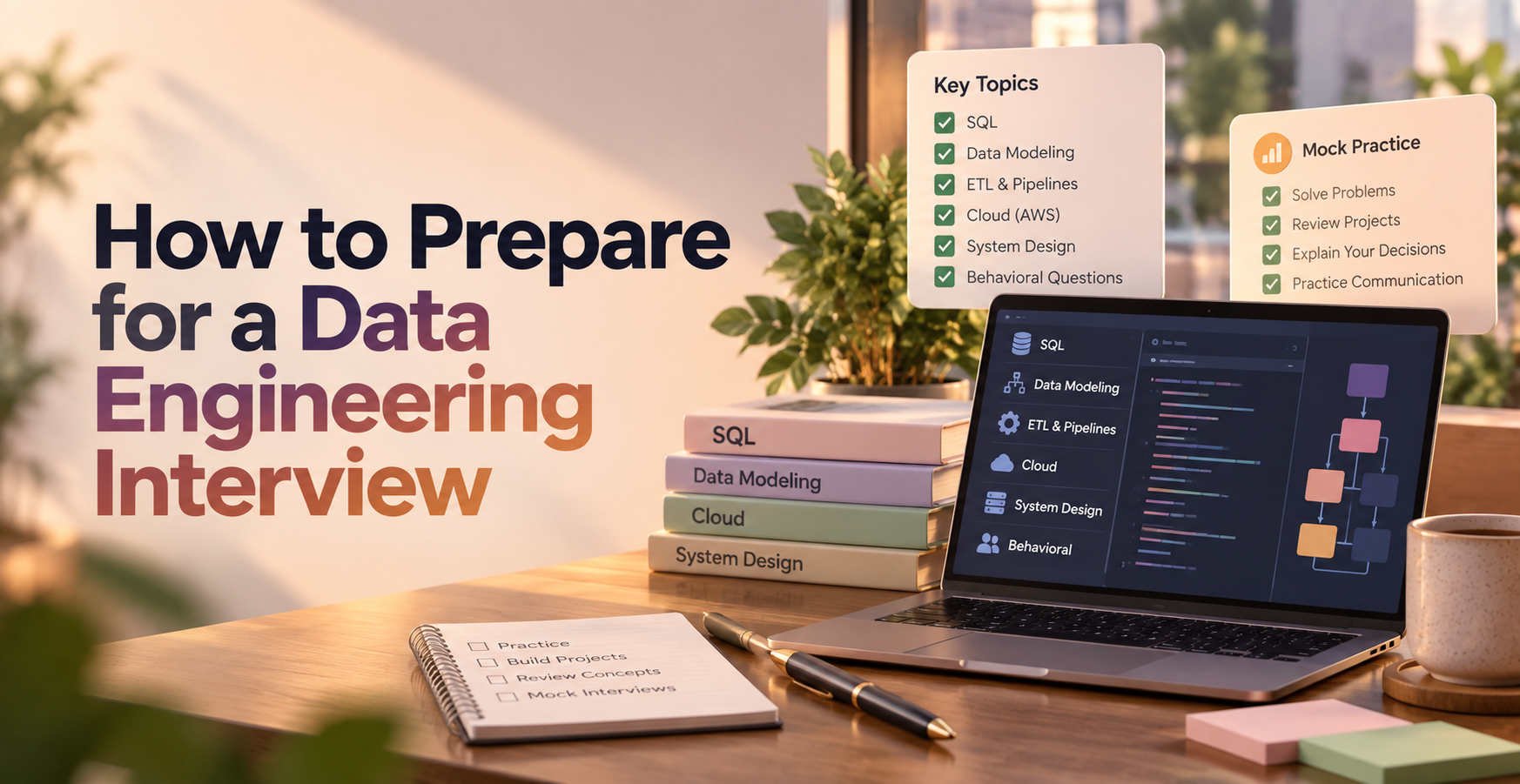
How to Prepare for a Data Engineering Interview
Prepare for a data engineering interview by matching your practice to the role, reviewing SQL and Python, explaining design choices, and rehearsing project and behavioral answers. Prioritize clear reasoning over memorizing every tool.
Knowing how to prepare for a data engineering interview helps you turn limited study time into focused practice. Start with the job description, then build a practical study plan around the problems you’ll need to solve.
Key Points
- Match your preparation to the role’s requirements and seniority.
- Practice SQL and Python while explaining your reasoning aloud.
- Design pipelines around freshness, reliability, and cost.
- Support project answers with your own contributions and verified outcomes.
Quick summary: Strong preparation combines role-specific coding practice, pipeline design, and project stories. Use mock interviews to find gaps before your interview.
Key takeaway: A pipeline design is incomplete until you explain how it recovers after partial failure without duplicating records or losing valid data.
Quick promise: You’ll have a one-week preparation schedule and a repeatable approach for answering coding, design, and experience questions.
How to Prepare for a Data Engineering Interview With Focus
Companies vary in their interview process. Your preparation should follow the actual role rather than a universal technology checklist.
Read the job description for the skills that matter most
Separate requirements into must-have skills and nice-to-have tools. SQL, Python, and data modeling deserve different attention than an optional visualization package.
Also check seniority and business context. A junior analytics role may emphasize transformations; a senior platform role may expect architecture and operational ownership.
Identify named technologies, such as Snowflake, Spark, or AWS. Practice their relevant concepts without assuming every product feature will appear. Then spend more time on weak requirements than familiar optional tools.
Know what to expect in each interview stage
Recruiter calls usually cover your background, interest, and logistics. Technical screens test coding and problem-solving, while take-home tasks may assess implementation and documentation.
Project discussions examine your contribution. System design interviews test architecture choices, and behavioral rounds examine judgment and collaboration.
Ask the recruiter about duration, coding environment, permitted resources, and expected depth. Confirm whether you’ll execute code or explain it. These details affect how to prepare for a data engineering interview under realistic conditions.
Strengthen SQL, Python, and Data Fundamentals
Practice SQL with realistic data problems
Practice joins, aggregations, common table expressions (CTEs), and window functions. Include nulls, duplicate records, and date boundaries in your exercises.
Before coding, state the output grain, such as one row per customer per month. Otherwise, a correct-looking join can multiply rows and inflate totals.
For deduplication, practice ROW_NUMBER() with a partition key and deterministic ordering. Explain how you would resolve records with identical timestamps.
Narrate your approach, then test a small dataset manually. Check whether customers without orders remain in the result. Also explain when filtering belongs in WHERE versus HAVING, and why.
Review Python and core data engineering concepts
Review dictionaries, sets, lists, functions, exceptions, and file handling. Practice reading JSON, validating records, and processing API responses without loading everything into memory.
For APIs, discuss pagination, timeouts, and bounded retries. Distinguish invalid input from temporary connection failures instead of catching every exception indiscriminately.
Connect coding decisions to pipeline behavior. An idempotent job produces the same intended result when repeated with the same input.
Explain how schema changes affect downstream models. For late-arriving data, describe which partitions you’d reprocess and how you’d avoid duplicates.
Review modeling fundamentals too: primary keys, fact tables, dimension tables, and the grain each table supports.
Get Ready for Data Pipeline and System Design Interviews
Use a clear framework to design a reliable pipeline
Start by clarifying users, freshness needs, data volume, retention, and access requirements. Then outline ingestion, storage, transformations, and serving.
For an event pipeline supporting daily analytics, confirm when reports must be ready. If daily freshness is sufficient, batch processing may meet the requirement.
Compare processing approaches against the actual need.
| Approach | Suitable requirement | Main consideration |
| Batch | Scheduled daily reporting | Processing window and backfills |
| Streaming | Low-latency event updates | State, ordering, and operations |
Choose the simplest approach that meets the freshness target.
Explain tool roles accurately: Kafka transports event streams, Spark processes data, Airflow orchestrates tasks, and Snowflake supports analytical storage and queries. Select them only when requirements justify them.
Explain how you would handle quality, failures, and growth
Validate required fields and monitor unexpected changes in row counts. Quarantine invalid records when appropriate, while retaining enough information to investigate them.
Discuss retry limits, replayable inputs, and backfills. Explain what happens when an upstream source fails after a job has partially completed.
Include access controls, secret management, and protection for sensitive fields. Then address storage costs, compute usage, and partitioning as volume grows.
State assumptions before choosing infrastructure. Compare options using freshness, operational effort, and cost rather than tool popularity.
Turn Your Experience Into Strong Answers and a Study Plan
Present projects with clear choices and measurable outcomes
Describe the problem, data sources, pipeline design, personal contribution, challenge, and result. Separate your work from the team’s work.
Use measurements you can defend, such as runtime or failed-job counts. Explain the baseline and measurement method; don’t invent improvements.
Prepare follow-up answers about bottlenecks, reliability, and rejected options. For portfolio projects, report demonstrated behavior and test results rather than claiming production experience.
Practice behavioral answers and mock interviews
Prepare examples about ownership, teamwork, mistakes, and changing priorities. Use situation-action-result, with most detail devoted to your decisions.
Explain a mistake honestly, including its impact and the changes you made afterward.
Complete timed SQL or Python practice and at least one mock system design session. After each attempt, identify the specific gap: syntax, assumptions, testing, or explanation. Repeat the weak task before adding another topic.
Use a one-week plan to organize final preparation
Adjust this sequence to your available time:
- Review the job description and assess your baseline skills.
- Practice SQL joins, aggregation, windows, and edge cases.
- Review Python files, APIs, validation, and error handling.
- Design an event pipeline and challenge its failure handling.
- Refine project stories and behavioral examples.
- Complete a timed mock interview and review mistakes.
- Review concise notes, confirm logistics, and rest.
Before interview day, test your connection and coding setup. Prepare questions about pipeline ownership, on-call responsibilities, and data quality expectations.
Key Takeaways for Your Next Practice Session
- Choose one target role before building your preparation plan.
- State assumptions and output grain before writing SQL.
- Test Python solutions against invalid and repeated inputs.
- Explain recovery behavior alongside your pipeline architecture.
- Rehearse project answers with defensible evidence.
- Use mock interview feedback to select your next exercise.
Data Engineering Interview Glossary
CTE: A named query expression defined with WITH and referenced within a SQL statement.
Window function: A SQL function that calculates across related rows without collapsing them into one grouped row.
Data grain: The level of detail represented by one row.
Idempotency: Repeating an operation with the same input produces the same intended result.
Batch processing: Processing a bounded collection of data in a scheduled or triggered run.
Streaming: Processing events continuously as they arrive.
Backfill: Processing historical data to populate or correct missing results.
Schema evolution: Changes to a dataset’s structure, such as adding fields or changing types.
Conclusion: Make Your Next Practice Session Count
Focused practice, clear reasoning, and specific evidence matter more than memorizing every tool. Choose one role and begin a timed SQL session, then review both your solution and explanation.
If you want guided projects and mock interview feedback, Data Engineer Academy offers support for that preparation.
Frequently Asked Questions About Data Engineering Interviews
How long should I prepare for a data engineering interview?
Preparation time depends on your starting skills and the role’s requirements. Use a timed SQL exercise, a Python task, and a pipeline design discussion to assess readiness. One week can organize final review, but unfamiliar fundamentals need additional practice. Let demonstrated gaps determine your schedule rather than a fixed deadline.
Can I pass without professional data engineering experience?
Yes, you can demonstrate relevant skills through well-documented projects, although some roles require professional experience. Use a real dataset, such as NYC Taxi and Limousine Commission trip records. Build ingestion, transformations, and quality checks. Explain your decisions and limitations honestly, and prepare to run or discuss the project during interviews.
Do data engineering interviews require advanced algorithms?
Some interviews include algorithm questions, but requirements vary by company and role. Ask the recruiter about the coding format. Review basic time and space complexity, dictionary lookups, sorting, and memory-efficient iteration first. Then practice the algorithm topics included in that process without sacrificing SQL or pipeline preparation for unrelated puzzles.
Which cloud platform should I study for the interview?
Study the platform named in the job description first. For AWS, review relevant services such as S3 and Glue; for Google Cloud, examine BigQuery when the role requires it. Focus on storage, permissions, compute, and costs. Explain how each service fits the proposed pipeline rather than memorizing product descriptions alone.
What SQL mistakes should I watch for during interviews?
Watch for incorrect join cardinality, missing null handling, and nondeterministic deduplication. State the expected row grain before coding, then check whether joins multiply records. Test empty inputs and tied timestamps. Also distinguish filtering individual rows with WHERE from filtering aggregated groups with HAVING, because those operations answer different business questions.
What should I do when I don’t know an interview answer?
State what you know, identify the uncertainty, and ask a clarifying question when needed. For unfamiliar technology, explain the underlying requirement and how you’d evaluate a solution. Avoid inventing features or guarantees. During coding, describe a simple correct approach first, then discuss improvements if you have time to consider them.
How are senior data engineering interviews different?
Senior interviews generally expect broader ownership and stronger architectural judgment. Prepare to discuss migration plans, operational incidents, data contracts, and organizational trade-offs. Explain how you assessed risk and coordinated with other teams. Support your answers with work you actually owned, including limitations and decisions you would change with better information.
Can I use AI during a data engineering interview?
Use AI only when the interviewer or assessment rules explicitly allow it. Ask about permitted tools before the session. During preparation, attempt problems independently before requesting feedback so you can identify genuine gaps. Verify suggested code against edge cases, and practice explaining every part of the solution without AI assistance.