
Junior Data Engineer Job Descriptions: How to Read Requirements Without Overlearning
You do not need to learn every tool in a junior data engineer job description before you apply. Most postings mix must-haves, preferred skills, and a team’s wish list. Your job is to spot the few skills that show up more than once and focus there first. That is usually enough to get interview-ready faster.
Key Points
- Junior job posts often ask for more tools than a new hire will use on day one.
- Titles like junior, entry-level, and associate do not mean the same thing at every company.
- Repeated skills matter more than one-off buzzwords in the requirements list.
- SQL, basic Python, data pipelines, and warehouse concepts cover most beginner roles.
- If you meet the core skills and understand the work, you should usually apply.
Quick summary: A job post is a map, not a syllabus. Read it for repeated skills, daily tasks, and signs of support, then study the smallest set of gaps that makes you interview-ready for the role you want.
Key takeaway: Junior postings usually ask for fundamentals plus room to grow. When SQL, Python, and simple pipeline work show up again and again, those are the skills to learn first. The long tail of tools can wait.
Quick promise: You can stop guessing what to study next. By the end, you should know when to apply now, when to spend two weeks filling a gap, and when a posting is clearly beyond junior level.
What employers really mean by junior, entry-level, and associate
Titles drift. One company calls a near-beginner role “junior.” Another uses “associate” for the same work. Because of that, the title alone should not scare you off.
Many entry-level data engineer requirements list cloud tools, Python, or ETL platforms. That usually tells you the team’s stack. It does not always mean they expect deep experience.
Why the same role title can mean very different things
A startup may want someone who can support live data pipelines with light guidance. A large company may hire for a narrower role with more onboarding. Mid-size teams often sit in the middle.
The post itself gives clues. Shorter postings with plain language often come from teams that know they can train. Posts packed with ownership words, production incidents, and system design language usually expect more independence.
The signs that a posting is truly junior-friendly
Look for signs like 0 to 2 years of experience, mentorship, onboarding, pair work, or support from senior engineers. Posts that focus on SQL, basic scripting, data quality, and maintaining existing jobs are often realistic for beginners.
A long tool list can still be fine. If the post names AWS, Azure, and GCP together, the real need may be simple cloud awareness, not mastery of all three.
How to separate must-haves from nice-to-haves in the posting
Most junior postings have only a few real gates. The rest are preferences. So start with the verbs.
“Required” and “must have” matter most. “Preferred,” “nice to have,” “bonus,” “familiar with,” and “exposure to” usually mean softer asks. A quick data engineering job posting analysis often shows two or three repeated priorities hiding inside a much longer list.
Look for repeated skills, not one-off buzzwords
If SQL appears in the summary, responsibilities, and requirements, it is a true priority. If Spark appears once near the bottom, it may be nice to have.
This quick table helps when wording gets fuzzy.
| Wording in the post | What it usually means | What to do |
| Required | Core skill | Apply only if you can show basics |
| Preferred | Helpful, not mandatory | Apply if core match is strong |
| Familiar with | Light exposure is enough | Learn the concept fast |
| Bonus | Extra credit | Ignore until later |
Spot the hidden priority by reading the day-to-day tasks
The task list often tells the truth. If the work is data cleanup, report support, simple pipeline fixes, and warehouse loads, the role is usually lighter.
If the post mentions orchestration, warehouse models, production monitoring, on-call work, and building new systems, the bar is higher. That does not make it unreachable, but it does change what you should study first.
The core skills worth learning first, and the skills you can delay
For most beginners, the winning move is not broad study. It is the right order.
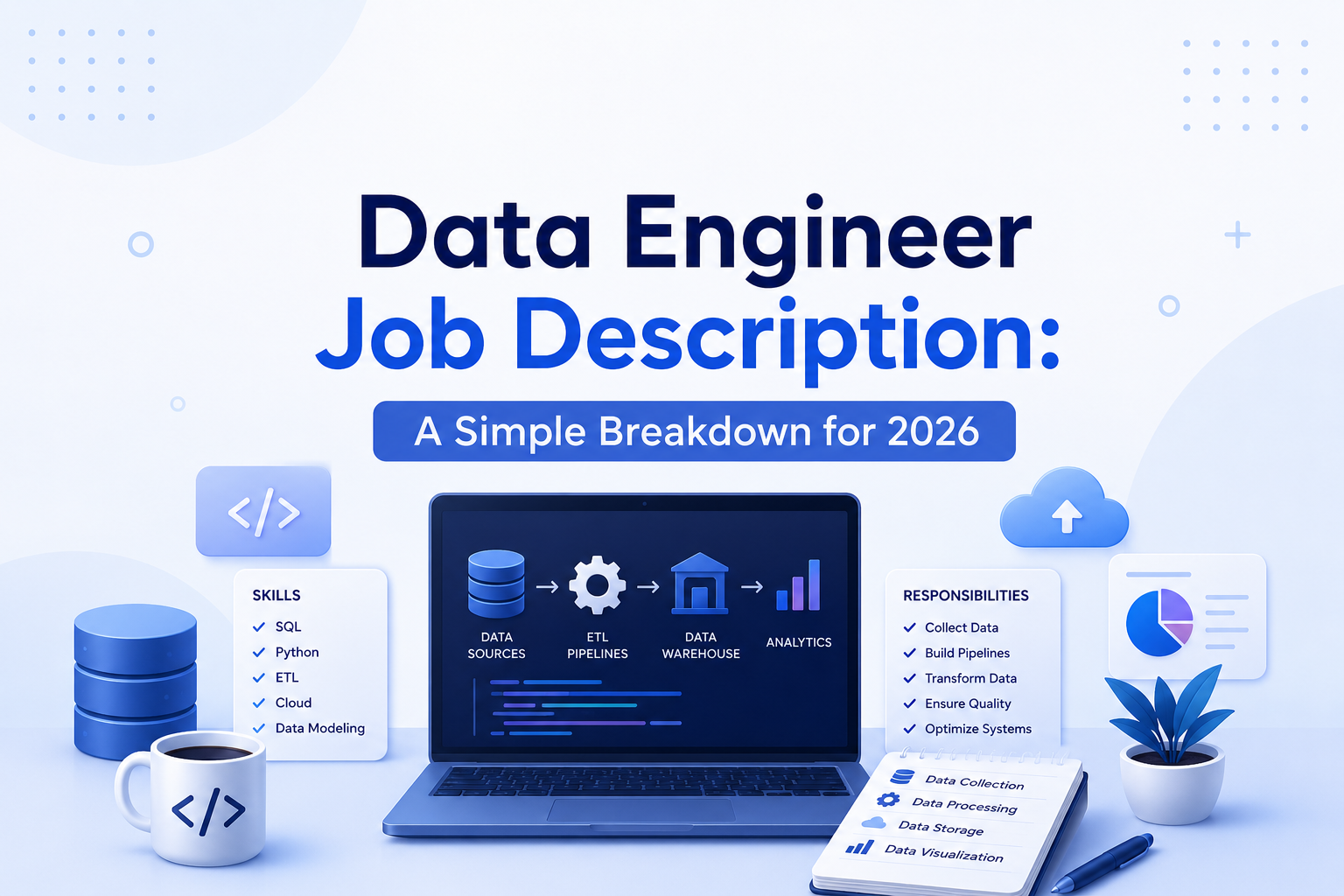
Start with SQL. Then learn basic Python, how a data pipeline moves data, simple warehouse modeling, and one cloud platform at a beginner level. You do not need every service name. You need to explain the flow from source to destination.
The short list that gets you through most junior postings
SQL is usually first because almost every team needs joins, filters, aggregations, and basic debugging. Python comes next because it helps with scripts, file handling, APIs, and simple transformations.
After that, learn ETL or ELT concepts, data warehouses like Snowflake, BigQuery, or Redshift, and basic cloud ideas in AWS, Azure, or GCP.
Skills to postpone until after you get the basics down
Advanced Spark tuning can wait. Deep distributed systems theory can wait too. The same goes for heavy DevOps work, Kubernetes, Terraform, and tool-specific edge cases.
Those topics matter later. They are weak first-month targets if your goal is to start applying soon.
How to decide if you should apply, study more, or skip the posting
Perfection is not the goal. Fit is.
Apply when you have most of the core skills and can explain one project clearly. Study more when the role matches your direction but you are missing one central piece, such as SQL or Python. Skip only when the role is clearly senior or highly specialized.
A simple 70 percent rule for junior applicants
If you match about 70 percent of the main requirements, especially the repeated ones, it is usually worth applying. That rule works because hiring teams often describe an ideal candidate, not a real one.
A close match can still win if you show learning speed and clear thinking.
Questions to ask before sending your application
Use a short self-check before you apply:
- Can you explain the main data flow?
- Can you write basic SQL without copying from memory aids?
- Can you talk through one project from source to output?
- Are you missing one or two skills, or would you need to start from zero?
Use the job post to build a focused learning plan, not a giant syllabus
A good posting tells you what to study next. It should narrow your plan, not blow it up.
Group the gaps by urgency. Then spend your time on the items that block interviews, not on every tool listed in the stack.
Turn the requirement list into a two-week or four-week plan
A simple plan works better than a huge one.
- Spend week 1 on SQL joins, grouping, window basics, and query debugging.
- Use week 2 for Python scripts, CSV or API data pulls, and one simple ETL task.
- Add warehouse modeling and basic cloud ideas in weeks 3 and 4 if needed.
- Finish with a small project that loads, transforms, and stores data end to end.
What to practice so you can talk about your skills in interviews
Do not memorize terms. Practice explanations.
Be ready to describe a pipeline, fix a broken query, explain why you chose a table model, and talk through one project step by step. Interview confidence usually comes from clear explanation, not from knowing the longest tool list.
One-minute summary
- Read the posting for repeated skills, not every named tool.
- Treat titles as hints, not truth.
- Learn SQL first, then Python, pipelines, warehouses, and basic cloud.
- Apply when you meet most core requirements, even if some extras are missing.
- Use each job post to build a short study plan tied to interviews.
Glossary
ETL: Extract, transform, load. A common way to move and clean data.
ELT: Extract, load, transform. The warehouse handles more of the processing.
Data pipeline: The path data takes from source systems to storage or reports.
Data warehouse: A system built for analytics, reporting, and organized query work.
Data model: The structure of tables and relationships used to store data.
Orchestration: Scheduling and managing pipeline steps, often with tools like Airflow.
Cloud platform: Services from AWS, Azure, or GCP used to store and process data.
Production: Live systems that real users or teams depend on every day.
FAQ
Do I need every tool in a junior data engineer job description to apply?
No. Most junior postings mix must-haves with preferred tools. If you match the core skills, especially SQL, basic Python, and simple data handling, you should usually apply. The long list often reflects the team’s stack, not a day-one checklist.
Is SQL enough to get a junior data engineer interview?
SQL alone is rarely enough, but it is the strongest first skill. Pair it with basic Python and one project that shows data movement, cleanup, and storage. That combination is often enough to start getting interviews for junior roles.
Should I apply if the post asks for AWS and I know Azure?
Yes, if the rest of the role fits. Many teams care more about basic cloud thinking than one exact platform. If you know storage, permissions, and simple data services in Azure, you can usually learn the AWS equivalent fast.
How do I know if a posting is truly junior-friendly?
Look for 0 to 2 years of experience, mentorship, onboarding, and support for existing pipelines. Also check the tasks. If the role focuses on maintenance, SQL, data quality, and simple scripts, it is usually more junior-friendly.
What kind of project helps most in a junior data engineer interview?
A small end-to-end project works best. Pull data from a source, clean it, load it into a warehouse, and write a few SQL queries on top. Then practice explaining each choice in plain language.
When should I skip a posting?
Skip when the post asks for senior ownership, architecture design, heavy on-call work, or several years of production experience with specialized tools. If you would need to build the whole skill set from zero, your time is better spent elsewhere.
Final thoughts
Junior job descriptions are meant to guide you, not overwhelm you. The smart move is to filter for the true requirements, ignore the extra wish-list items, and build strength in the skills that repeat.
Start with one posting today. Mark the repeated tools, choose one missing core skill, and practice talking through one project. If you want more structure after that, interview-focused courses can help you turn study time into better answers and stronger applications.