
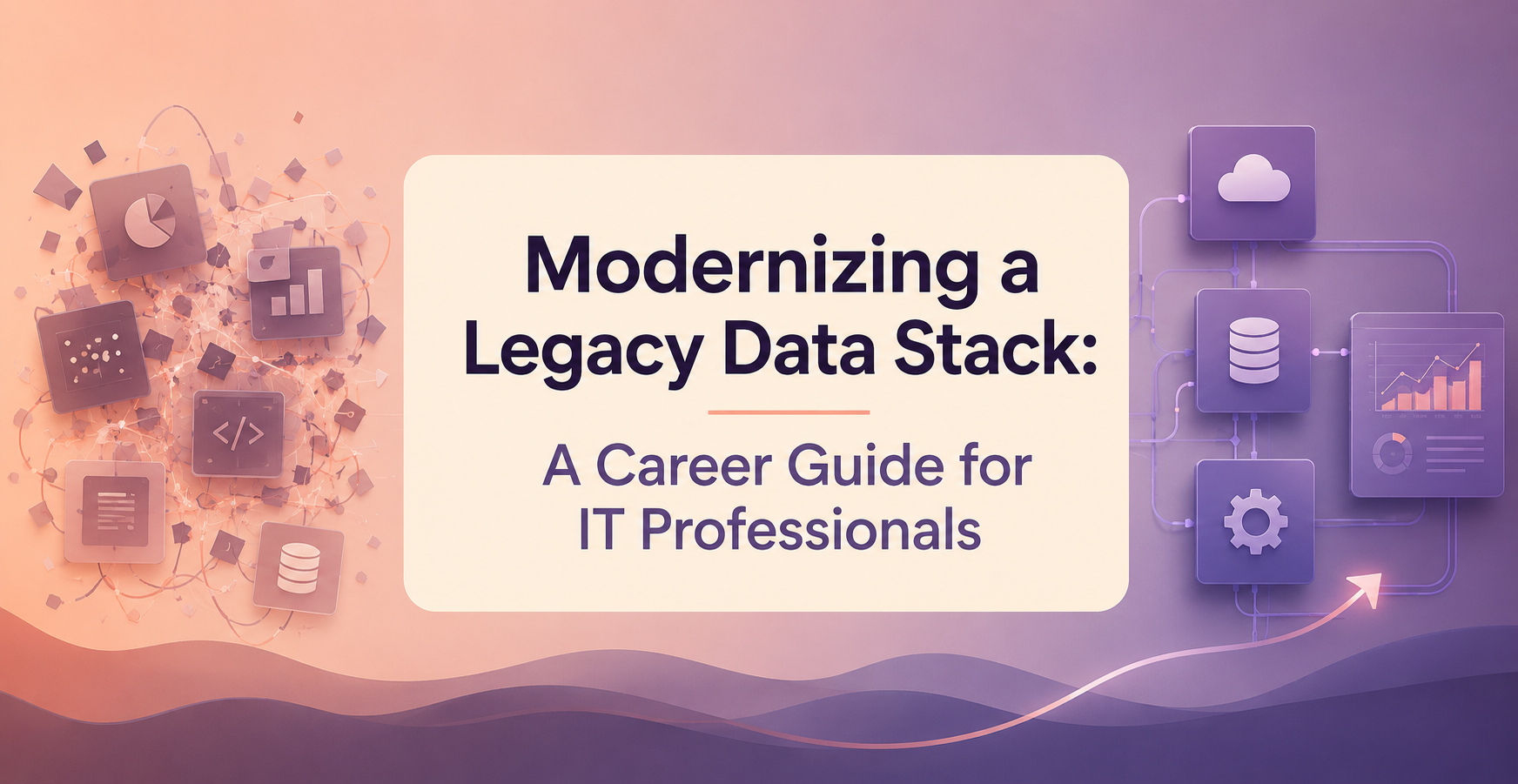
Modernizing a Legacy Data Stack: A Career Guide
Modernizing a legacy data stack can feel intimidating when you’ve spent ten or twenty years working with SSIS, Informatica, DataStage, Oracle, or mainframe systems. The company migrates, and either you keep up or you become the person maintaining the thing nobody wants to touch.
There’s a third option most people in this position never consider. The migration itself is the best job you’ll ever be positioned for because it requires understanding both the old system and the new one, and almost nobody has both halves.
A bootcamp graduate can write a dbt model. They cannot read a fifteen-year-old PowerCenter mapping and tell you which of its 40 transformations still matter. You can. That’s not a legacy skill. That’s the scarce half of a migration.
Key Points
- Legacy-to-cloud migration roles are widely posted and have a small qualified candidate pool.
- Roughly 60% of what you know transfers directly; the vocabulary changed more than the concepts.
- The pay gap between legacy and modern roles is smaller than most people assume.
- The real risk of staying isn’t your salary today it’s your trajectory and your optionality.
- The fastest path runs through your current employer, not a career restart.
Quick summary: Your experience is an asset that’s being described as a liability, mostly by you. Migration roles explicitly want people who understand legacy systems, and positioning yourself as the bridge is faster and better paid than presenting yourself as a beginner in modern tooling.
Key takeaway: Don’t start over. Reposition. The concepts you’ve used for fifteen years staging, incremental loads, slowly changing dimensions, dependency management are the same concepts, running on different infrastructure.
Quick promise: This guide covers the honest market picture for legacy skills, a concept-by-concept translation map from your stack to the modern one, a 90-day plan you can run without quitting, and how to rewrite your resume so recruiters stop filtering you out.
Where You Actually Stand
Let’s be accurate in both directions, because the discourse here is unhelpfully dramatic.
1. The demand hasn’t vanished
Glassdoor lists roughly 2,885 ETL developer roles in the US as of July 2026. ZipRecruiter puts the average SSIS data engineer at $129,716, with most between $114,500 and $137,500. Contract Informatica work commonly runs $52–$69 an hour, with senior roles above that.
Nobody is about to be unemployed. If you’ve been told your skills are worthless, that’s wrong and you can verify it in ten minutes on any job board.
2. But the trajectory is the actual problem
Here’s the honest version. The risk isn’t that legacy roles disappear next year. It’s four slower things:
- The pool of employers shrinks every year, which reduces your negotiating leverage even while your salary looks stable.
- The remaining roles concentrate in contract work and in organizations that pay for continuity rather than innovation.
- Your ceiling flattens. Legacy specialists tend to plateau because there’s no architecture ladder above “the person who knows the old system.”
- Optionality decays. Each year in the same stack narrows what you can credibly apply for without a story.
This is a slow problem, which is precisely what makes it dangerous. Nothing forces action until something does.
3. The pay gap is smaller than you’d guess and that’s not a reason to stay
Compare the SSIS data engineer average of $129,716 against a general data engineer at roughly $133,972. That’s about a $4,000 difference. If you were expecting modernization to produce an immediate windfall, that number should recalibrate you.
The case for moving isn’t next year’s salary. It’s the ceiling and the risk. Senior data engineers report averages around $176,000, and the architecture and platform roles above that are largely closed to someone whose experience stops at the on-prem boundary. You’re not buying a raise this year. You’re buying access to a ladder.
We’d rather say that plainly than sell you a fantasy about doubling your income in ninety days.
The Third Door: Migration Roles
Most people in your position see two options: stay until the system is decommissioned, or restart as a junior somewhere modern. Both are bad, and there’s a well-paid door between them.
4. What these postings actually say
Scan current listings and this pattern appears constantly:
- Lead or contribute to legacy-to-cloud migrations Informatica PowerCenter to Azure Data Factory, on-prem Teradata, Oracle, or SQL Server to Synapse or Fabric.
- Support the gradual transition from traditional ETL processes to Python, Docker, and dbt while maintaining the existing SQL Server and SSIS foundation.
- Perform data conversions from legacy systems; requires COBOL and mainframe understanding alongside advanced Python.
- Modernize our data architecture, bridging raw source systems and the enterprise reporting environment.
Read those again with your own résumé in mind. Every one of them requires exactly the thing you’ve been treating as dead weight.
5. Why your competition is thin here
A pure modern data engineering role attracts hundreds of applicants, many of them younger, cheaper, and fluent in the current toolset.
A migration role requires someone who can look at 200 SSIS packages and determine which encode real business logic, which are duplicates, which are dead, and which contain a rule nobody documented in 2011 that the finance team still depends on. That’s archaeology, and it can’t be learned from a course.
The candidate pool for that is small. You’re in it. Most of your competition for modern roles isn’t.
This is the single most useful reframe available to you: stop applying as a beginner in the new stack and start applying as the only person who understands both.
The Translation Map
The vocabulary changed more than the concepts did. Here’s what you already know, in the new language.
| What you’ve been doing | The modern equivalent | How much is genuinely new |
| SSIS package / Informatica mapping | dbt model, Spark job, or Python task | Syntax, not concept |
| SSIS control flow, job dependencies | Airflow DAG dependencies | Very little |
| SQL Agent jobs, cron | Airflow, Dagster, Prefect scheduling | Some retries and backfills are richer |
| Stored procedure transformations | dbt models with tests and lineage | Moderate version control is the shift |
| Staging → ODS → mart layers | Bronze / silver / gold, or raw / core / marts | Almost nothing. Same idea, new names |
| Slowly changing dimensions | Slowly changing dimensions | Identical |
| Incremental loads, watermarks | Incremental models, CDC with Debezium | Moderate |
| On-prem SQL Server / Oracle / Teradata | Snowflake, BigQuery, Synapse, Databricks | Significant but concepts port |
| Network file shares | S3, ADLS, GCS object storage | Moderate |
| Manual package deployment | Git, CI/CD pipelines | Significant and important |
| Nightly batch window | Scheduled batch or micro-batch | Little |
| Row-by-row cursor processing | Set-based and distributed processing | Real mindset shift |
| Data quality checks in procedures | dbt tests, Great Expectations | Little |
Look at that middle column honestly. You have been doing orchestration, dependency management, incremental loading, dimensional modeling, and data quality for fifteen years. Nobody has to teach you why a watermark exists.
6. What genuinely transfers
Beyond tooling, the things that actually make you valuable and take a newcomer years to develop:
- Debugging production data problems under pressure, with a business waiting.
- Understanding that data has politics. You know that the finance definition of “active customer” differs from marketing’s, and that resolving it is a conversation, not a query.
- Institutional knowledge of failure. You know what breaks at month-end close.
- Dimensional modeling instincts from doing it repeatedly, not from reading Kimball once.
- Change management discipline. You’ve been burned by an untested deployment, which makes you take testing seriously in a way tutorials never instill.
7. What’s genuinely new, the honest gap list
Don’t let anyone tell you it’s all just renaming. Real gaps exist:
- Python beyond scripting. Not pandas tutorials production code with error handling, logging, and tests.
- Git and CI/CD. If you deploy by copying files to a server, this is your biggest cultural shift and it’s non-negotiable.
- Cloud fundamentals. Object storage, IAM, compute, networking, and critically cost. On-prem hid the cost from you. Cloud makes every inefficiency a line item.
- Distributed processing. Spark thinks differently than SQL Server. Partitioning, shuffles, and skew are new problems.
- Infrastructure as code. Terraform or equivalent.
- Set-based and distributed thinking if you’ve leaned on cursors and row-by-row logic.
That’s a real list, and it’s roughly six months of consistent part-time work not a degree.
A 90-Day Legacy Data Stack Modernization Plan
The fastest path runs through your current employer, because that’s where you have access to real legacy systems and real business context.
Days 1–30: Learn the target of your own migration.
Find out what your organization is moving toward, or would move toward. Azure shops go to Data Factory, Synapse, or Fabric. AWS shops to Glue, Redshift, or Databricks. Learn that one platform specifically rather than surveying all three. Get Python to the point where you can write a tested script that pulls from a source and loads to a target. Learn Git properly branches, pull requests, reviews.
Days 31–60: Rebuild something you already own.
Take one real SSIS package or Informatica mapping from your job ideally an unloved one and reimplement it on the modern stack. Same source, same target, same business logic. Orchestrate it with Airflow, transform with dbt, version it in Git, add tests.
This is the highest-leverage exercise available to you, because you already understand the business logic. You’re learning one variable at a time instead of learning tooling and a domain simultaneously.
Days 61–90: Make it official and measurable.
Propose it. Frame it in the language management responds to: reduced maintenance burden, faster processing, better auditability, lower risk. Volunteer for the migration working group if one exists. If one doesn’t, become the reason it does.
Then measure. Runtime before and after. Manual steps eliminated. Failures reduced. Incremental loading improvements are especially quotable because the numbers are dramatic.
At the end of ninety days you have modern-stack experience, at a real company, on real data, with a measurable outcome. That’s not a portfolio project. That’s a line on your résumé.
Rewriting Your Resume
Most people in your position get filtered before a human reads anything, because their résumé is a list of deprecated tools.
The fix isn’t hiding your experience. It’s leading with the concepts and letting the tools follow.
Before: “Developed and maintained SSIS packages for the enterprise data warehouse. Wrote stored procedures for ETL. Managed SQL Agent jobs.”
After: “Own 40+ production data pipelines processing 12M daily records into an enterprise warehouse, including incremental loading, slowly changing dimensions, and data quality validation. Led migration of 12 legacy pipelines to Azure Data Factory and dbt, cutting nightly batch runtime 55% and eliminating six manual steps.”
Same person, same job. The second version leads with scale, concepts, and outcomes, then names tools. It survives both the recruiter scan and the keyword filter.
Three rules:
- Lead with concepts, not products. “Incremental loading and CDC,” not “SSIS packages.”
- Put every modern tool you’ve actually touched in the top third, even if the exposure is limited. Be honest about depth in conversation.
- Quantify everything. Records, runtime, packages, uptime, incidents avoided. Your resume structure matters, but the numbers are what get you read.
Four Traps to Avoid
Waiting for your company to modernize. Many organizations will run these systems for another decade. Your timeline and theirs are different problems.
Learning everything at once. Spark, Kafka, Airflow, dbt, Terraform, and three clouds simultaneously produces shallow familiarity with all of it. Pick one cloud and one orchestrator. Go deep.
Hiding the legacy experience. Some people bury fifteen years of Informatica to look “modern.” This destroys the exact advantage that makes migration roles winnable, and the gap in your timeline raises more questions than the tools would.
Accepting a junior title. This is the most expensive mistake available to you. Fifteen years of production data experience is not entry-level experience, whatever the tooling. Target mid-to-senior roles with a repositioning story, not junior roles with an apology.
Essential Terms
- Legacy stack: An older, typically on-premises data platform still running production workloads.
- Lift and shift: Moving a system to the cloud largely unchanged, without redesign.
- Refactor: Rebuilding logic to suit the target platform rather than porting it directly.
- CDC (change data capture): Capturing row-level changes at the source rather than reloading.
- Medallion architecture: Layered bronze / silver / gold table design; the modern name for staging, core, and marts.
- Infrastructure as code: Defining infrastructure in version-controlled configuration files.
- Technical debt: Accumulated shortcuts that raise the cost of future change.
- Parity testing: Verifying a migrated pipeline produces identical output to the original.
Final Thoughts
The story you’ve probably absorbed is that you’re behind, that the industry moved on, and that catching up means starting near the bottom.
The accurate story is that you have half of a rare skill combination and you’re missing the other half and the missing half is roughly six months of focused, part-time work. Meanwhile thousands of organizations are running migrations right now that need someone who can read both languages.
The work you’ve done isn’t obsolete. Every one of those companies has a warehouse full of business rules encoded in packages nobody understands, and the person who can decode them is worth considerably more than the person who only knows the destination.
Start with one pipeline. Rebuild it on the new stack. Measure what changed. Then do it again with a bigger one, and let your résumé follow the work.
Frequently Asked Questions
Am I too old to move into modern data engineering?
No, and the specific concern behind that question that you’ll be competing with 25-year-olds is misplaced for migration roles. Those roles explicitly require the experience that younger candidates don’t have. Where age genuinely creates friction, it’s usually because the résumé reads as legacy-only rather than as bridge-capable.
Should I learn AWS, Azure, or GCP?
Learn whichever your current employer uses or would plausibly move to, because that’s where you can get real experience fastest. For legacy Microsoft shops, Azure is usually the shortest path since Data Factory and Fabric are the natural targets from SSIS. The concepts transfer between clouds afterward.
How long does this realistically take?
Six to twelve months of consistent part-time effort to be credibly interviewing, assuming you already have strong SQL and data warehousing fundamentals which most people in this position do. Faster if you can claim migration work at your current job.
Will I have to take a pay cut?
Usually not, if you target migration and hybrid roles rather than junior modern-stack positions. The averages for legacy and modern data engineering are within a few thousand dollars of each other, so a lateral move at similar pay with a better trajectory is a realistic target.
My company will never modernize. What do I do?
Build the proof anyway, on your own time, using business logic you understand from work without taking any proprietary data or code. Then target migration roles elsewhere. Your legacy experience is portable even if your employer is static.
Is it worth getting a cloud certification?
Moderately. It helps with keyword screens and gives your learning structure, which is genuinely useful for a self-directed six-month plan. It won’t substitute for having migrated something. Pair one certification with one rebuilt pipeline.
Should I mention COBOL or mainframe experience?
Yes, if you’re targeting organizations that have those systems and many banks, insurers, and government agencies still do, with active migration programs. It’s a differentiator in that market and neutral elsewhere.
What if I’ve only ever used GUI-based ETL tools?
That’s the most common starting point and it’s manageable. The concepts you learned in the GUI are the concepts you’ll write in code. Expect the adjustment to be about version control and testing discipline more than about logic.
P.S. Here’s a fast way to test everything above. Search any job board for “Informatica migration,” “SSIS to Azure,” or “legacy modernization” and read ten postings properly. Count how many require exactly the legacy experience you already have, alongside a modern tool you could learn in a quarter. Most people in your position have never run that search, because they assumed the answer. The answer is usually a list of roles you’re 70% qualified for today.