
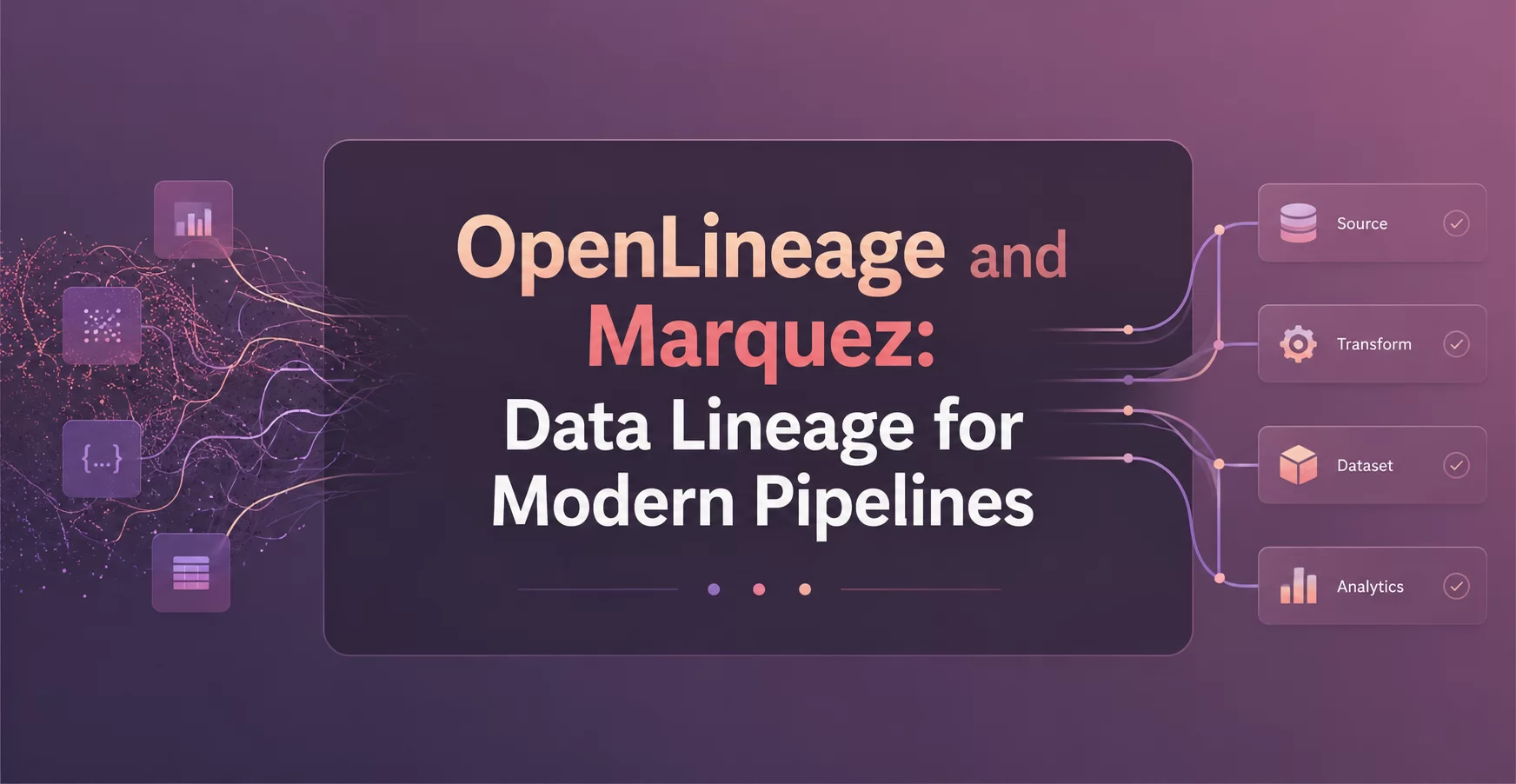
OpenLineage and Marquez: Data Lineage for Modern Pipelines
OpenLineage gives teams a standard way to track lineage across tools, and Marquez gives them an open-source place to store and view that lineage. If you’re trying to make OpenLineage data lineage useful in a real platform, this pairing is one of the clearest options. It matters because modern pipelines cross schedulers, SQL models, Spark jobs, streams, and dashboards, so one bad number can start far upstream.
You need more than table names and owners. You need to see how data moved, what ran, and what changed before metrics went off.
Key Points
- OpenLineage emits lineage events in a shared format.
- Marquez stores those events and makes them searchable.
- Lineage helps teams debug broken data faster.
- Cross-tool lineage matters in mixed data stacks.
- Smaller teams may not need full lineage on day one.
Why data lineage matters when pipelines keep getting more complex
Modern data work rarely stays inside one tool. A file lands in cloud storage, Airflow schedules a task, dbt builds models, Spark reshapes a large table, and a BI dashboard reads the result. When a metric drops, the bug could sit anywhere in that chain.
What lineage tells you that metadata alone cannot
Basic metadata tells you facts about an asset. You might see a table name, schema, owner, and last update time. That helps, but it doesn’t explain movement.
Lineage adds the missing path. It shows that dataset A fed job B, which produced table C, which powered dashboard D. In other words, it tells you how data flowed, not only what the asset is.
Picture a conversion metric on a dashboard that suddenly looks wrong. Metadata tells you who owns the dashboard and which model backs it. Lineage lets you trace that metric through a mart table, a dbt model, a Kafka topic, and the raw event table that missed yesterday’s load. That is why pipeline lineage matters in day-to-day work.
The business value of being able to trace data end to end
Lineage shortens debugging time because engineers can follow a path instead of guessing. It also makes changes safer. Before renaming a column or swapping a source, you can inspect downstream impact.
That same visibility improves trust in analytics. Analysts stop treating broken metrics like weather and start seeing a cause. Meanwhile, audit and compliance work gets easier because teams can show where data came from and where it landed. In lineage in data engineering, that end-to-end trace is what turns scattered metadata into usable context.
How OpenLineage works as a shared language for pipeline lineage
OpenLineage is an open standard for emitting lineage events from different tools into one common format. That matters because most teams do not run a single-vendor stack. They use the best tool for orchestration, transformation, processing, and streaming, then need one way to describe what happened across all of them.
The core pieces: runs, jobs, datasets, and lineage events
A job is a named unit of work, such as a dbt model build or a Spark task. A run is one execution of that job. A dataset is an input or output data asset, such as a table, file, or topic. A lineage event is the record emitted when the run starts, completes, or changes state.
Here’s a simple example. Airflow triggers a nightly job. That run reads raw.orders, joins it with raw.customers, and writes analytics.orders_daily. OpenLineage can capture the job name, run ID, timing, input datasets, output datasets, and extra details such as schema information.
Where OpenLineage fits in tools like Airflow, Spark, dbt, and Kafka
OpenLineage works best when tools emit events while they run. Airflow can report task execution. Spark can describe what datasets it read and wrote. dbt can connect sources, models, and targets. Kafka or stream processors can treat topics as datasets in the same lineage graph.
The point is not to force every tool into one interface. The point is to let each tool tell part of the same story. Because of that, open lineage works well in modern stacks where jobs run at different layers but still touch the same data.
Why Marquez is a useful place to store, search, and view lineage
Marquez is the open-source metadata service and UI built to work with OpenLineage. It collects lineage events, stores them, and turns them into something humans can inspect. When people talk about Marquez data lineage, they usually mean this practical setup: OpenLineage captures the facts, and Marquez makes those facts usable.
How Marquez turns lineage events into a usable graph
As events arrive, Marquez groups them around jobs, runs, namespaces, and datasets. Then the UI presents those relationships as a graph that you can scan quickly. Instead of reading raw event payloads, you can click a dataset and inspect its upstream producers, downstream consumers, and recent activity.
That graph matters because dependencies are hard to hold in your head. A visual map makes hidden links obvious. You can spot which jobs touch a table, which outputs depend on a model, and where a break may have started.
What teams usually inspect in the Marquez UI
Most teams open Marquez for a few common tasks. They check upstream sources when a table looks wrong. They review downstream impact before changing a model. They search run history when a job fails overnight. They also inspect dataset history to find when a bad change first appeared.
You do not need perfect event coverage for Marquez to help. Even partial lineage can narrow the search area fast, which is often enough to cut incident time.
A simple way to decide if OpenLineage and Marquez fit your stack
This setup is a strong fit when your platform spans several tools and ownership is spread across teams. It also helps when schema changes happen often, or when bad data costs real time and trust. Still, a simple stack does not always need a full lineage system on day one.
Signs your team will benefit from open, cross-tool lineage
- Your pipelines cross tools such as Airflow, dbt, Spark, and Kafka.
- Engineers keep asking what feeds a table or dashboard.
- Renames and schema changes break downstream work.
- Dataset ownership is fuzzy across teams.
- Audit, privacy, or source-tracing requests happen often.
Common limits to plan for before adopting either tool
Setup takes effort, especially early on. Some tools emit richer events than others, so coverage may start uneven. Naming also matters more than people expect. If jobs and datasets use messy namespaces, the graph gets noisy fast.
Teams also need shared habits around owners, environments, and stable identifiers. If your platform is small, one orchestrator, a few pipelines, and clear documentation may be enough for now.
One-minute summary
- Capture lineage where work runs, not after the fact.
- Start with one high-value pipeline and verify the events.
- Use Marquez before making risky schema changes.
- Clean up naming early so the graph stays readable.
- Expect lineage coverage to improve over time, not overnight.
Glossary
- Data lineage: A record of how data moves from source to output.
- Pipeline lineage: Lineage focused on jobs, tasks, and their data flow.
- Job: A named unit of work, such as a dbt model or Spark task.
- Run: One execution of a job.
- Dataset: Any input or output asset, such as a table, file, or topic.
- Upstream: The sources or jobs that feed the current asset.
- Downstream: The jobs, tables, or dashboards that depend on the current asset.
- Namespace: A grouping label that helps separate systems or environments.
FAQ
What is OpenLineage in simple terms?
OpenLineage is an open standard for reporting data lineage during job execution. It lets tools like Airflow, Spark, and dbt describe runs, inputs, and outputs in a shared format, so teams can track data flow across a mixed stack.
What is Marquez used for?
Marquez stores and displays lineage metadata, especially events emitted through OpenLineage. Teams use it to search jobs and datasets, inspect run history, and view dependency graphs when they need to debug broken pipelines or estimate downstream impact.
Do I need both OpenLineage and Marquez?
No, but they work well together. OpenLineage defines how lineage events get emitted, while Marquez is a practical place to store and view those events. You can use OpenLineage with other back ends, but Marquez is a common open-source choice.
Can beginners learn data lineage without a large platform?
Yes. You can start with a small pipeline and trace one table from source to dashboard. The key idea is simple: know what produced a dataset, what it consumed, and what breaks if it changes.
Does OpenLineage only work with batch pipelines?
No. Batch jobs are a common starting point, but the model also fits streaming systems. Kafka topics and stream processors can appear as datasets and jobs, which helps teams trace both scheduled and event-driven flows.
When is a simpler setup enough?
A simpler setup is often enough when one tool runs most of your pipelines and ownership is clear. If a few documented jobs and tables cover your main workflows, manual docs may beat a lineage system until the stack grows.
Conclusion
OpenLineage gives you a standard way to capture lineage, and Marquez gives that lineage a place people can use. Together, they make debugging less like guesswork and make pipeline changes safer.
That matters more as data platforms spread across tools and teams. When you can trace what changed, where it flowed, and who depends on it, trust in the pipeline becomes easier to earn and easier to keep.
If you want hands-on practice, the DE Projects Course at Data Engineer Academy puts these problems inside real pipelines. A good next read is an Airflow and dbt architecture guide, because that is where many lineage events begin.