
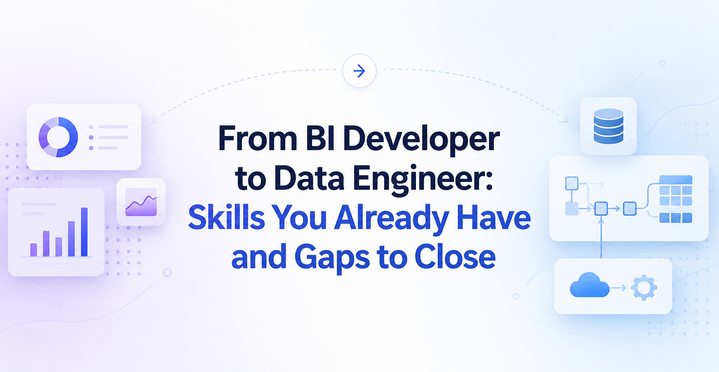
From BI Developer to Data Engineer: Skills You Already Have and Gaps to Close
You can move from BI developer to data engineer without starting over. Your SQL, reporting logic, data modeling, and ETL habits already fit a big part of the job. The main gaps are Python, cloud platforms, orchestration, and production reliability. If you’re planning a BI developer to data engineer move, the fastest path is to build on what you already know, then close the few gaps that matter most.
That matters because many BI developers already think in datasets, refresh cycles, broken joins, and stakeholder trust. Data engineering asks for the same mindset, but at a larger and more operational level.
Key Points
- BI developers already bring strong SQL, modeling, and data quality skills.
- The hardest jump is moving from analysis work to production systems.
- Python, cloud storage, and orchestration are the main skill gaps.
- One focused stack beats shallow exposure to many tools.
- A strong portfolio project proves the transition better than certificates alone.
The BI skills that transfer well into data engineering
If you’ve spent years building reports, tracing bad numbers, and fixing source issues, you are not starting from zero. You already know where data breaks, how teams use it, and why bad logic spreads fast.
SQL, data validation, and working with messy tables
Strong SQL is a real advantage. Data engineers write joins, CTEs, aggregations, and window functions every day. They also clean bad timestamps, handle nulls, and check duplicate keys.
That work is familiar to a SQL-heavy BI engineer. You already know how to test whether the numbers look right, compare outputs across sources, and write logic that supports both dashboards and backend transformations.
Data modeling and understanding business rules
BI developers also know how data should look for reporting. If you’ve built star schemas, fact tables, and dimensions, you already understand grain, conformed dimensions, and business definitions.
That helps when designing datasets for analytics teams. A data engineer needs more than technical skill. They need to know why “customer,” “order,” or “active user” means one thing in finance and another thing in product.
ETL thinking, dashboard dependencies, and stakeholder needs
Most BI work sits on top of a data flow. You know when refreshes run, which dashboards depend on which tables, and what happens when a source changes without warning.
That mindset transfers well. Data engineering is often about building dependable pipelines for the same downstream users you already support.
This is the overlap in plain terms:
| BI experience | Why it matters in data engineering |
| Writing advanced SQL | It powers transformations, checks, and pipeline logic |
| Modeling data for reports | It helps build stable analytics tables |
| Managing refresh issues | It builds pipeline ownership habits |
| Working with business teams | It keeps engineering tied to real use cases |
The big takeaway is simple: your BI background gives you context that many junior engineers still need to learn.
Where the BI-to-data-engineer jump gets harder
The jump gets harder when you move from using clean data to building systems that produce it. One good query is useful. A pipeline that runs every day, handles failure, and stays fast is a different level of responsibility.
Coding beyond SQL, especially Python
SQL alone usually isn’t enough. Data engineers use Python for file handling, API pulls, scheduling logic, tests, and small utilities that keep pipelines moving.
A Power BI to data engineer shift often stalls here. Many BI developers know basic scripts, but they need deeper comfort with functions, error handling, packages, and reading raw JSON or CSV files.
Cloud platforms, storage, and pipeline orchestration
You also need to understand where data lives and how jobs run. That means object storage like Amazon S3 or Azure Data Lake Storage, warehouses like Snowflake or BigQuery, and orchestration tools like Airflow.
You do not need every cloud at once. Pick AWS, Azure, or GCP, then learn the basics of storage, compute, permissions, scheduling, and warehouse loading.
Production skills that BI work does not always require
This is the part many BI roles only touch lightly. Data engineering cares about logging, retries, alerting, version control, testing, and performance over time.
A dashboard can be fixed after a complaint. A failed pipeline at 2 a.m. has to recover fast, or downstream jobs break too. That is why the role feels more operational.
Good SQL gets you noticed. Healthy pipelines keep you employed.
A practical learning plan to close the gap fast
You do not need a random pile of tools. You need one path that mirrors real work and proves you can own data from raw source to trusted table.
Start with one stack instead of chasing every tool
Pick one scripting language, one cloud, one warehouse, and one orchestrator. For example, Python, AWS, Snowflake, and Airflow is a clear stack. Azure, SQL Server, and ADF is also a valid path.
Focus matters because hiring teams want proof of competence, not ten half-learned badges.
Build one end-to-end project that mirrors real work
Create a project that ingests raw data from an API or files, stores it, cleans it, models it, and schedules it. Then add tests, logging, and a small dashboard on top.
That project should show pipeline thinking. A notebook with nice charts is useful, but it does not prove you can build and run a repeatable system.
Use your BI background to show business impact
Your BI past is not something to hide. It is evidence that you understand data consumers, report trust, and the cost of bad logic.
A Tableau developer career change works the same way. Frame your story around ownership, quality control, and the ability to turn messy source data into reliable business data.
How to present your BI background in interviews and on your resume
Hiring managers want a clean story. They need to see that you are not running away from BI. You are moving closer to the data foundation work you were already doing.
Turn dashboard wins into pipeline wins
Rewrite resume bullets so they show engineering value. “Built executive dashboards” is fine, but it is weak on its own. “Created SQL transformations, validated source data, reduced refresh failures, and fixed root-cause issues across reporting tables” tells a stronger story.
Good examples include:
- reducing manual refresh steps
- tracing bad numbers to upstream logic
- building reusable SQL models
- standardizing definitions across teams
Those points show ownership, reliability, and process improvement.
Answer the question, Why data engineering, without sounding vague
Keep your answer direct. Say that BI work pulled you toward upstream problems. Say you liked building trusted datasets more than formatting charts. Say you want to own data movement, quality, and system reliability.
That answer works because it connects your past to your next role. It also sounds better than saying you want a change because engineering “feels more technical.”
One-minute summary
- Keep your SQL, modeling, and data quality skills at the center of your story.
- Learn Python well enough to handle files, APIs, and testing.
- Pick one cloud stack and one orchestration tool.
- Build one project that runs like a real pipeline.
- Translate dashboard work into ownership, reliability, and upstream impact.
FAQ
Can a BI developer become a data engineer?
Yes. Many BI developers already have the hardest-to-teach skills: SQL, data modeling, and business context. The main work is adding Python, cloud basics, orchestration, and production habits. You are shifting upstream, not starting from scratch.
Is SQL enough to move into data engineering?
No, but it is a strong base. SQL gets you through transformations, checks, and warehouse work. Most data engineering roles also expect Python, version control, and some cloud knowledge because pipelines do more than query tables.
How long does it take to switch from BI to data engineering?
For many working professionals, six to twelve months is realistic. The timeline depends on your current SQL depth, how much ETL work you already do, and whether you build a real project that proves end-to-end pipeline skills.
Do I need a computer science degree?
No. Many data engineers came from analytics, BI, software, or operations roles. Hiring managers care more about proof. If you can build, test, and explain a pipeline, your degree matters much less than your skills.
What should I learn first, Python or cloud?
Start with Python if your coding is weak. It helps with APIs, files, tests, and automation right away. Then learn one cloud platform so you can place that code inside a realistic pipeline.
Is a Power BI or Tableau background respected in data engineering interviews?
Yes, if you frame it well. Do not stop at report design. Show how you handled bad data, fixed logic issues, mapped business rules, and supported reliable refreshes. That sounds like upstream ownership, which engineering teams value.
What kind of project helps most for this career change?
Build a small pipeline that ingests raw data, stores it, transforms it, tests it, and runs on a schedule. Add logging and a final analytics table. That shows far more than a notebook full of one-time analysis.
What is the biggest mistake BI developers make when switching?
Many focus on tools instead of systems. They collect cloud badges, but skip error handling, testing, and scheduling. Hiring teams want to see that you can keep data healthy over time, not only write a good query once.
Conclusion
The move into data engineering is realistic for BI developers because so much of the foundation already exists. SQL, data modeling, ETL thinking, and business context carry over better than most people think.
The gaps are real, but they are narrow. Pick one stack, build one end-to-end project, and start telling your experience in engineering language. If you want a structured path, Data Engineer Academy’s personalized training can help you practice the exact skills hiring teams expect.