
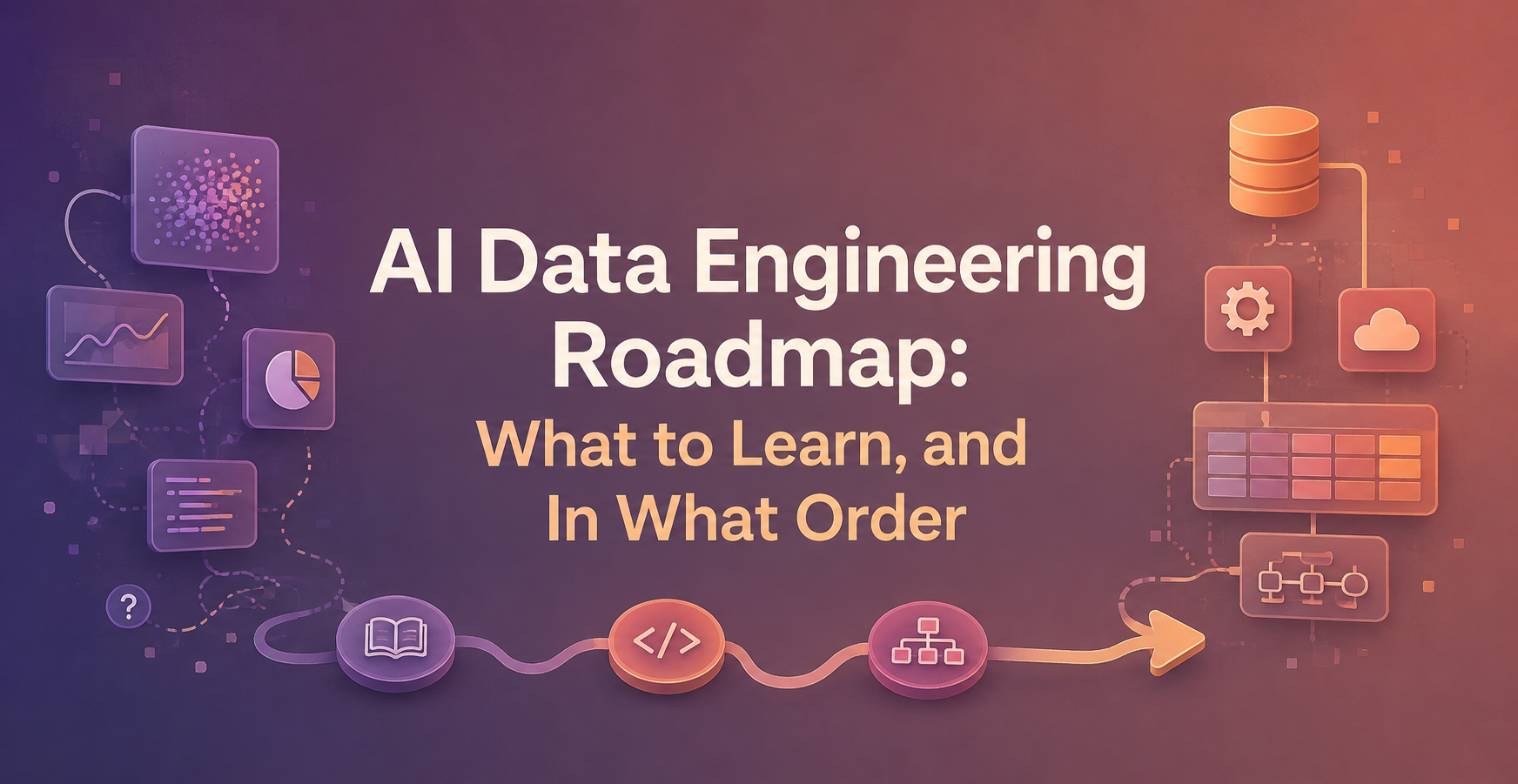
AI Data Engineering Roadmap: What to Learn, and In What Order
An AI data engineering roadmap is not a separate career track. It’s your existing data engineering foundation plus four additions: pipelines for unstructured data, retrieval infrastructure, evaluation systems, and cost control for workloads priced per token.
The order matters more than the list. Most people attempt this backwards, they start with a vector database and a framework tutorial, build something that works once, and discover in interviews that they can’t explain what happens when it fails at scale.
Key Points
- Roughly 70% of AI data engineering is ordinary data engineering applied to new payloads.
- Learn in this sequence: foundation, unstructured pipelines, retrieval, evaluation, cost and governance.
- Evaluation is the most underrated skill and the fastest way to separate yourself.
- Most “AI engineering roadmaps” online are written for app developers, not data engineers.
- Three portfolio projects, built deeply, beat a broad tool list every time.
Quick summary: The AI layer sits on top of the data layer, not instead of it. Ingestion, schema handling, orchestration, testing, and monitoring still decide whether a system works the payload just changed from rows to documents, audio, and embeddings.
Key takeaway: Don’t skip the foundation to get to the interesting part. Engineers who do end up able to build a demo and unable to operate a system, which is exactly the gap hiring managers are screening for in 2026.
Quick promise: This guide gives you a phased sequence with realistic timelines, the specific concepts that matter at each stage, three projects worth building, and an honest account of which trendy skills you can safely ignore.
What AI Data Engineering Actually Means
The clearest definition: you build and operate the data infrastructure that AI systems depend on, both to be trained and to run.
That splits into two workloads. Training and fine-tuning support assembling large, clean, well-governed datasets. And inference-time infrastructure the retrieval systems, feature pipelines, and context assembly that run every time a user asks a question.
For most engineers, the second is where the jobs are. Comparatively few companies train models. Almost every mid-sized company now has at least one system that retrieves internal data and feeds it to a model.
1. What transfers, and what doesn’t
This is the part nobody tells you clearly, so let’s be specific.
Transfers directly: ingestion patterns, incremental processing, idempotency, orchestration, schema evolution, data quality testing, lineage, access control, monitoring, cost management, and the general discipline of building things that run unattended.
Genuinely new: document parsing and chunking, embedding generation as a pipeline stage, vector indexing and retrieval, non-deterministic output evaluation, and per-token cost modeling.
The ratio is roughly 70/30 in favor of what you already know. That’s the good news and the trap at the same time the good news because your transition distance is shorter than the discourse suggests, the trap because the 30% is where every interview concentrates.
2. Why most roadmaps you’ll find are wrong for you
Search “AI engineering roadmap” and you’ll get a path designed for application developers: call an LLM API, write prompts, wire up a framework, deploy a chatbot.
That’s a real job. It isn’t yours. The AI data engineer owns what happens before the model call and after it where documents come from, how they’re processed, whether retrieval returns the right thing, whether the whole system can be rebuilt when the embedding model changes. Following an app-developer roadmap will leave you fluent in framework syntax and shallow on infrastructure, which is precisely the wrong profile for the roles that pay well.
Phase 1: The Foundation (Months 1–3, or skip if you have it)
If you’re already working as a data engineer, read this section as a checklist and move on. If you’re transitioning from analytics, BI, or IT, this phase is not optional and shortcutting it is the single most common way people waste a year.
3. What “foundation” means concretely
- SQL beyond reporting – window functions, CTEs, deduplication, merge logic, queries that rerun safely.
- Python for reliability – error handling, logging, retries, typed interfaces, tested code that runs unattended.
- Data modeling – grain, fact and dimension design, and why a schema decision today becomes a bug in six months.
- Orchestration – Airflow, Dagster, or Prefect. Scheduling, dependencies, retries, backfills.
- Cloud fundamentals – object storage, compute, IAM, and secrets on at least one platform. AWS is the most commonly requested.
- Engineering hygiene – version control, code review, CI, staged deployment.
4. The honest test for moving on
You’re ready for Phase 2 when you have built a pipeline that ingests from a real source, transforms, tests, and loads on a schedule and you can explain what happens when it fails halfway through.
Not “I completed a course on it.” Built it, broke it, fixed it.
Phase 2: Unstructured Data Pipelines (Months 3–5)
Here’s where it becomes AI-specific. The mental shift: a document pipeline is still a pipeline. Same stages, different payload.
5. Ingestion and parsing
Your sources are now PDFs, Confluence pages, Slack exports, support tickets, contracts, call transcripts, images. Each parses badly in its own way. A PDF with a two-column layout and a table will destroy a naive extractor, and you won’t notice until an answer is subtly wrong three weeks later.
Learn a serious parsing toolchain rather than PyPDF2 and hope. Learn to detect and quarantine documents that parsed poorly. Treat parse quality as a data quality metric with thresholds and alerts, because that’s exactly what it is.
6. Chunking and metadata the most underrated stage
Chunking is where naive systems die, and it gets a fraction of the attention that vector database selection gets.
Fixed-size chunking with arbitrary character counts splits sentences, separates a table from its header, and detaches a clause from the section that defines its terms. Structure-aware chunking respecting headings, sections, and semantic boundaries routinely produces a larger quality improvement than any change to the retrieval layer.
Attach metadata at this stage: source system, document ID, section path, timestamp, access level, version. You will need every one of those later for filtering, permissions, freshness checks, and debugging. Retrofitting metadata after you’ve embedded ten million chunks is a re-embedding project nobody wants to fund.
7. Embeddings as a pipeline stage
Generating embeddings is batch processing with an API bill. Which means: batching, rate limits, retries, checkpointing, cost estimation, and incremental processing so you only embed what changed.
The concept to internalize is re-embedding as a first-class operation. Embedding models get replaced. When that happens, every vector you’ve stored is stale, and you need a documented, tested procedure to regenerate the corpus without downtime. Design for that on day one; teams that don’t end up frozen on an old model because migration is too scary.
Phase 3: Retrieval Infrastructure (Months 5–7)
8. Vector storage and indexing
Learn the concepts, not one product: embeddings as high-dimensional vectors, approximate nearest neighbor search, HNSW and IVF indexing, and the recall-versus-latency tradeoff you’re always making.
| Option | Strong fit | Main tradeoff |
| pgvector | Teams already running Postgres | Scaling limits at very large corpora |
| Qdrant / Weaviate | Self-hosted, filter-heavy workloads | You operate it |
| Pinecone | Managed, minimal ops burden | Cost at scale, vendor lock-in |
| Chroma / FAISS | Local development, prototyping | Not production infrastructure |
An honest note: the choice matters far less than most content implies. Retrieval quality is dominated by chunking, metadata, and search strategy. Anyone whose retrieval story starts with which vector database they picked is telling you where their understanding stops.
9. Hybrid search and reranking
This is the highest-value technical concept in the phase, and it’s the one that separates candidates in interviews.
Pure vector search is semantic, which is a strength for conceptual questions and a serious weakness for exact matching. Ask about part number XR-4471-B and semantic similarity will happily return XR-4471-C. Keyword search (BM25) handles that case precisely. Hybrid search runs both and merges results, usually with Reciprocal Rank Fusion.
Reranking is the second layer: retrieve a wide candidate set, then use a cross-encoder to re-score the top results for actual relevance before anything reaches the model. It improves precision substantially and multiplies your per-query cost, which is a tradeoff you should be able to reason about out loud.
Also learn where retrieval isn’t the answer. Aggregate questions (“how many contracts expire this quarter?”) are SQL problems, not retrieval problems. Knowing when to route a query to a warehouse instead of a vector store is a design skill, and it comes up constantly in system design interviews.
Phase 4: Evaluation, Observability, and Cost (Months 7–9)
10. Evaluation is your differentiator
If you take one thing from this roadmap, take this: almost every senior job description in this space asks for evaluation experience, and almost every candidate arrives without it.
The reason is structural. In traditional pipelines, correctness is binary the row is right or wrong. With generated output, correctness is a distribution. The same input can produce different output tomorrow. You cannot assert equality in a test.
So you build measurement infrastructure instead:
- A golden dataset of representative queries with known-good answers.
- Retrieval metrics – did the right chunks come back at all? Context precision and recall are measured separately from generation quality, because a system that retrieves badly and generates smoothly is worse than one that fails loudly.
- Generation metrics – faithfulness (is the answer grounded in retrieved context?) and answer relevancy. Frameworks like RAGAS give you a standard vocabulary here.
- LLM-as-judge scoring for qualities you can’t measure mechanically, with its own validation, because the judge is also a model that can be wrong.
- Regression testing in CI, so a chunking change that quietly degrades retrieval gets caught before it ships.
An engineer who can walk through their eval pipeline is operating at a different level from one who says the answers “seemed good.” That gap is visible in the first five minutes of a technical conversation.
11. Observability
Trace every request end to end: query received, retrieval performed, chunks returned, context assembled, tokens consumed, latency at each stage, output produced. Tools like LangSmith or OpenTelemetry-based tracing handle the plumbing.
Then monitor what drifts. Retrieval quality degrades as the corpus grows. Embedding distributions shift as document types change. Cost per query creeps as contexts get longer. None of these announce themselves they show up as a gradual complaint rate that nobody can explain.
12. Cost and governance
Cost is engineering here, not accounting. The levers are context length, retrieval breadth, reranking depth, caching, model routing (small model for easy queries, large for hard ones), and embedding batch efficiency. An engineer who cuts inference cost by 40% without degrading measured quality has made a self-evident case for their next promotion.
Governance is now non-negotiable. Retrieval systems are excellent at leaking data across permission boundaries, because a document someone shouldn’t see becomes an answer nobody audited. Access filtering at retrieval time, PII handling, lineage from answer back to source document, and prompt injection awareness for anything ingesting untrusted content all belong to you.
The Roadmap at a Glance
| Phase | Focus | Realistic time | Signal you’re done |
| 1 | DE foundation | 0–3 months (skip if working DE) | Built, broke, and fixed a scheduled pipeline |
| 2 | Unstructured pipelines | 2 months | Parse and chunk quality measured, not assumed |
| 3 | Retrieval infrastructure | 2 months | Can explain hybrid search and reranking tradeoffs |
| 4 | Evaluation and cost | 2 months | Eval suite runs in CI against a golden dataset |
Assumes 8–10 hours a week. Working data engineers realistically reach interview-ready in four to six months. From analytics or IT, plan closer to nine to twelve.
Three Projects Worth Building
Skip the “chat with your PDF” tutorial. It was a credible portfolio piece in 2023. In 2026 it signals that you followed a walkthrough.
Project 1: A document pipeline with measured quality. Ingest a few thousand real, messy documents. Parse, chunk with structure awareness, enrich with metadata, embed incrementally, load into a vector store. Include a re-embedding path. Report parse failure rates and chunk quality as metrics.
Project 2: A hybrid retrieval service with an eval harness. Vector plus BM25 with rank fusion and a reranker. Build a golden dataset of 50+ queries. Measure retrieval precision and recall, then demonstrate a change that improved a specific number. The improvement story is the point.
Project 3: An operated system. Take one of the above, containerize it, orchestrate the ingestion, add tracing, alerting on drift, access filtering, and a cost dashboard. Run it for a month and let it break. What you learn from that month is the material for your best interview answers.
The through-line: each project should produce a number you improved and a failure you diagnosed. Those are the two things interviewers actually probe.
What You Can Safely Ignore
- Fine-tuning and model training. Interesting, occasionally relevant, rarely your job. Understand what it is and when someone would choose it. Don’t build a curriculum around it.
- Framework maximalism. Learn one orchestration library well enough to know what it’s doing underneath. The frameworks churn; the concepts don’t.
- Agentic architecture, for now. Genuinely emerging, genuinely immature. Follow it. Don’t build your identity on it before the patterns settle.
- Benchmark chasing. Which model tops which leaderboard changes monthly and almost never changes your architecture.
Final Thoughts
The pattern in this roadmap is deliberate: everything AI-specific sits on top of ordinary engineering discipline, and the sequence protects you from the most common failure mode impressive surface knowledge with nothing underneath it.
Your existing experience is worth more here than the discourse suggests. Companies have no shortage of people who can call an API. They have a serious shortage of people who can build a document pipeline that runs every night, prove its quality moved in the right direction, and explain what breaks first when the corpus triples. If you already have data engineering fundamentals, that’s a four-to-six month distance, not a career restart.
Frequently Asked Questions
Do I need machine learning knowledge to be an AI data engineer?
Working knowledge, not research depth. You should understand embeddings, tokenization, context windows, and why models hallucinate. You don’t need to derive backpropagation or train a model from scratch.
Should I learn LangChain or LlamaIndex?
Learn one well enough to understand the operations underneath retrieval, chunking, context assembly then be prepared to work without it. Production teams frequently drop frameworks once requirements get specific. Framework fluency alone is a weak signal.
Is RAG going to be obsolete as context windows grow?
Unlikely to disappear, though the boundaries shift. Longer contexts reduce the need for retrieval on small corpora but don’t help with millions of documents, permission filtering, freshness, or cost. Retrieval remains the answer when the corpus is large, sensitive, or changing.
How is this different from an MLOps role?
MLOps centers on model lifecycle training, versioning, deployment, monitoring. AI data engineering centers on the data feeding those systems and the retrieval infrastructure serving them. They overlap and increasingly appear in the same job descriptions.
Can I move into this without being a data engineer first?
You can, but it’s slower and the resulting profile is weaker. Engineers who skip the foundation typically hit a wall at the operational questions; orchestration, failure recovery, schema handling that show up in every interview loop.
What’s the single fastest way to stand out?
Build an evaluation pipeline. Most candidates can describe a RAG architecture. Very few can show a golden dataset, defined metrics, a regression suite, and a specific number they improved.
Which cloud should I learn for AI – data work?
AWS appears in the most postings, Azure dominates in enterprises already on Microsoft, and GCP is strong in ML-heavy shops. Learn one properly. The concepts transfer.
Does this pay more than standard data engineering?
Generally yes, though the premium tracks demonstrated production experience rather than the words on your resume. Titles in this space are unsettled enough that responsibilities are a better guide than headline.
P.S. Before committing to a nine-month plan, run a two-hour test. Take twenty real documents messy ones, with tables and inconsistent formatting and chunk them two different ways. Retrieve against both with the same ten questions. Look at what actually comes back. If the difference in results makes you want to understand why, you’ll enjoy this work. If it feels tedious, that’s useful information too, and it cost you an afternoon instead of a year.