
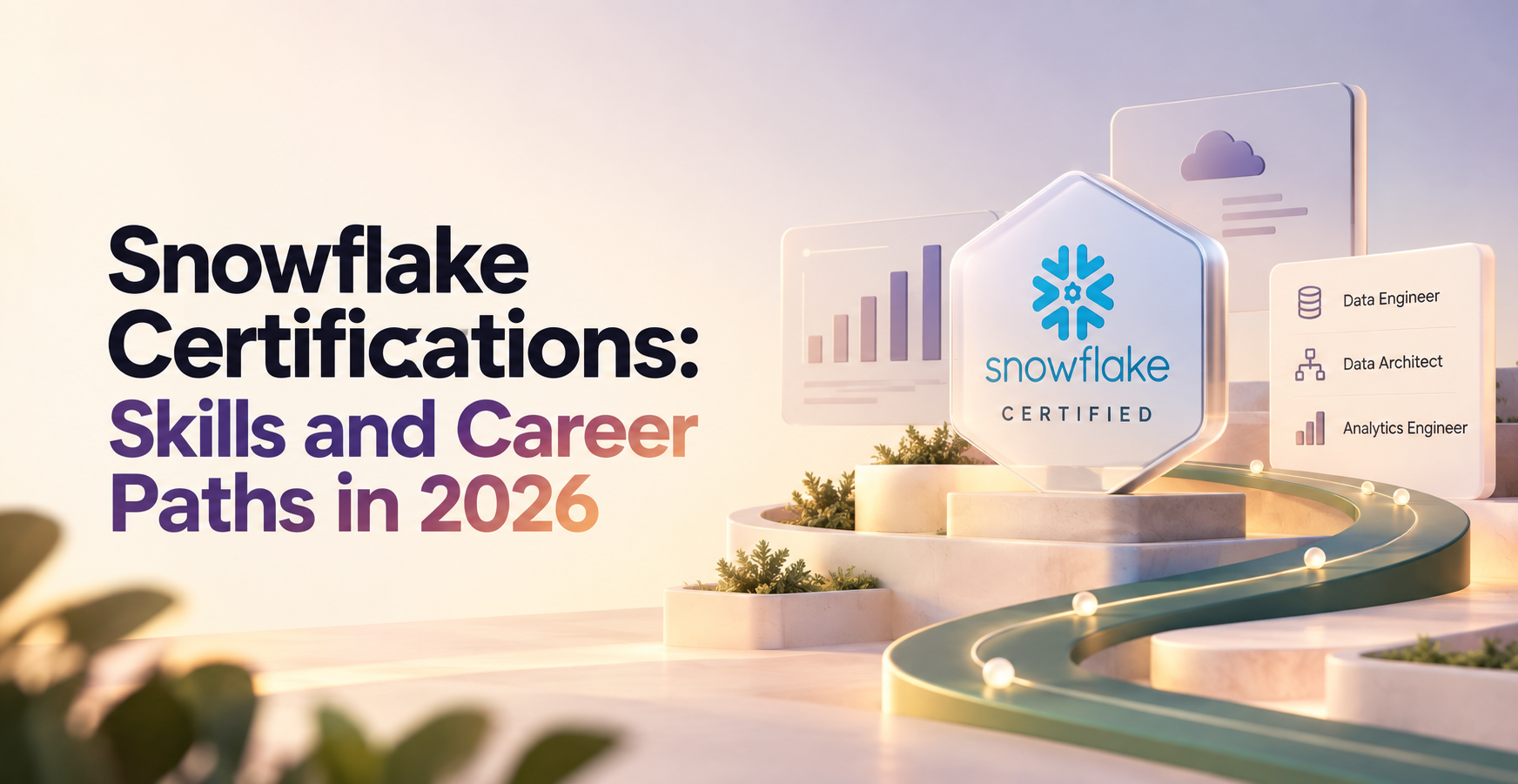
Snowflake Certifications: Skills and Career Paths in 2026
Snowflake certifications can show employers that you understand the platform, but the right credential depends on your experience and target role. In 2026, a badge can help make your skills easier to identify, especially when you’re changing careers or moving into a Snowflake-heavy team. It can’t replace the judgment you gain by building and troubleshooting real projects.
If you’re aiming for data engineering, platform administration, architecture, analytics, or data science, start with the work you want to do. Then choose an exam that matches it and prepare with hands-on practice.
Key Points
- Choose a credential that matches your current skills and the role you want next.
- Learn platform fundamentals before pursuing a specialty if you’re new to Snowflake.
- Use the official exam guide to check what your chosen exam covers.
- Build a small project so you can discuss Snowflake decisions in interviews.
Quick summary: Snowflake certifications validate knowledge of the platform or a specialized area. The strongest career story pairs one relevant credential with a project that shows how you load, transform, secure, and use data.
Key takeaway: An exam can validate Snowflake knowledge. A project shows how you apply it when choosing access controls, checking results, and balancing query performance against credit use.
Quick promise: Pairing exam study with one documented project gives you two things to discuss: the Snowflake concepts you’ve learned and the choices you made while putting them to work.
Snowflake Certifications in 2026: What the Credential Paths Cover
Snowflake’s certification program covers broad platform knowledge and more focused skills. The exact catalog, credential names, availability, and exam requirements can change, so check Snowflake’s official certification pages before choosing an exam or registering. Treat the paths below as a way to narrow your choice, not a fixed exam catalog.
Start with platform knowledge, then choose a specialty
A broad platform credential is a sensible first step if you’re still learning Snowflake’s architecture. You should understand databases and schemas, virtual warehouses, SQL queries, data loading, access controls, and basic performance concepts before narrowing your focus.
That foundation helps you recognize how a change in one area affects another. For example, adding compute may speed up a slow query, but poor SQL or an unsuitable warehouse setting may still waste credits. If you already solve these problems at work, compare your experience with the objectives for a role-focused exam instead of assuming you must start with a broad one.
Explore credentials for engineering, administration, and analytics
Role-focused options may cover data engineering, platform administration, architecture, data analysis, data science, or Snowpark development, depending on the current catalog. These areas call for different evidence: an engineer might design transformations, while an administrator might manage access and resource use.
A certification track isn’t a job title. An analyst who owns data pipelines may need engineering skills, and an architect still needs practical security knowledge. Choose by the tasks you perform or want to perform, then confirm that a current exam covers them.
What Skills Do Snowflake Certifications Demonstrate?
A passing result shows you understand the material in that exam’s objectives. Employers, however, also need to know whether you can use those ideas when data is messy, requirements change, or a query costs more than expected. No single exam proves that you can deliver an entire production system.
Core platform skills: SQL, data loading, security, and cost awareness
Most Snowflake work starts with SQL and a clear understanding of where data lives. You may need to join tables, create views, organize databases and schemas, or load files with COPY INTO. Transformations then turn raw records into data others can trust.
Virtual warehouses provide compute for queries and other work. Choosing their size and managing when they run affects credit use, while query history can help you investigate performance. Role-based access controls determine who can see or change data. These are useful working skills, although you should check the guide for your chosen exam rather than assume it tests every topic equally.
Role-based skills: pipelines, architecture, and advanced workloads
A data engineer may combine SQL transformations with streams and tasks to process changes on a schedule. They also need data models that support downstream reporting. Where Python development fits the job, Snowpark may be relevant.
Platform owners face different decisions: which roles receive access, how teams share governed data, and how to manage compute without disrupting workloads. Analysts need trustworthy definitions and checks behind their reports. In each case, the valuable skill is explaining a decision in its work context, not naming a feature.
Which Snowflake Certification Fits Your Career Path?
Start with your next job’s daily work, not the largest collection of badges. Snowflake certifications are most useful when their objectives overlap with skills you can practice and discuss. These starting points can help you narrow the field.
| Learner profile | Likely first credential or direction | Skills to build alongside it |
| New to Snowflake | Broad platform knowledge | SQL, loading, schemas, warehouses |
| Aspiring data engineer | Platform foundation, then engineering | Pipelines, modeling, Python |
| Platform administrator | Administration-focused direction | Access, governance, resource management |
| Experienced architect | Architecture-focused direction | Design tradeoffs, security, scale |
| Analyst or data scientist | Relevant analytics or specialist direction | SQL, interpretation, modeling |
The table is a guide, not a required sequence. Check current exam objectives before committing to a path.
Choose a path for data engineering or platform administration
If you want to build pipelines, learn the platform basics and practice loading, transforming, and modeling data. An engineering-focused exam makes more sense once you can explain how a pipeline handles updates and failed runs. Python, dbt, and cloud services may matter in hiring, depending on the team.
Administrators and platform owners should spend more time on roles, grants, warehouses, governance, and monitoring. Their interview examples should show how they operate an environment for other users, not only how they query it.
Choose a path for architecture, analytics, or data science
Architecture candidates need design judgment. Be ready to explain choices about data access, workload separation, and maintainability. Analysts should connect Snowflake queries to reliable metrics and reporting, while data scientists should pair platform knowledge with sound modeling and data preparation.
Snowpark belongs in your study plan when your work calls for development with languages such as Python inside Snowflake. It isn’t a default requirement for every analyst or architect.
Use experience level to decide when to take the exam
Beginners should complete guided platform practice before booking an exam. Practitioners can choose objectives close to the tasks they already own. Experienced candidates should prioritize a credential that fills a clear gap rather than collect unrelated badges.
Before registering, compare each objective in the current official exam guide with work you can perform without step-by-step instructions.
Prepare for the Exam and Turn Your Certification into Career Proof
A focused plan starts with the official exam guide and ends with examples you can explain to another engineer. Confirm prices, delivery options, identification rules, retake policies, and renewal details on Snowflake’s official site. Those details may change.
Build a focused study plan around the official exam guide
Turn the exam objectives into a checklist. Mark the topics you can explain and the ones that still require practice. Use Snowflake documentation and available training materials to work through weak areas in short sessions.
Practice questions can reveal gaps, but choose trustworthy sources and review why an answer is correct. An unofficial test score can’t guarantee a pass, especially if its questions don’t match the current guide.
Practice with a project that reflects real Snowflake work
Use a sample of the publicly available NYC Taxi and Limousine Commission trip records, or another public dataset you can handle comfortably. Load the data, transform it with SQL, check for missing or unexpected values, and limit access with appropriate roles.
Then document your warehouse choice, test results, and tradeoffs. A short explanation of why a transformation changed is more useful in an interview than a screenshot of a finished dashboard.
Show employers what the badge does and does not prove
List the exact credential name and date earned on your resume or professional profile. Under a relevant project, name the skills you applied and the decisions you made. Prepare to discuss a problem you found and how you checked the fix.
Certification can strengthen an application, but it doesn’t guarantee employment or replace experience.
Key Takeaways
- Check Snowflake’s current certification catalog and exam objectives before registering.
- Match your first credential to work you do or want to do next.
- Practice SQL, access controls, and warehouse decisions in a realistic environment.
- Document a project’s tests and tradeoffs for interviews.
- Present your badge alongside applied skills, not in place of them.
Snowflake Terms Worth Knowing
Database: A container that organizes schemas and other database objects.
Schema: A named grouping for objects such as tables and views.
Virtual warehouse: Snowflake compute that runs queries and other workloads.
Credit: A unit Snowflake uses to measure certain resource consumption.
Role: A collection of privileges that controls access to objects and actions.
ELT: A process that extracts and loads data before transforming it in the target platform.
Stream: A Snowflake object that helps track changes to table data.
Task: A Snowflake object that runs SQL or other supported work on a schedule or after another task.
Conclusion
The right certification depends on your current skills and the work you want to own next. One relevant credential, backed by a project you can explain, is more useful than a badge that has little connection to your goals.
Check Snowflake’s current exam catalog, choose an appropriate guide, and build while you study. For a practical next step, explore Data Engineer Academy’s hands-on Snowflake or data engineering training, then continue with its SQL and pipeline project tutorials.
Frequently Asked Questions
Are Snowflake certifications worth it in 2026?
Yes, when the credential matches the work you want to do. It can give employers a clear signal that you’ve studied defined Snowflake topics. Its value is stronger when your resume also shows a project or job experience where you applied those skills. A certification alone doesn’t promise an interview, a job, or a raise.
Which Snowflake certification should a beginner take?
A broad platform credential is a reasonable starting point for a beginner. First, learn SQL queries, databases and schemas, data loading, virtual warehouses, and access controls. Complete guided exercises before comparing your knowledge with the current official exam objectives. Snowflake’s catalog can change, so confirm the available credential and its requirements before registering.
Do I need SQL before taking a Snowflake certification?
You should be comfortable with SQL before preparing for a broad platform or data-focused Snowflake exam. Queries, joins, filters, and transformations are central to much of the work people do in Snowflake. The depth you need depends on the exam, so use its current guide to identify gaps and practice the relevant tasks.
Can a Snowflake certification help me become a data engineer?
It can support your application, but employers will also look for pipeline, SQL, and data modeling skills. Build a project that loads data, transforms it, checks its quality, and documents design choices. That work gives you concrete examples for interviews and shows more than an exam result can show on its own.
How hard is a Snowflake certification exam?
Difficulty depends on your experience and the objectives of the exam you choose. A topic you’ve used at work may feel familiar, while an unfamiliar security or architecture concept may take more practice. Read the current official guide, test your understanding with hands-on exercises, and spend review time on topics you can’t yet explain clearly.
How much does Snowflake certification cost in 2026?
Check Snowflake’s official certification and registration pages for the current price of your chosen exam. Costs and related policies can change, so an older article or discussion post may give you the wrong amount. Review the price alongside delivery options and retake rules before you book.
Does a Snowflake certification expire?
Check the current policy for your exact credential on Snowflake’s official certification pages. Renewal requirements can vary or change over time. Record the date you earned your credential, keep its official details, and review your professional profile when renewal is due. Don’t assume a policy for one exam applies to another.
What should I build for a Snowflake certification portfolio?
Build a small, complete data project rather than several unfinished examples. Load a public dataset, transform it with SQL, check the output, and set sensible access controls. Document your warehouse choice and at least one issue you resolved. A reviewer should be able to understand your decisions without relying on the badge alone.