
How to Answer Behavioral Interview Questions as a Data Engineer
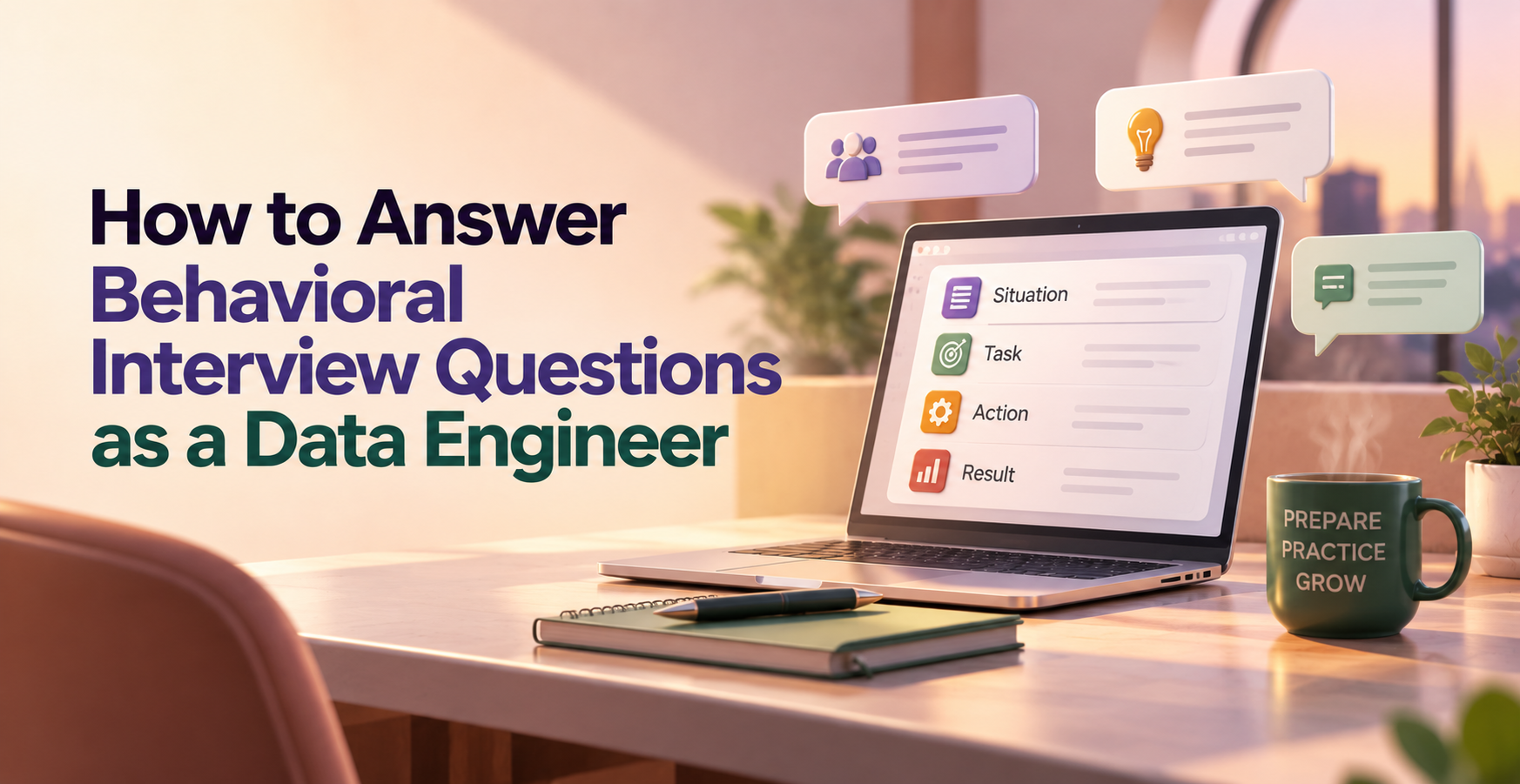
To answer behavioral interview questions as a data engineer, tell a real story using Situation, Task, Action, and Result (STAR). State what you owned, explain the decisions you made, and close with the effect on your team or its users. Interviewers assess communication, judgment, ownership, and teamwork alongside technical skill. A pipeline failure, for example, can show all five when you explain how you restored the data and kept analysts informed.
Key Points
- Choose a real example that matches the question.
- Spend more time on your actions than on background.
- Explain technical decisions through their effect on people or work.
- Credit teammates while making your own contribution clear.
- Practice concise answers and prepare for follow-up questions.
Quick summary: Build a small bank of honest stories, then shape each answer around the responsibility you held, the choices you made, and what happened next.
Key takeaway: The strongest answer makes your personal contribution clear without turning a team effort into a solo achievement.
Quick promise: With a few prepared stories and aloud practice, you can answer unfamiliar questions without memorizing a script.
How to Answer Behavioral Interview Questions as a Data Engineer
STAR gives your answer a beginning, a decision point, and an outcome. For most questions, aim for one to two minutes. That leaves enough room for technical substance without losing the interviewer in a long setup.
Use STAR to make your answer clear and specific
Start with the Situation: the project, problem, and people affected. Then name the Task, meaning the responsibility you held. Keep these two parts brief so the interviewer can reach the decision you made.
Give the Action the most time. Say what you investigated, proposed, changed, or communicated. Finish with the Result: what improved, what remained unresolved, or what you learned. Use numbers only when you can explain where they came from. A clear outcome such as “analysts could use the corrected dataset before their review” is stronger than an unsupported percentage.
Connect engineering details to the impact
Interviewers need enough detail to understand your judgment, not a line-by-line account of your SQL. If you added a data-quality check, explain what bad data it caught and who would have relied on that data. If you changed a batch schedule, explain how the timing affected reporting.
The same principle applies to improving a SQL transformation or adding an alert for pipeline failures. Name the choice, the tradeoff you considered, and its effect on reliability or recovery. Then stop. Save the deeper technical walkthrough for a follow-up.
Build a Story Bank for Data Engineering Interviews
A story bank is a short set of real experiences you can adapt to different questions. Choose examples with different stakes and people involved. Five accounts of fixing broken jobs won’t show how you handle unclear requirements or disagreement.
Prepare examples about pipelines, data quality, and delivery
Look for a failed or delayed data pipeline, a data-quality issue, a hard deadline, an unclear request, and a project that improved a team’s workflow. For each, write down what happened, what you owned, your main actions, and the outcome.
Use the tools you worked with. An Airflow schedule, dbt test, Snowflake transformation, or cloud service belongs in the story only if it shaped your decision. You don’t need to name every tool in the stack.
| Story to prepare | Decision worth explaining |
| A delayed pipeline | How you assessed the impact and updated users |
| A data-quality issue | How you found, corrected, and checked the data |
| An unclear request | How you agreed on a definition before building |
| A deadline or workflow change | How you balanced scope, quality, and delivery |
Choose stories that show ownership and teamwork
Include an example where you asked for help, worked with an analyst or product partner, or changed your approach after feedback. Prepare one mistake you can discuss without shifting blame. These stories show how you work when the answer isn’t obvious.
One experience can fit several behavioral interview questions. A data-quality incident might answer a question about failure, collaboration, or priorities. Change the emphasis to match the question, but don’t change the facts.
Answer Common Behavioral Questions With Concrete Examples
Treat sample answers as models to adapt, not scripts to memorize. Your account needs the details that made the decision yours, including constraints, conversations, and results.
Describe a pipeline failure or a mistake you learned from
For “Tell me about a time a pipeline failed,” begin with the affected dataset and how you noticed the problem. Then explain how you limited its impact before attempting a fix.
A useful answer might follow this sequence: “I found that a scheduled load had stopped updating a reporting table. I checked the last successful run, told the analysts their report might contain stale data, and worked with a teammate to isolate the failed step. After we restored the load, I checked the corrected records and added an alert so a similar failure would reach us sooner.”
That model shows investigation, communication, recovery, and prevention. If your own change caused the failure, say so. Explain how you corrected it and what you changed afterward, without blaming a colleague or hiding the impact.
Explain how you handled conflict, ambiguity, or competing priorities
For a disagreement over a metric, describe each team’s definition before stating your preference. You might explain that an analyst needed one interpretation of “active customer” while a product partner expected another. Your contribution could be documenting both definitions, checking sample records together, and agreeing which one the report would use.
When two requests compete, explain the tradeoff you raised, who set the priority, and how you updated the other stakeholder. For a failure question, keep that same direct tone. Acknowledge your part, explain the repair, and show what the experience taught you.
Practice Your Answers Before Interview Day
Preparation should make you clearer, not rehearsed. Say each story aloud without reading it. Time the answer, then remove background details that don’t help someone understand your decision. If your contribution disappears into “we,” add a sentence that names your responsibility.
Make every answer sound natural, focused, and honest
Avoid vague claims such as “I improved the pipeline” when you can describe the change. Don’t bury the result under tool names, take sole credit for team work, blame colleagues, or quote numbers you can’t support. A balanced answer might say, “The team agreed on the fix, and I updated the transformation and checked the output with the analyst.”
Ask a peer in a mock interview: “What did you think I personally did, and why did it matter?” If they can’t answer, revise the story. Then practice follow-ups about your tradeoffs, validation, and what you’d do differently.
Before interview day:
- Match your stories to the role’s responsibilities.
- Practice a concise version of each answer aloud.
- Check that the action and outcome are easy to identify.
- Prepare to explain one decision in greater technical depth.
For a role centered on analytics, emphasize data definitions and trust in reports. For a platform role, be ready to discuss recovery, monitoring, and coordination during incidents.
A Short Glossary for Interview Stories
- STAR: Situation, Task, Action, and Result, a structure for telling a work story.
- Situation: The context and problem you faced.
- Task: The responsibility you personally held.
- Action: The steps and decisions you took.
- Result: The outcome, including any lesson you carried forward.
- Data pipeline: A process that moves or transforms data for later use.
- Batch schedule: The timing of a data job that runs at set intervals.
- Data-quality check: A test for problems such as missing or unexpected values.
- Transformation: A change that prepares source data for analysis or another use.
Conclusion: Make Your Contribution Easy to See
A strong behavioral answer starts with a real example, gives the most space to your actions, and connects the result to the team’s needs. Clear ownership matters more than a polished speech.
- Pick stories that show different skills.
- Use STAR to keep each answer on track.
- Explain your decisions before listing tools.
- Name the people affected by the outcome.
- Credit the team and state your role.
- Practice follow-ups as well as opening answers.
If you want feedback before an interview, Data Engineer Academy’s mock interviews offer a place to practice these stories aloud.
Frequently Asked Questions
How long should a data engineer’s behavioral interview answer be?
Aim for about one to two minutes for your first answer. Give enough context to establish the problem, then spend most of the time on your actions and the outcome. If the interviewer wants more detail about your SQL, architecture, or tradeoffs, they can ask a follow-up.
What behavioral questions do data engineers get asked?
Expect questions about pipeline failures, data quality, deadlines, unclear requirements, mistakes, and disagreements with stakeholders. An interviewer may ask how you responded when a report used stale data or when teams disagreed on a metric. Prepare real stories rather than a separate script for every possible wording.
Can I use a team project in a behavioral interview?
Yes. Data engineering work often depends on analysts, product teams, and other engineers. Explain what the team needed, then identify your own decisions and work. Give colleagues credit for their contributions. The interviewer should understand both how you collaborated and what you were responsible for delivering.
What if I don’t have a production pipeline failure story?
Use a real incident with similar decisions, such as finding incorrect data in a project, catching a failed test, or correcting a broken transformation. Explain how you noticed it, checked the impact, told the relevant people, and fixed it. Don’t present a practice project as production experience.
How do I answer a question about a mistake without sounding defensive?
State the mistake plainly and explain its effect. Then describe how you corrected the work, informed anyone affected, and changed your process. Keep the focus on what you controlled. A credible answer doesn’t need a perfect ending, but it should show that you took responsibility.
Should I mention Airflow, dbt, or Snowflake in my answer?
Mention a tool when it helps explain your action. An Airflow alert matters if it changed how your team detected failures. A dbt test matters if it caught a data problem before analysts used the output. Otherwise, lead with the decision and result, then supply tool details if asked.
How do I prepare for a behavioral interview as a career switcher?
Draw on work that shows relevant judgment, even if your title wasn’t data engineer. You might discuss resolving an unclear requirement, checking an important report, or coordinating a fix across teams. Be accurate about the setting and tools. Connect your actions to the role without claiming experience you don’t have.
What should I do if I forget part of a prepared answer?
Return to the question and state the decision you made. You can pause briefly, give the essential context, and continue with your actions and the result. You don’t need to reproduce a memorized script. A clear, honest account is more useful than a perfectly recited one.