

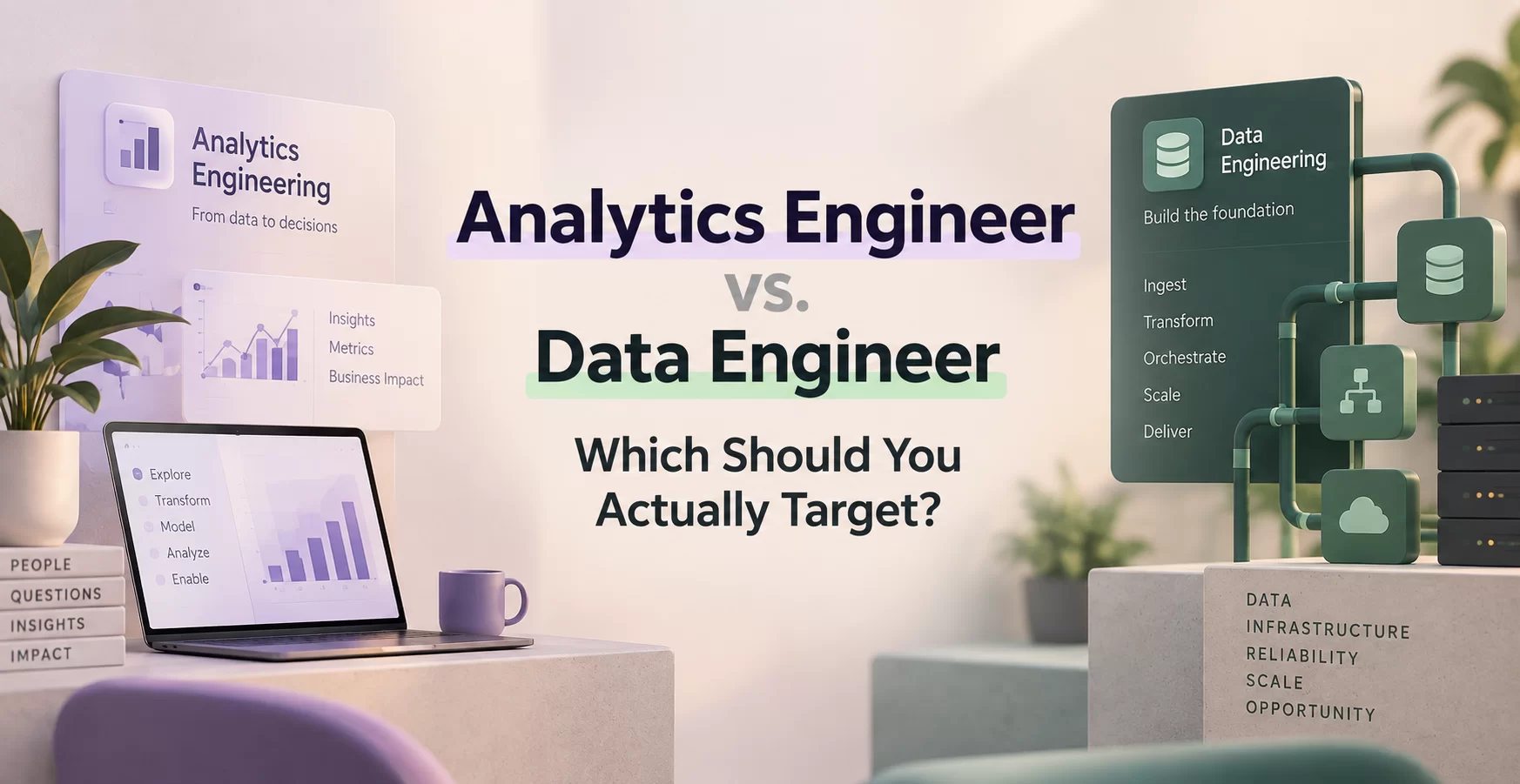
Analytics Engineer vs. Data Engineer: Which Should You Actually Target?
The analytics engineer vs data engineer decision usually gets framed as a hierarchy, with analytics engineering as the junior version. That framing is wrong and it costs people money.
Here’s the number that surprises most people: Glassdoor puts the average analytics engineer at $156,743 against $134,644 for a data engineer. On the headline figures, analytics engineering pays more.
That comparison has real problems, which we’ll get to. But it should immediately kill the idea that one is a stepping stone to the other. They’re different jobs, drawing on different strengths, and for a large share of people reading this, analytics engineering is the shorter and higher-probability move.
Key Points
- Analytics engineers own the transformation layer; data engineers own the platform beneath it.
- Headline salary data favors analytics engineering, but the samples aren’t comparable.
- From a BI or analyst background, analytics engineering is a substantially shorter transition.
- Data engineering has broader optionality and a higher ceiling for deep individual contributors.
- The honest tiebreaker is whether you prefer business logic or systems.
Quick summary: Analytics engineering sits between the warehouse and the business modeling, testing, and defining metrics. Data engineering sits beneath it ingestion, infrastructure, orchestration, reliability. The skills overlap enough that moving between them later is straightforward.
Key takeaway: If you’re coming from analytics or BI, analytics engineering is closer than you think and pays better than you’ve been told. Don’t default to data engineering because it sounds more technical.
Quick promise: This guide covers what each role actually does, honest salary data with its caveats, which is a shorter move from your background, and how to decide.
What Each Role Actually Owns
The cleanest way to separate them is by where they sit relative to the warehouse.
Data engineers work upstream of it. Getting data in from source systems, building and operating pipelines, managing infrastructure, orchestration, storage design, and making sure everything runs reliably at scale. Their consumers are largely other data people.
Analytics engineers work inside and downstream of it. Taking raw tables that have landed and turning them into modeled, tested, documented tables the business can trust. Their consumers are analysts, executives, and business teams.
A useful test: when a number is wrong, whose problem is it? If the data didn’t arrive, arrived late, or arrived corrupted, that’s data engineering. If the data arrived fine but the definition of “active customer” produces the wrong answer, that’s analytics engineering.
1. The daily work
| Analytics Engineer | Data Engineer | |
|---|---|---|
| Core question | Does this table mean what people think it means? | Is this data arriving reliably and at scale? |
| Primary tools | dbt, SQL, warehouse, BI layer | Python, Spark, Airflow, cloud infrastructure |
| Main output | Modeled tables, metric definitions, tests, docs | Pipelines, platforms, ingestion, storage |
| Hardest problem | Definitional disagreement between teams | Distribution, failure recovery, cost |
| Stakeholders | Analysts, finance, product, executives | Engineering, analytics teams, platform |
| Code is mostly | SQL with software practices around it | Python and configuration |
| Failure mode | A metric is subtly wrong for weeks | A pipeline breaks and data goes stale |
2. What’s genuinely the same
More than the titles suggest. Both roles require version control, testing, code review, CI/CD, and documentation. Both require data modeling dimensional modeling is central to analytics engineering and important in data engineering. Both require strong SQL.
The overlap is large enough that moving from one to the other after a couple of years is routine, which matters if you’re worried about picking wrong.
The Money, Honestly
Here’s where it gets interesting, and where most comparisons are careless.
| Source | Analytics Engineer | Data Engineer |
|---|---|---|
| Glassdoor 2026 average | $156,743 | $134,644 |
| Glassdoor typical range | $129,713–$192,024 | Entry to experienced: $79,470–$169,551 |
| Glassdoor 90th percentile | $229,433 | $215,287 |
| Job-posting analysis (median base) | $158,000 | – |
| ZipRecruiter | ~$109,000 | ~$131,000 |
| Senior level | – | ~$174,000–$176,000 |
Sources: Glassdoor 2026 role pages; analytics engineer figures based on 1,017 reported salaries, data engineer on over 16,000 contributions.
3. Why the analytics engineer number is inflated and why it’s still real
Three things distort the headline comparison, and you should know all of them.
Sample size and composition. Glassdoor’s analytics engineer figure draws on roughly 1,017 salaries; the data engineer figure draws on more than 16,000. Smaller samples wobble more.
Aggregators disagree violently. Glassdoor puts analytics engineers near $154,610 while ZipRecruiter puts them near $109,000 a $45,000 gap between two reputable sources. One recruiting analysis explained it cleanly: Glassdoor skews toward self-reported total compensation in expensive markets, while ZipRecruiter pulls posted base salaries from every metro. Both are accurate about different populations.
Selection bias in the title itself. “Analytics engineer” is a newer title, concentrated at modern-stack companies venture-backed, cloud-native, dbt-using, generally well-funded. “Data engineer” spans everything from those same companies down to legacy ETL maintenance at a regional insurer. You’re not comparing like with like.
So what’s true? Analytics engineering is genuinely well paid comparable to data engineering at mid-level, not a discount version of it. But the apparent $22,000 advantage is mostly an artifact of which companies use which title.
4. Where the paths diverge
Data engineering has the higher ceiling for deep individual contributors. The senior, staff, and architect track runs further, and the roles at the top distributed systems, platform architecture, AI infrastructure sit on the data engineering side.
Analytics engineering has a shorter runway to a good number and a natural path toward analytics leadership, which is well compensated in its own right.
One recruiter observation worth repeating: analytics engineering done well, meaning dbt at scale, adds less on paper but is often the smartest mid-market hire. Translation the role is undervalued in job titles relative to the impact it has, which is usually a good place for a candidate to be.
Which Is Shorter From Where You Are?
This should carry more weight in your decision than the salary tables.
From BI, reporting, or analytics. Analytics engineering is dramatically shorter. You already have SQL, business context, and an understanding of what the numbers mean. What you’re adding is engineering discipline version control, testing, modular modeling, documentation, dbt specifically. That’s months, not a year, and you’re building directly on what you already do.
Data engineering from the same starting point means adding Python for production, orchestration, cloud infrastructure, and distributed processing. Doable, and well documented, but meaningfully longer.
From software engineering. Data engineering is closer. Your infrastructure and production-code instincts transfer directly; analytics engineering would ask you to develop business fluency you may not have.
From IT, sysadmin, or ops. Data engineering, clearly. Systems thinking is the harder half and you have it.
From data science. Either, but analytics engineering is often closer you already model data and think about metric definitions.
5. The strategic argument for starting with analytics engineering
If you’re coming from analytics and you’re genuinely unsure, there’s a case for analytics engineering as the first move that isn’t about settling.
You get into a data-adjacent engineering role faster, which means you’re building relevant experience while you’d otherwise still be studying. You’re paid comparably in the meantime. And once you’re inside, moving toward data engineering later is straightforward you’ll be working alongside data engineers, using their tooling, seeing the problems they solve.
The alternative is spending an extra six to nine months preparing for a data engineering role you might get, while your analytics experience ages. The expected value usually favors the shorter path.
That’s not true for everyone. If you’re certain you want infrastructure work and you find business definitions tedious, go directly at data engineering. But “data engineering sounds more serious” is not a reason.
The Honest Tiebreaker
Since the pay is comparable and both are reachable, decide on what you’d rather argue about.
Analytics engineering suits you if: you enjoy the definitional questions what counts as an active customer, whether refunds belong in this metric and find it satisfying when a business team finally trusts a number. You like being close to decisions. You’d rather write excellent SQL than adequate Python.
Data engineering suits you if: you’d rather solve a systems problem than a definitional one. You find the business arguments tedious and the infrastructure interesting. You want the option of going deep into distributed systems, streaming, or platform work later.
The dividing line is roughly: do you want to be closer to the business or closer to the machine? Both are legitimate. Neither is more technical in any meaningful sense analytics engineering done well is real engineering, and anyone who tells you otherwise hasn’t seen a large dbt project.
How to Move Into Analytics Engineering
If that’s the direction, the path is unusually concrete.
Get dbt properly. Not a tutorial build something with staging, intermediate, and mart layers, with tests, documentation, and sensible naming. This is the single most requested skill in analytics engineering postings.
Learn dimensional modeling seriously. Grain, facts, dimensions, slowly changing dimensions. This is what separates an analytics engineer from an analyst who knows dbt syntax.
Adopt engineering practice. Git, branches, pull requests, code review, CI. Coming from analytics, this is usually the genuine gap, and it shows up immediately in interviews.
Learn enough orchestration to be dangerous. Airflow or equivalent, at the level of understanding scheduling, dependencies, and retries.
Then reposition. Your résumé should stop saying “built reports” and start saying “modeled data and owned the semantic layer.” Translating existing work into the target field’s vocabulary is often the difference between getting screened out and getting called.
Essential Terms
- Transformation layer: Where raw warehouse tables become modeled, business-ready tables.
- Semantic layer: The agreed definitions sitting between tables and reporting.
- dbt: The transformation tool that defines much of modern analytics engineering practice.
- Medallion architecture: Bronze, silver, and gold layering of raw to curated data.
- Grain: What a single row in a table represents.
- Slowly changing dimension: A pattern for attributes that change over time.
- ELT: Extract, load, then transform inside the warehouse the pattern analytics engineering assumes.
- Data mart: A curated set of tables serving a specific business function.
Final Thoughts
The hierarchy framing analytics engineering as data engineering’s waiting room is the most expensive misconception in this comparison. The pay is comparable, the work is genuinely engineering, and for someone coming from analytics it’s a substantially shorter path to a substantially better salary.
Data engineering earns its reputation on ceiling and optionality. If you want to go deep into infrastructure, streaming, or platform architecture, that’s the track, and it runs further.
But pick based on which problems you want to own, and be honest about which one you’re closer to today. The person who spends nine extra months preparing for the “better” title, while their analytics experience gets staler, usually ends up behind the person who took the shorter route and moved sideways two years later.
Frequently Asked Questions
Is analytics engineering a real engineering role?
Yes. A mature analytics engineering codebase involves modular SQL, version control, automated testing, CI/CD, documentation, and dependency management. The tooling differs from data engineering; the discipline doesn’t.
Which pays more?
Headline averages favor analytics engineering roughly $157,000 against $135,000 on Glassdoor but the samples aren’t comparable and aggregators disagree sharply on the analytics engineer number. Treat them as roughly equivalent at mid-level, with data engineering having a higher ceiling for senior individual contributors.
Can I switch from analytics engineering to data engineering later?
Yes, and it’s common. You’d add production Python, orchestration depth, cloud infrastructure, and distributed processing to an existing foundation of SQL, modeling, and engineering practice. Most of the discipline transfers.
Do analytics engineers need Python?
Some, but far less than data engineers. Most analytics engineering work is SQL within a transformation framework. Python helps for automation and edge cases, and it makes a later move to data engineering easier.
Which role is more exposed to AI?
Both are exposed at the low-complexity end. Generating a simple model or a simple pipeline is increasingly automatable. What isn’t automatable is deciding what a metric should mean, or what an architecture should tolerate the judgment work at the top of both roles.
Is analytics engineer just a rebranded analyst?
No, though some companies use the title loosely. The distinction is engineering practice: version control, testing, modularity, and ownership of a codebase rather than production of individual reports. Check the posting’s actual requirements rather than the title.
Which has more job openings?
Data engineering, by a substantial margin, since it’s an older and broader title. Analytics engineering postings are fewer but the candidate pool is also smaller, so the competition isn’t necessarily easier on the data engineering side.
What if my company doesn’t use dbt?
Learn it anyway it’s the standard vocabulary of the role, and you can build a credible project independently. Then look for the transformation work that exists at your company under a different name, since the layer exists whether or not it’s called that.
P.S. Run a quick test before committing to either path. Open ten job postings for each title in your city, ignore the titles entirely, and read only the requirements. Mark how many you could credibly claim today. Most people coming from analytics find the analytics engineering column is two or three items short and the data engineering column is six or seven which is a much more useful answer than any salary average, because it tells you how many months stand between you and an interview.