
Career Change to Data Engineer: What to Learn First in 2026
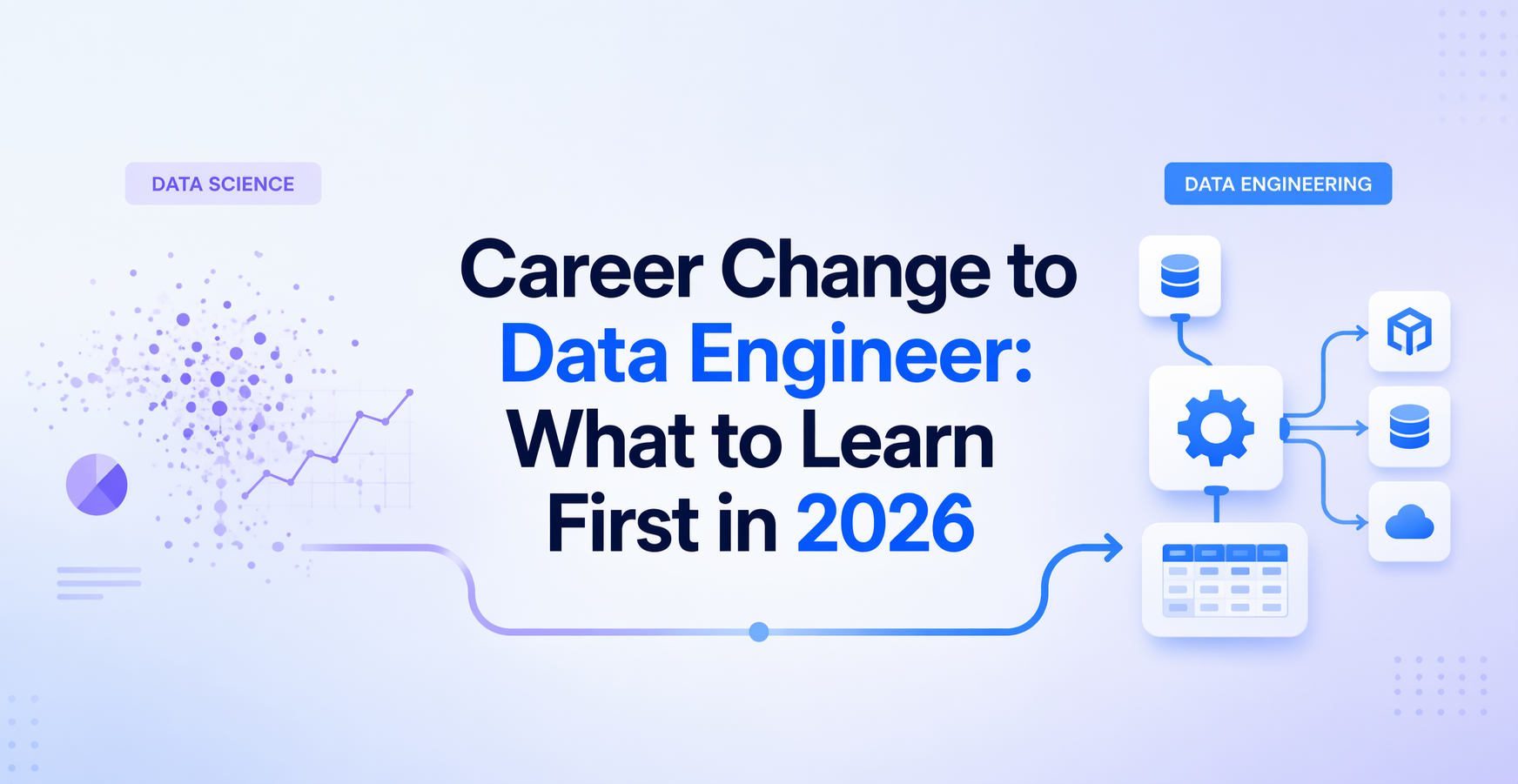
If you want to move into data engineering, learn SQL, Python, data modeling, and one cloud data stack first. That’s the short answer. Most career changers get stuck because they try to learn everything at once, then end up with lots of tool names and no real foundation.
You don’t need that. You need a starting point that makes sense, saves time, and gets you closer to job-ready projects. Let’s keep it simple and build the right base first.
Quick summary: Start with the skills that show up in almost every data engineer role, SQL, Python, warehousing, modeling, and one practical stack. Ignore the giant tool list for now.
Key takeaway: Depth beats breadth early on. One stack you can explain and demo is better than ten tools you barely touched.
Quick promise: By the end, you’ll know what to learn first, what to skip, and how to turn study time into a real transition plan.
Learn the core building blocks before touching advanced tools
Start with the basics that transfer across companies, tools, and cloud platforms. If your foundation is weak, every new tool feels harder than it should.
Why SQL should be your first skill
SQL is the first skill because data engineers work with tables all day. You read data, join it, filter it, clean it, and shape it into something people can use.
A lot of beginners think SQL is “just for analysts.” Not true. SQL is often tested in interviews, and on the job you’ll probably use it more than you expect. If SQL feels easy, the rest of the stack starts to make more sense.
Focus on these first:
- SELECT, WHERE, ORDER BY, and GROUP BY
- JOINs, especially inner and left joins
- CTEs
- Window functions
- Basic query tuning, like avoiding unnecessary scans
Think of SQL as your wrench set. You won’t build the whole house with it, but you won’t get far without it either.
Why Python comes next for automation and pipelines
Python is next because it helps you turn one-off work into repeatable work. That’s a huge part of data engineering.
You do not need advanced software engineering skills on day one. You do need enough Python to read, write, and debug simple scripts. Start with variables, functions, loops, conditionals, files, and APIs. Then learn how to work with data in memory, usually with basic library usage.
If SQL is how you ask for data, Python is how you move it around and automate the boring parts. That’s the jump from “I can query a table” to “I can build a small pipeline.”
Understand how data moves, not just how code works
Data engineering is about moving, cleaning, storing, and serving data in reliable ways. Code matters, but systems thinking matters more than most beginners realize.
Get comfortable with data warehouses, ETL, and ELT
A data warehouse is where cleaned, usable data lives for reporting, analysis, and sometimes downstream apps. Common names you will see are Snowflake, BigQuery, and Redshift.
ETL means extract, transform, load. You clean the data before it lands in the final system. ELT means extract, load, transform. You load first, then transform inside the warehouse. That’s a common pattern in modern stacks.
You don’t need to memorize vendor details yet. What matters is understanding the flow:
- Data comes from an API, app, CSV, or database.
- It gets loaded somewhere central.
- It gets cleaned and modeled.
- Someone uses it for dashboards, analytics, or products.
Once you see that flow, job descriptions stop looking like random buzzwords.
Learn basic data modeling so your pipelines make sense
Data modeling is how data gets organized so people can trust and use it. Learn tables, primary keys, foreign keys, facts, and dimensions first.
Here’s the simple version. Fact tables track events or measurements, like orders or clicks. Dimension tables describe those facts, like customer, product, or date.
Why does this matter? Because bad structure creates bad downstream work. Duplicates show up. Joins get messy. Metrics stop matching. A beginner data engineer does not need to be a modeling expert, but you should understand what “clean structure” looks like.
If your pipeline loads data fast but the tables are confusing, you didn’t finish the job.
Pick one modern stack and build real projects with it
After the fundamentals, the fastest path to job readiness is choosing one stack and building with it. Shallow exposure to many tools looks busy, but it doesn’t prove much.
A simple beginner stack that covers most job needs
Keep your first stack boring and practical. That’s a good thing.
| Area | Good first choice | Why it works |
| Querying | SQL | Used everywhere |
| Scripting | Python | Great for automation |
| Version control | Git | Expected on teams |
| Cloud | AWS or Azure | Pick the one you see most in job posts |
| Warehouse | Snowflake or BigQuery | Common in modern data teams |
| Transform/orchestrate | dbt or Airflow | Helps you build real workflows |
Don’t turn this into a “learn every cloud” mission. Look at job postings in your target market. If most roles mention AWS and Snowflake, start there. If your market leans Azure, follow that signal.
Build projects that prove you can do the work
A strong beginner project shows a full data flow, not a notebook with a few screenshots.
A good project usually does five things:
- Pulls data from an API, CSV, or database
- Cleans and validates it
- Loads it into a warehouse
- Models it into useful tables
- Documents the pipeline in GitHub
Two or three solid projects beat ten tiny ones. Add a clean README. Include a simple architecture diagram. Show what problem the pipeline solves.
If you want a faster path, Data Engineer Academy has free tutorials, hands-on projects, bootcamps, and interview prep built around this exact kind of work. That matters, because guided practice is often what turns “I studied” into “I can explain what I built.”
Turn your learning plan into a real career move
Learning skills is only half the job. The other half is avoiding distractions, building proof, and aiming your effort at the roles you want.
What to skip at the start so you do not get overwhelmed
Most career changers don’t fail because they aren’t capable. They fail because the roadmap gets too wide.
Skip these early mistakes:
- Trying to master AWS, Azure, and GCP at the same time
- Jumping into Spark before you’re good with SQL and Python
- Chasing certifications before building projects
- Studying advanced system design before understanding basic pipelines
- Collecting courses without finishing anything
You need a focused path, not a giant backlog. That’s the whole game early on.
A simple 90 day roadmap for your first data engineer role
A 90-day plan works if you keep it realistic. Will everyone move at the same speed? No. It depends on your background, schedule, and consistency.
| Month | Focus | Output |
| 1 | SQL and Python basics | Query practice and small scripts |
| 2 | Warehouses, ELT, modeling, one cloud tool | One small pipeline |
| 3 | Portfolio, resume, interview prep | Two polished projects and better applications |
This is where a lot of people finally feel momentum. Not because they learned everything, but because the pieces connect. Your resume improves when your projects improve. Your interviews improve when you can talk through tradeoffs, tables, and pipeline steps clearly.
Conclusion
If you’re making a career change into data engineering, start with SQL, Python, data warehousing concepts, data modeling, and one practical stack. That’s enough to build real projects and enough to start applying once you can explain your work clearly.
You do not need to learn every tool before you make the move. Focus on the fundamentals, build a few strong projects, and get help from guided resources if you want a shorter path with less guesswork.
FAQ
Can I switch to data engineering without a computer science degree?
Yes, you can. Hiring teams care a lot about practical skills, projects, and how well you explain your work. A degree can help, but it isn’t the only path. Strong SQL, Python, and project experience matter more than many career changers think.
Should I learn SQL or Python first for data engineering?
Learn SQL first, then Python. SQL shows up in interviews and daily work almost immediately. Python becomes much easier to place once you understand tables, joins, transformations, and the shape of the data you’re working with.
Do I need to learn Spark before applying for entry-level roles?
No, not usually. Spark is useful, but it is not the best first stop for most career changers. Start with SQL, Python, warehousing, and a small modern stack. Learn Spark later if the jobs you want clearly ask for it.
Is data modeling important for beginner data engineers?
Yes. You do not need expert-level modeling, but you should understand keys, facts, dimensions, and why table structure matters. Good modeling makes pipelines easier to trust, query, and maintain.
Which cloud platform should I learn first?
Pick one, usually the one that appears most in your target job market. AWS and Azure are both solid starting points. The point is not choosing the “best” cloud. The point is building enough depth to speak about real work.
How many projects do I need before applying?
Two or three strong projects are enough for many beginners. Each project should show data ingestion, cleaning, loading, modeling, and documentation. A smaller number of complete projects beats a pile of half-finished repos.
Are certifications required for a data engineer career change?
No. Certifications can help in some cases, but they are not a substitute for skills and projects. If time is limited, put it into SQL practice, Python scripts, and an end-to-end portfolio project first.
How long does it take to become job-ready in data engineering?
It depends on location, company, skills, and how much time you can study each week. Some people move faster because they already know analytics or software basics. What matters most is consistent progress and project work you can explain with confidence.