
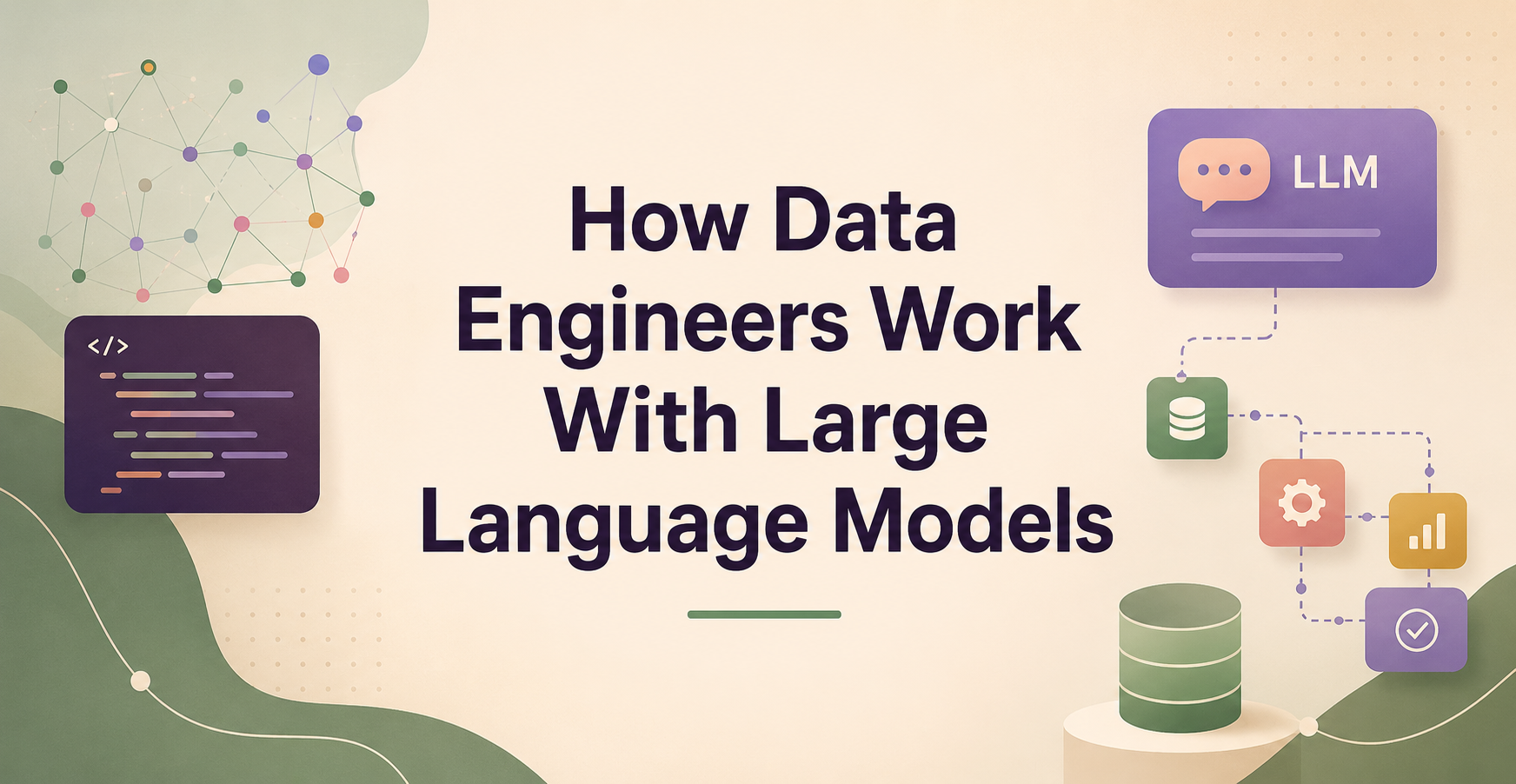
How Data Engineers Work With Large Language Models
Data engineers work with large language models by preparing trustworthy data, building retrieval pipelines, connecting model APIs to business systems, and operating them safely. This work extends SQL, Python, data modeling, and cloud skills; it doesn’t replace them. Most teams need engineers who can make internal information searchable, controlled, and observable rather than train a foundation model. Start with a small retrieval-augmented generation project, then apply the production habits you already know.
Key Points
- LLM projects depend on clean data, useful metadata, and strict access controls.
- RAG connects a model to current company knowledge without retraining it.
- Testing retrieval quality matters as much as testing pipeline code.
- Cost, latency, security, and monitoring need design choices from day one.
Quick summary
Data engineering is the operational backbone of many LLM applications. Strong pipelines make model responses more accurate, traceable, secure, and useful.
Key takeaway
Trusted data and retrieval quality shape an LLM application’s value more than clever prompts alone.
Quick promise
You can build a credible LLM portfolio project by applying familiar data engineering practices to a focused RAG pipeline.
How Data Engineers Can Work With Large Language Models
Most data engineers will not train a foundation model from scratch. Instead, they prepare documents, create searchable representations, connect model providers, and keep the system dependable after launch.
Training teaches a model from a massive dataset by updating its weights. Fine-tuning also updates weights, but uses a narrower dataset for a particular style or task. Retrieval-augmented generation, or RAG, retrieves relevant source material at query time and adds it to the model prompt without changing model weights.
When data engineers work with large language models, RAG is often the best first production pattern because business information changes frequently.
A simple LLM workflow looks like this:
- Ingest documents, records, tickets, or event data.
- Clean, split, tag, and validate that content.
- Create embeddings and store them for similarity search.
- Retrieve approved context for a user request.
- Send context and instructions to the LLM, then log the response.
Prepare clean, trusted data for LLM applications
LLMs inherit the quality problems in their source data. Stale policies, duplicate support articles, and exposed customer records can produce incorrect or unsafe answers.
Use Python, Spark, dbt, or SQL to standardize fields and remove duplicates. Apache Airflow can schedule batch jobs, while Kafka supports event-driven updates. Snowflake, BigQuery, and Databricks can hold curated source tables before documents reach an embedding job.
Chunking also matters. Split long documents at meaningful boundaries, such as headings or sections, then attach metadata like source, owner, date, region, and permission group. Data quality checks should flag empty chunks, missing metadata, malformed files, and unexpected source changes.
Build RAG pipelines with embeddings and vector search
An embedding converts text into numbers that capture semantic similarity. A vector database stores those numbers, then returns source chunks that resemble a user’s question.
A common architecture is: approved documents -> chunking pipeline -> embedding model -> vector store -> retrieval service -> LLM API -> application. Options include pgvector, Pinecone, Weaviate, Milvus, OpenSearch, and cloud-managed search services. The right choice depends on scale, existing infrastructure, filtering needs, and operational limits.
RAG works well for current manuals, policies, product documentation, and knowledge bases. Fine-tuning fits narrower needs, such as producing a consistent classification format, after you have a stable labeled dataset.
LLM applications need the same discipline as any production data product. Orchestration, retries, schema checks, observability, and cost controls prevent small failures from becoming customer-facing problems.
| Workflow | Best use case | Main strength | Main tradeoff |
| Batch processing | Re-indexing documents nightly | Predictable cost and scheduling | Content can become stale |
| Real-time retrieval | Support and knowledge assistants | Fresh context at request time | Higher latency risk |
| Fine-tuning jobs | Stable, repeated specialized tasks | Consistent task behavior | Requires labeled data and evaluation |
Connect LLMs to warehouses, APIs, and business workflows
OpenAI, Anthropic, Google, AWS, and Azure offer model APIs that can connect to warehouses, lakehouses, internal services, and customer applications. A support-ticket workflow might classify incoming tickets, validate the structured result, and write the category back to a warehouse table.
Use JSON schemas or structured outputs when a downstream system expects fields such as priority, product, or escalation status. Add retries with backoff for rate limits, cache repeated requests, and make writes idempotent so retries do not create duplicate records.
Long-running requests belong in asynchronous jobs. A queue lets the application respond quickly while workers process documents, embeddings, or large classification batches.
Test model quality, data quality, and pipeline performance
Standard unit tests catch broken transformations, but LLM systems need more checks. Test for missing embeddings, invalid vectors, retrieval results that ignore permission filters, and model outputs that fail schema validation.
Keep a small evaluation set with real questions, approved source passages, and expected answer traits. Track retrieval precision, latency, token use, failure rates, and citation coverage. Human review remains necessary for legal, medical, financial, and other high-risk outputs.
Control latency and cloud costs before they grow
Choose smaller models for extraction and classification when they meet quality targets. Batch embedding jobs, filter documents before embedding, limit retrieved chunks, and cache repeated answers.
More retrieved context does not always improve an answer. Irrelevant chunks can increase token cost and distract the model.
Secure LLM Systems With Governance and Responsible Data Practices
An LLM should never receive more data than the user can access. Data engineers need to account for personally identifiable information, confidential records, prompt injection, poisoned documents, unsafe logs, and vendor retention settings.
Protect sensitive data before it reaches a model
Classify source data before ingestion. Redact or tokenize sensitive fields where possible, store secrets in a managed secret manager, and use private network paths when your cloud provider supports them.
Apply row-level or document-level permissions during retrieval, not only when loading data. A user who cannot open an HR document should not receive a summary of it through a chat interface. Encrypt data in transit and at rest, retain audit logs, and define deletion rules for prompts and responses.
Reduce hallucinations and prevent unsafe retrieval
Use approved sources, metadata filters, access checks, citations, and response validation. Refusal rules should block answers when retrieval finds no trusted support.
RAG improves grounding, but it does not guarantee truth. Log prompts, retrieved source IDs, model versions, and outcomes while removing unnecessary sensitive content from logs. An incident plan should name owners, containment steps, and review procedures.
The Skills and Tools Data Engineers Need for LLM Projects
LLM work rewards engineers who can diagnose data problems instead of treating a model as a black box.
Strengthen the data engineering foundations first
Focus on SQL, Python, APIs, data modeling, batch and streaming design, testing, Git, Docker, Linux, cloud storage, orchestration, and warehouse or lakehouse concepts. These skills explain why a retrieval job failed, why a source table changed, or why a response cannot be trusted.
Add LLM engineering skills that employers value
Learn prompt design, embeddings, vector search, RAG, model APIs, evaluation, observability, privacy, and basic machine learning concepts. LangChain, LlamaIndex, and Haystack can speed up prototypes, but they are optional. Choose tools based on deployment limits, team skills, and data sensitivity.
Create a portfolio project that proves production judgment
Build a secure RAG assistant over public or synthetic documents. Include ingestion, cleaning, metadata filters, a vector store, model integration, an evaluation set, monitoring, and a clear README.
Document architecture choices, failure cases, and latency or token measurements when available. Data Engineer Academy’s projects, mentorship, resume reviews, and interview preparation can help turn that work into a stronger job application.
One-Minute Summary
- Start with a small RAG application using public documentation.
- Clean, deduplicate, chunk, and tag every source.
- Apply permissions during retrieval, not after response generation.
- Validate structured outputs before writing them to business systems.
- Measure retrieval quality, latency, token use, and failures.
- Document security decisions and known limitations in your portfolio.
Glossary
- Embeddings: Numeric representations of text used for semantic similarity search.
- Fine-tuning: Updating model weights with a narrower, task-specific dataset.
- Grounding: Tying a model response to trusted source material.
- Hallucination: A confident model output that lacks factual support.
- RAG: A pattern that retrieves context before generating a response.
- Token: A unit of text that models process and providers often bill for.
- Vector database: A system that stores and searches embeddings.
- Vector search: Retrieval based on similarity between embeddings.
FAQs
Can a data engineer work with LLMs without machine learning experience?
Yes. Data engineers can contribute quickly with SQL, Python, APIs, orchestration, cloud platforms, and data quality practices. Basic machine learning knowledge helps with embeddings, evaluation, and fine-tuning decisions, but most entry-level LLM projects do not require training models.
Is RAG better than fine-tuning for company knowledge?
RAG is usually better for changing company knowledge. It can retrieve current policies, documentation, and records without retraining model weights. Fine-tuning fits stable tasks with high-quality labeled examples, such as strict classification or standardized output style.
What vector database should data engineers learn first?
Start with a tool that fits your current stack. PostgreSQL users can try pgvector, while Pinecone, Weaviate, Milvus, and OpenSearch offer other paths. Learn embeddings, metadata filtering, permissions, and evaluation before worrying about a particular vendor.
Do data engineers need LangChain or LlamaIndex?
No. LangChain and LlamaIndex can speed up prototypes, but SQL, Python, APIs, and solid pipeline design matter more. Build one small retrieval workflow without heavy abstraction first, then adopt a framework if it solves a clear maintenance problem.
How do data engineers test LLM applications?
Test transformations, schema validation, embedding coverage, retrieval relevance, permissions, latency, token use, and model output quality. Keep an evaluation dataset with expected sources and answer criteria. Human reviewers should inspect outputs in high-risk use cases.
How can an LLM application expose sensitive company data?
Risk appears when retrieval ignores user permissions, logs retain prompts, source documents contain unredacted personal data, or API keys have excessive access. Apply least-privilege permissions, redact sensitive fields, encrypt traffic, and audit retrieval activity.
Is learning LLM engineering worth it for data engineers in 2026?
Yes. LLM applications need dependable data pipelines, governed source data, retrieval systems, and production monitoring. Those needs align closely with data engineering. The strongest candidates combine established engineering fundamentals with practical RAG and evaluation experience.
Where can I practice LLM data engineering projects?
Build a secure RAG assistant using public or synthetic documents, then document quality checks and failure cases. Data Engineer Academy offers guided projects, mentorship, resume reviews, and interview preparation.