
Batch Processing vs Streaming: Which One Should You Learn First?
Most beginners should learn Batch Processing vs Streaming by starting with batch processing. Batch pipelines teach the core skills behind reliable data work with fewer moving parts, while streaming comes next for real-time systems and specialized roles. Your best path depends on your career goal, current skills, and the systems you want to build.
Key Points
- Batch processing handles collected data on a schedule.
- Streaming processes events with low delay as they arrive.
- SQL, Python, modeling, and testing transfer across both approaches.
- Most entry-level data engineering work starts with batch pipelines.
- Real-time roles often require Kafka, Flink, Kinesis, or Pub/Sub.
Quick summary: Start with batch processing to learn how data moves, changes, and reaches analytics users. Add streaming once you can build, test, and explain a dependable pipeline.
Key takeaway: Streaming is valuable when seconds matter. Batch is the stronger starting point when you need practical pipeline fundamentals.
Quick promise: By the end, you’ll know which path fits your target role and what to build first for a credible data engineering portfolio.
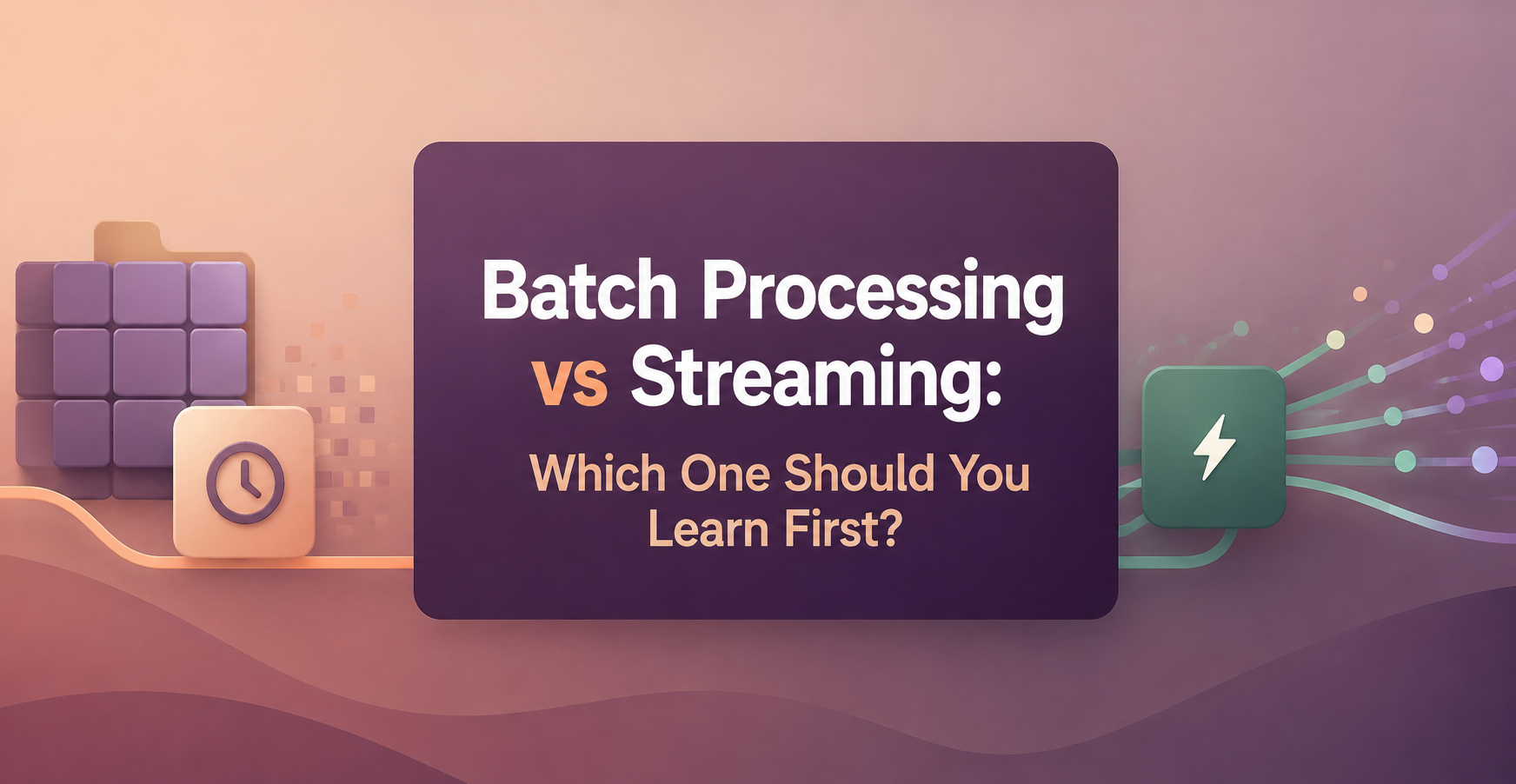
Batch Processing vs Streaming: Which One Should You Learn First?
Batch processing collects data, then processes it in groups on a set schedule. A company might refresh a nightly sales report, calculate payroll every two weeks, or load yesterday’s website activity into a warehouse.
Streaming handles records as a continuous flow, usually with low delay. Payment events, delivery locations, sensor readings, and application logs are common streaming data sources.
Neither method is always better. However, most new data engineers should begin with batch work because it teaches the foundations that every data platform needs: SQL, Python, data modeling, storage, orchestration, testing, and monitoring.
How batch processing works in a typical data pipeline
An hourly customer-orders pipeline might collect orders from an application database, save raw files in Amazon S3 or Google Cloud Storage, transform records with SQL or Python, validate totals, and load clean data into Snowflake, BigQuery, or Amazon Redshift.
Apache Airflow can schedule the work, while dbt can manage warehouse transformations and tests. You don’t need every tool at once. Build the flow first, then learn the tools that make it repeatable.
Streaming systems move events from producers to consumers. A mobile app might produce a payment event, Apache Kafka might store it in a topic, and a consumer might check it for fraud.
Topics can have partitions so several consumers process work in parallel. Stream processors such as Apache Flink and Spark Structured Streaming apply logic over time windows. Amazon Kinesis and Google Pub/Sub move events, while Flink and Spark process them.
The choice affects cost, operational work, and how quickly users receive data.
| Area | Batch processing | Streaming |
| Processing speed | Minutes, hours, or days | Milliseconds to minutes |
| Data arrival | Collected into groups | Arrives continuously |
| System complexity | Lower at the start | Higher, with more failure cases |
| Cost | Often easier to control | Can require always-on resources |
| Failure recovery | Re-run a job or backfill data | Replay events and manage offsets |
| Data completeness | Usually complete before processing | May arrive late or out of order |
| Common use cases | Reporting, billing, warehouse loads | Fraud alerts, telemetry, live monitoring |
| Beginner difficulty | More approachable | Requires more distributed-systems knowledge |
Many production platforms use both methods. A lakehouse or warehouse may receive a stream of raw events, then run batch transformations for trusted reporting tables.
Batch versus streaming is usually a design decision for a data product, not a permanent career choice.
When batch processing is the better fit
Batch is a strong fit for scheduled reporting, payroll, billing, historical analysis, machine learning feature creation, warehouse loads, and large backfills. It also makes debugging easier because you can inspect a defined input set and rerun the same job.
A failed batch job can usually restart from a known point. Costs may also stay lower because compute can stop between runs. The tradeoff is delay, which can leave dashboards stale until the next scheduled refresh.
When streaming is worth the added complexity
Streaming earns its complexity when a delayed answer loses value. Fraud alerts, recommendation updates, logistics tracking, IoT telemetry, clickstream monitoring, and operational dashboards can benefit from fresh events.
However, real-time systems must handle duplicate events, changing schemas, out-of-order records, state management, replay, and observability. If a business team only reviews data each morning, streaming adds technical work without improving the decision.
How to Choose the Right Data Processing Skill for Your Career
Choose based on the job you want, not the loudest technology trend. Complete beginners, analytics engineers, and warehouse-focused data engineers should prioritize batch pipelines. These roles rely heavily on SQL, dimensional modeling, ELT, and warehouse performance.
Backend developers moving into data can learn batch first, then add event-driven architecture. Candidates targeting platform engineering, real-time fraud systems, or large-scale event platforms should move streaming earlier in their plan.
Both paths share important concepts: data modeling, partitioning, SQL, Python, testing, monitoring, storage, and distributed systems. Those skills make the second approach easier to learn.
Choose batch processing first if you are building core skills
Start with SQL and Python. Then learn CSV and Parquet files, relational databases, dimensional modeling, ETL and ELT, cloud storage, orchestration, data tests, and warehouse performance.
Build one complete project before adding Kafka or Flink. For example, pull public transit or weather data, clean it, load it into BigQuery or Snowflake, test key fields, and publish a dashboard.
Choose streaming earlier if your target role needs real-time systems
Move streaming up your learning plan when job descriptions repeatedly mention Kafka, Kinesis, Pub/Sub, Flink, Spark Structured Streaming, event-driven architecture, or real-time fraud detection.
Learn batch fundamentals first, then study event schemas, partitions, offsets, windows, state, delivery guarantees, and replay. Streaming tools make more sense when you understand how data is stored and modeled after processing.
A Practical Learning Roadmap From Batch Pipelines to Streaming
Build skills in stages so each project adds one useful layer instead of becoming a pile of disconnected tools.
Build one reliable batch project before adding real-time features
- Learn SQL joins, window functions, aggregations, and Python data handling.
- Load raw CSV data into cloud object storage and convert it to Parquet.
- Model clean warehouse tables in Snowflake, BigQuery, or Redshift.
- Add dbt transformations, tests, and documentation.
- Schedule the pipeline with Apache Airflow and monitor failed runs.
- Add a small Kafka or Pub/Sub event source after the batch version works.
Document your tradeoffs. During interviews, explain why you chose a batch schedule, how you checked data quality, and how you would recover from a failed load.
One-minute summary
- Build a SQL and Python foundation before chasing streaming tools.
- Finish one end-to-end batch project with tests and documentation.
- Learn Parquet, warehouses, orchestration, and data modeling.
- Read job descriptions for the technologies employers actually request.
- Add Kafka or Pub/Sub to an existing project, not an empty repository.
- Practice explaining latency, cost, recovery, and data-quality tradeoffs.
Learn the terms and tools that appear in data engineering roles
Batch processing: Processes a collected group of records on a schedule.
Stream processing: Processes events continuously with low delay.
Event: A record of something that happened, such as a purchase.
Latency: The time between an event occurring and a result appearing.
Throughput: The amount of data a system processes in a period.
Partition: A split of data that supports parallel processing.
Offset: A consumer’s recorded position in an event stream.
Window: A time range used to group streaming events.
Watermark: A signal that estimates how complete event-time data is.
Idempotency: The ability to repeat work without changing the final result.
ETL: Extract, transform, load, where data changes before warehouse loading.
ELT: Extract, load, transform, where transformations happen in the warehouse.
Tool names matter less than the design patterns behind them.
Final Thoughts
For most beginners, batch processing should come first. It teaches you how to build reliable pipelines, model data, schedule work, test outputs, and recover from failures. Streaming is the right early focus for roles that depend on real-time events, but it isn’t a shortcut to becoming a strong data engineer.
Build one batch portfolio project, then review job descriptions for your target roles. If you want guided projects, mentorship, interview preparation, and career support, Data Engineer Academy can help you practice the skills employers expect.
Frequently Asked Questions
Should I learn batch processing or streaming first?
Learn batch processing first if you’re new to data engineering. It teaches SQL, Python, storage, transformations, orchestration, testing, and warehouse concepts with fewer operational problems.
Is streaming harder than batch processing?
Yes, streaming is usually harder. You must manage event order, duplicates, late data, consumer offsets, state, replay, and continuous monitoring alongside normal transformation logic.
Is Apache Kafka worth learning for data engineers?
Yes, Kafka is worth learning for real-time data roles. Learn it after you understand pipeline fundamentals, data modeling, storage, and batch processing recovery patterns.
Can I get a data engineering job with batch skills?
Yes, many data engineering jobs center on warehouses, scheduled loads, reporting tables, dbt, Airflow, SQL, and cloud storage. Batch skills create a strong entry-level foundation.
Should analytics engineers learn streaming?
Most analytics engineers should begin with batch and ELT workflows. Streaming becomes useful when their team needs low-latency product metrics, operational reporting, or event-driven transformations.
What is the difference between ETL and streaming?
ETL describes data movement and transformation steps. Streaming describes how records arrive and process continuously. A streaming pipeline can use ETL logic.
Do real-time dashboards always need streaming?
No, real-time dashboards only need streaming when users need fresh data within seconds or minutes. Hourly or daily refreshes often meet business needs at lower complexity.
What batch project should I add to my portfolio?
Build a project that ingests public data, stores raw files, transforms warehouse tables, adds tests, schedules jobs, and produces a dashboard with documented design decisions.