
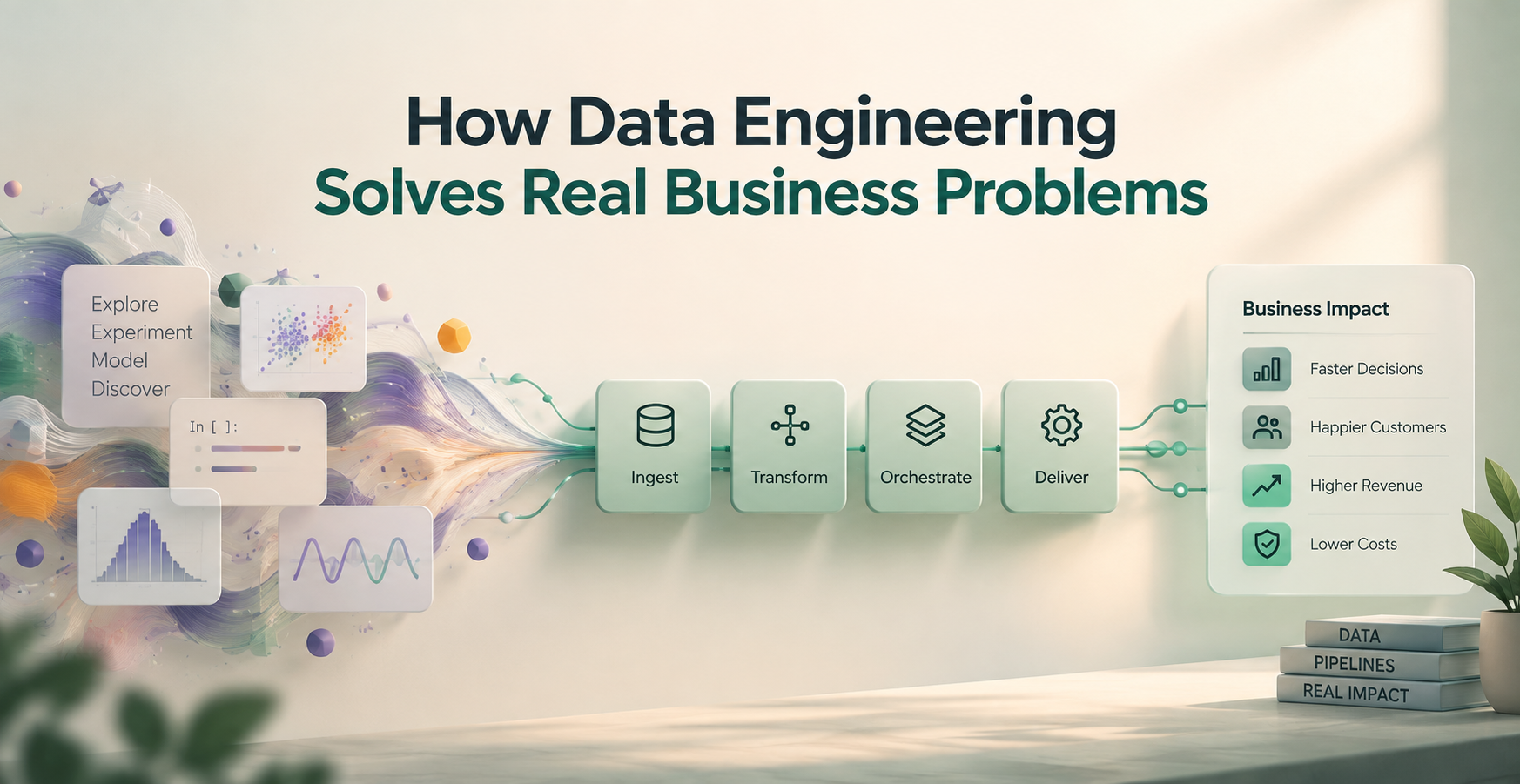
How Data Engineering Solves Real Business Problems
Data engineering builds reliable systems that collect, clean, organize, and deliver data for business decisions and daily operations. Data engineering solves real business problems when a retailer combines sales and inventory data to spot a likely stockout before shelves go empty. The pipeline matters because it supports faster decisions, lower costs, better customer experiences, and safer operations.
Without dependable data, teams waste time reconciling spreadsheets and debating whose numbers are correct. A focused data product gives people information they can use with confidence.
Key Points
- Data engineers turn scattered records into dependable business data.
- Data quality rules prevent flawed reports and duplicate customer records.
- Batch and streaming pipelines solve different timing needs.
- Trusted data improves reporting, planning, fraud response, and AI work.
- Business outcomes, not tool choices, should guide every project.
Quick summary
Data engineering connects operational systems to useful, governed data products. It reduces manual work and gives teams a shared view of sales, customers, finance, inventory, and risk.
Key takeaway
A pipeline creates value only when it improves a decision or workflow that matters to the business.
Quick promise
You can identify a high-value data engineering project, choose a sensible design, and measure whether it produced a useful result.
How Data Engineering Solves Real Business Problems
Applications, payment processors, CRM platforms, sensors, and cloud services all create records. Data engineers build pipelines that collect those records, validate them, transform them into consistent formats, store them, and make them available for approved users.
A retailer might receive online orders from Shopify, inventory updates from a warehouse system, and payments from Stripe. If each system reports a product or order differently, planners can’t trust a stock report. A pipeline can connect those systems and create a dependable inventory view.
A simple business flow looks like this:
- Late inventory reports create delayed purchasing decisions.
- A pipeline collects sales, warehouse, and supplier data.
- Validation flags missing product IDs and impossible quantities.
- A shared inventory dataset reaches planners on a schedule.
- Teams gain earlier visibility into items that need attention.
Turning messy data into one trusted source of truth
Data engineers standardize names, currencies, timestamps, customer IDs, and business rules. They also handle duplicate records, schema changes, lineage, and ownership. Tools such as SQL, Python, dbt, and Snowflake can support this work.
A shared definition prevents costly disagreements. For example, finance may define revenue after refunds, while sales tracks booked order value. Both measures can be valid, but reports must label and document them clearly.
Making business data available at the right speed
Batch pipelines fit daily financial reporting because the business can act the next morning. Streaming systems, often built with Kafka, fit fraud alerts, delivery tracking, or live recommendations.
Real-time processing costs more and adds operational complexity. The right design depends on when someone must act, the cost of delays, and the reliability required.
Data analysts use prepared data to answer questions and build reports. Meanwhile, data scientists use that information to build predictive models. Behind both roles, data engineers create and maintain the data foundation they need.
Business Problems Data Engineering Can Fix Across Teams
The strongest projects begin with a visible symptom: failed payments, unclear campaign results, manual month-end reporting, or stock shortages. Data engineering then connects the systems behind that symptom.
| Business Problem | Data Engineering Approach | Business Result |
| Failed payments and fraud | Join transaction, device, and account events | Faster review and better risk visibility |
| Stockouts and excess inventory | Combine orders, stock, returns, and supplier data | Better replenishment planning |
| Conflicting customer records | Resolve identities across customer systems | More dependable segmentation |
| Slow month-end reporting | Automate billing, expenses, and payment data | Fewer manual errors and earlier reporting |
| Weak AI outputs | Prepare governed historical and current datasets | More reliable model inputs |
Helping finance and operations replace spreadsheets
Finance teams often reconcile billing, payments, orders, expenses, and fulfillment records by hand. Scheduled transformations and quality checks can place those records in a warehouse such as BigQuery, Snowflake, or Databricks.
Leaders can then review cash flow, margins, late shipments, and operational delays sooner. Audit trails and role-based access matter because financial and employee data requires controlled handling.
Giving sales and marketing a clearer view of customers
A customer can appear in a CRM, website analytics tool, email platform, ad system, and support desk under different identifiers. Identity resolution links those records while preserving consent choices and access restrictions.
The result is a consistent customer profile for attribution, segmentation, churn signals, and service history. Data engineering prepares dependable information, while sales and marketing teams decide what action to take.
Supporting fraud detection, forecasting, and AI projects
Fraud rules, demand forecasts, recommendation systems, and generative AI applications all depend on accurate inputs. Feature pipelines prepare repeatable model-ready data, while freshness checks show whether the latest records arrived.
Poor inputs create unreliable outputs. Model teams also need monitoring, lineage, and controlled access so they can trace what data influenced an output and protect sensitive information.
How a Data Engineering Solution Works From Problem to Outcome
Start with one narrow use case. Rebuilding every data system at once usually delays useful results.
- Define the decision or workflow that needs better data.
- Map source systems, owners, users, and sensitive fields.
- Set quality rules for completeness, accuracy, and duplicates.
- Choose batch or streaming delivery based on response time.
- Build and test the pipeline with realistic failure cases.
- Publish a trusted dataset, report, or application feed.
- Monitor freshness, errors, costs, and schema changes.
- Measure the business result against an agreed baseline.
Analysts, product managers, security teams, and business owners should help define requirements. Airflow can schedule workflows, dbt can manage transformations, and Python can handle custom logic, but tools come after the operating need.
Choosing the right architecture, tools, and delivery model
| Option | Best Fit | Watch For |
| Data warehouse | Structured analytics and BI reporting | Less flexible for raw files |
| Data lake | Raw, varied, high-volume data | Governance can become difficult |
| Data lakehouse | Analytics plus data science workloads | Requires clear platform practices |
AWS, Azure, and Google Cloud all offer storage, compute, and security services. Choose based on data types, workload, scale, team skills, maintenance effort, security needs, and cost controls.
Measuring whether the pipeline solved the business problem
Technical metrics matter, including pipeline failure rate, data freshness, and data quality error rate. However, they don’t prove value alone.
Track a business measure too, such as report delivery time, manual hours removed, forecast accuracy, prevented losses, or conversion improvement. Agree on a baseline and target before development begins.
Avoiding common data engineering mistakes
Unclear ownership leaves broken data unresolved, so assign a business owner and technical owner. Weak documentation makes logic hard to audit, so record definitions, assumptions, and lineage near the pipeline.
Don’t build real-time systems without a time-sensitive use case. Set cost alerts, test access controls, monitor jobs after launch, and fix data quality issues at the source whenever possible.
Building Data Engineering Skills That Lead to Business Impact
Start with SQL and data modeling. Then learn Python, pipeline design, cloud fundamentals, orchestration, testing, security, system design, and communication with stakeholders.
Tools change quickly, but clear problem framing and sound engineering habits remain useful. End-to-end projects teach both technical work and business judgment.
A practical project path for proving data engineering ability
Build projects that end with a usable data product.
- Create an inventory pipeline using order, warehouse, and product files. Load curated tables into a warehouse, test product IDs and stock counts, then provide a replenishment report for planners.
- Build a customer analytics platform using CRM, web, email, and support exports. Resolve identities, track consent, test duplicate records, and deliver segments for a marketing team.
- Create a transaction-monitoring workflow using payment events. Validate timestamps and amounts, publish fresh records for risk reviewers, and document how alerts would be prioritized.
Your project README should state the problem, architecture, tradeoffs, quality checks, results, and next improvements.
Glossary of Essential Data Engineering Terms
Core terms to know
- Data pipeline: A system that moves and processes data between sources and destinations.
- ETL: Extract, transform, load. Data changes before it reaches its destination.
- ELT: Extract, load, transform. Data lands first, then transforms inside the platform.
- Data warehouse: A structured repository designed for reporting and analytics.
- Data lake: Storage for raw structured, semi-structured, and unstructured data.
- Data lakehouse: A platform that combines lake flexibility with warehouse-style analytics.
- Orchestration: Scheduling and coordinating pipeline tasks and dependencies.
- Data quality: Checks that measure completeness, accuracy, consistency, and validity.
- Data lineage: A record of where data came from and how it changed.
- Schema: The defined structure of a dataset, including fields and data types.
One-Minute Summary and Next Steps
Put the ideas into practice
- Start with one costly, slow, or error-prone business process.
- Identify its source systems, decision-makers, and data owners.
- Define quality rules before writing pipeline code.
- Choose the simplest architecture that fits the workload.
- Measure delivery time, manual effort, errors, or financial impact.
- Document assumptions, access rules, and known limitations.
A practical next step is building a first end-to-end data pipeline around a real business question.
Build Data Products That People Can Trust
Data engineering solves business problems by making information accurate, accessible, timely, secure, and useful. Reliable inventory data helps teams prevent stockouts. Automated finance reporting reduces spreadsheet work. Governed customer and transaction data supports better service and safer decisions.
Begin with a specific need and measure the outcome. Don’t choose a warehouse, cloud platform, or streaming tool before you know what decision must improve.
Data Engineer Academy offers hands-on projects, cloud practice, interview preparation, mentorship, and career coaching for people who want to turn these skills into stronger data roles.
Frequently Asked Questions
What business problems can data engineering solve?
Data engineering can fix slow reporting, duplicate customer records, unreliable inventory counts, payment monitoring gaps, and weak forecasting inputs. It connects data from operational systems, applies checks, and publishes trusted datasets. The best use cases have a clear user, a recurring decision, and a measurable cost of poor data.
What is the difference between data engineering and data analysis?
Data engineering builds and maintains the pipelines, storage layers, and quality checks that make data dependable. Data analysis uses prepared datasets to find patterns, answer questions, and create reports. Analysts may write SQL, but data engineers focus more on reliability, scale, automation, and system design.
Do all companies need real-time data pipelines?
No. Daily batch pipelines work well for many reports, finance processes, and planning tasks. Real-time delivery fits cases where fast action changes the result, such as fraud alerts or delivery updates. Teams should weigh response time against added cost, complexity, and operational support.
Can beginners learn data engineering?
Yes. Beginners can start with SQL, relational data modeling, and Python before moving to cloud platforms and orchestration tools. A useful learning path includes one complete project with source data, transformations, tests, storage, monitoring, and a report that answers a business question.
Should I use a data warehouse, data lake, or lakehouse?
A data warehouse fits structured reporting and business intelligence. A data lake fits varied raw data, including files and logs. A lakehouse can support analytics and data science together. The right choice depends on data types, user needs, governance requirements, budget, and team experience.
How do teams measure data engineering success?
Teams should track both technical and business measures. Useful technical measures include freshness, job failures, and data quality errors. Business measures include reporting time, manual work removed, lower processing delays, forecast accuracy, or prevented losses. Agree on a baseline before building the pipeline.
What is the biggest data engineering mistake?
Building technology without a defined business outcome is a common mistake. A polished pipeline has little value if no one uses its output. Start with a decision or workflow, name the owners and users, document quality rules, and review pipeline health after launch.
What should a first data engineering portfolio project include?
A strong project includes a real business problem, realistic source data, clear transformations, storage design, quality checks, and basic monitoring. It should also explain tradeoffs, costs, security choices, and a measurable outcome. A clear README helps hiring teams understand your thinking quickly.