Blog

Writing from our team. The latest news, insights, and resources.

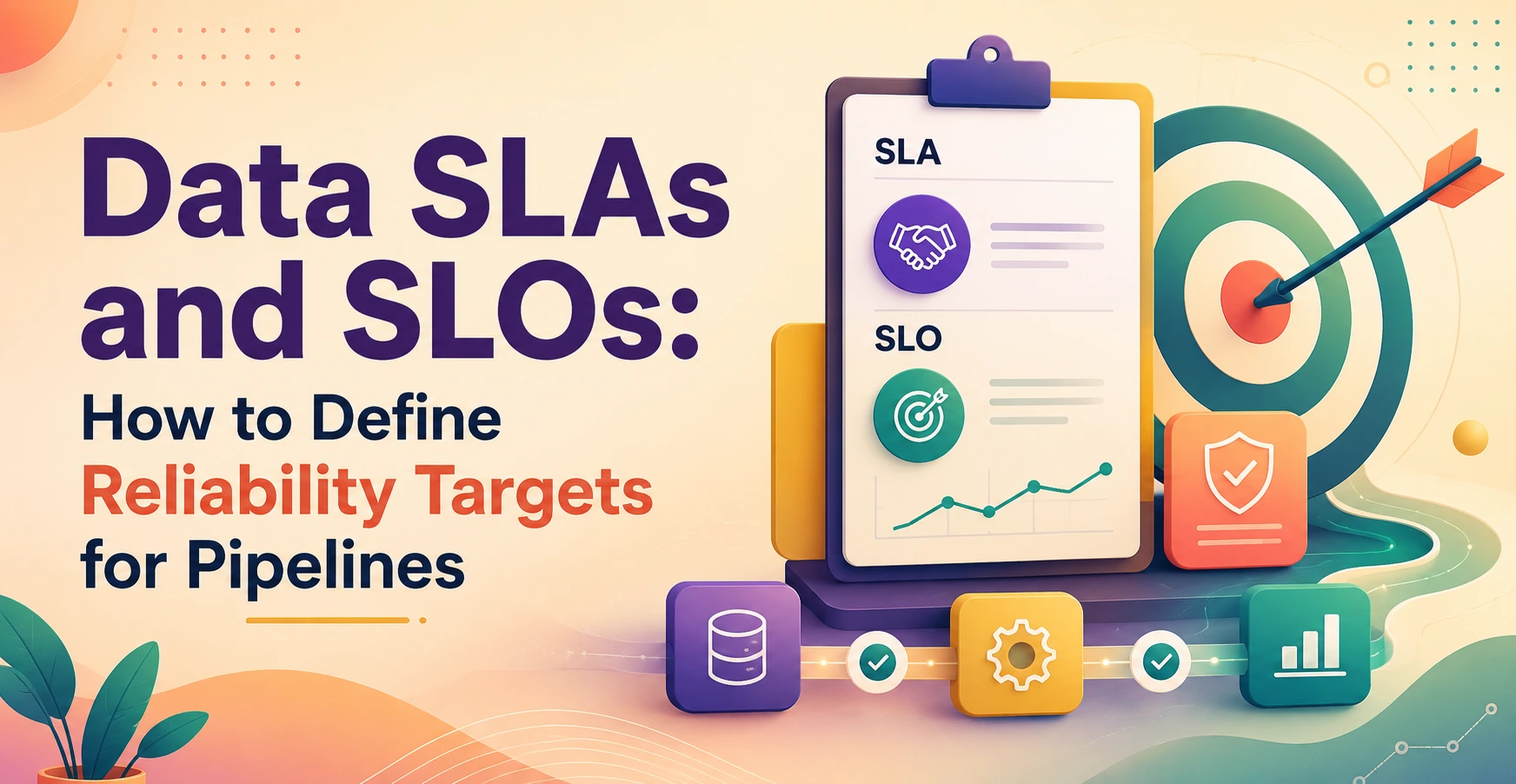
Data SLAs and SLOs: How to Define Reliability Targets for Pipelines

Data SLAs and SLOs: How to Define Reliability Targets for Pipelines

Data SLAs and SLOs set clear reliability targets for your pipelines. An SLA is the promise users can count on, while an SLO is the internal target your team tracks to keep that promise. When a dashboard is late or a table is missing rows, vague complaints do not help. A good data SLAs and...

By: Chris Garzon | June 27, 2026 | 9 mins read
Learn More
Data Mesh for Beginners: What Data Engineers Actually Need to Know

Data Mesh for Beginners: What Data Engineers Actually Need to Know

Data mesh is a way to organize data work around business domains, not one central data team. In data engineering, that means sales data stays close to the sales domain, finance data stays close to finance, and each team owns what it publishes. You should care because if you build pipelines, models, or platforms, a...

By: Chris Garzon | June 25, 2026 | 9 mins read
Learn More
15 Must-Have Data Engineering Skills for the Career Transitioner

15 Must-Have Data Engineering Skills for the Career Transitioner

Introduction If you are already working with data as an analyst, a BI developer, a QA engineer, or a SQL-fluent IT professional you have probably noticed something: data engineering jobs pay well, the demand is strong, and a meaningful portion of the role overlaps with work you already do. But there is a gap between...

By: Chris Garzon | June 24, 2026 | 18 mins read
Learn More
Essential Data Engineering Skills: A Practical Guide for Career Transitioners

Essential Data Engineering Skills: A Practical Guide for Career Transitioners

Introduction Data engineering is one of the fastest-growing technical disciplines in the industry, and the demand for qualified professionals is outpacing the supply. That gap is an opportunity but only for people who show up with the right skills. If you are transitioning into data engineering from a neighboring role – analytics, IT, software-adjacent work,...

By: Chris Garzon | June 24, 2026 | 22 mins read
Learn More
Soft Skills for Data Engineer: 10 Skills That Matter Most

Soft Skills for Data Engineer: 10 Skills That Matter Most

Introduction Most content about becoming a data engineer focuses on the technical stack: SQL, Python, dbt, Airflow, Spark, cloud platforms. That is appropriate. The technical foundation matters. But there is a reason experienced data engineers and hiring managers consistently say the same thing: the candidates who struggle in their first year are not usually struggling...

By: Chris Garzon | June 24, 2026 | 17 mins read
Learn More
Data Catalogs for Data Engineers: DataHub, OpenMetadata, Collibra, and Alation

Data Catalogs for Data Engineers: DataHub, OpenMetadata, Collibra, and Alation

Data catalogs help data engineers find trusted data faster, understand where it came from, and keep pipelines easier to debug. For dxata engineering teams, the right catalog turns scattered metadata into searchable context, so you spend less time chasing table owners and more time fixing real issues. DataHub, OpenMetadata, Collibra, and Alation all solve that...

By: Chris Garzon | June 23, 2026 | 8 mins read
Learn More
Synthetic Data for Testing Data Pipelines: When It Helps and When It Fails

Synthetic Data for Testing Data Pipelines: When It Helps and When It Fails

Synthetic data testing helps when you need safe, fast, repeatable pipeline tests. It fails when the data is too clean, too random, or too simple to expose what production will do. If you build ETL, ELT, or streaming jobs, synthetic data can speed up development, but it can’t replace reality checks. The safest approach is...

By: Chris Garzon | June 19, 2026 | 8 mins read
Learn More
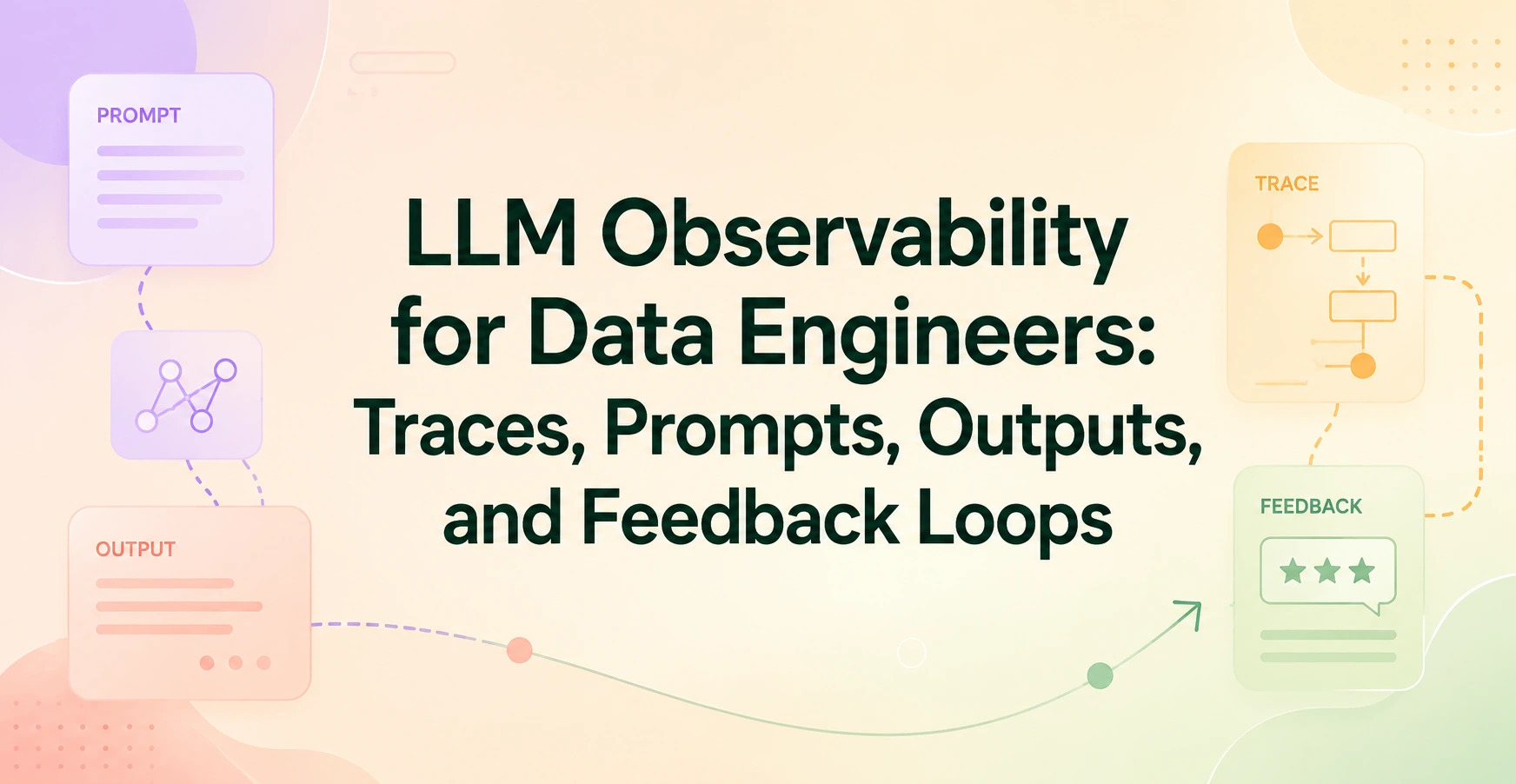
LLM Observability for Data Engineers: Traces, Prompts, Outputs, and Feedback Loops

LLM Observability for Data Engineers: Traces, Prompts, Outputs, and Feedback Loops

LLM observability is the practice of tracking what a model request saw, how it moved through your system, what it returned, and what happened next. Data engineers need it because LLMs don’t behave like normal batch jobs. Two requests that look the same can still produce different answers, costs, or failures. Basic logs won’t catch...

By: Chris Garzon | June 18, 2026 | 10 mins read
Learn More
Load More